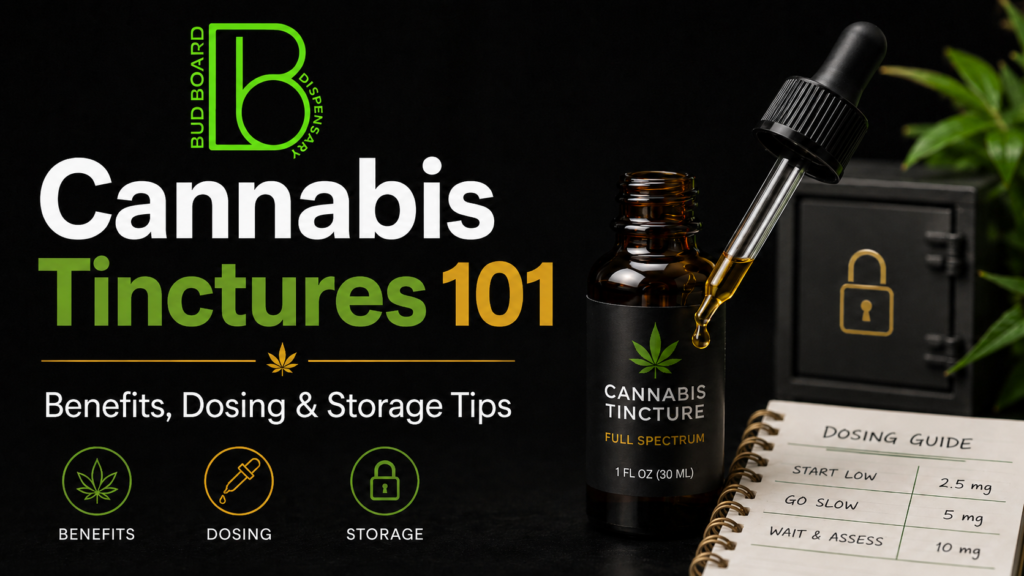
Cannabis Tinctures 101: Benefits, Dosing & Storage Tips
Last Updated: June 2026. Cannabis rules, product labels, serving guidance, and safety recommendations can change. Always follow the product label, ask a licensed dispensary for help, and check official New Mexico cannabis guidance when needed.
TL;DR: Cannabis tinctures are liquid cannabis extracts, usually measured with a dropper. Many people use them because they are smoke-free, discreet, and easier to measure than some other cannabis products. Drops held under the tongue may work faster than tincture swallowed in food or drinks. Beginners should start low, measure carefully, wait before taking more, and store tinctures sealed, cool, dark, and locked away from kids and pets. Tiny bottle, big responsibility. Very dramatic for something that fits in a drawer.
Cannabis tinctures are one of those products that look simple, then immediately raise five questions. How many drops? Under the tongue or in a drink? THC or CBD? Why is the bottle so tiny? Is the dropper judging me?
The good news is that tinctures are not hard once you understand the basics. They are liquid cannabis products designed to be measured in small servings. That makes them useful for adults who want a smoke-free option and would rather not guess their way through a gummy like it is a snack with a plot twist.
This guide explains what cannabis tinctures are, how CBD and THC tinctures differ, how beginners can think about dosing, how long tinctures may take to work, and how to store them safely at home in New Mexico.
Quick Answer: What Are Cannabis Tinctures?
Cannabis tinctures are liquid cannabis extracts that usually come in small bottles with droppers. Depending on the product, they may contain THC, CBD, both cannabinoids, or other cannabis compounds in a measured liquid carrier.
- Smoke-free: Tinctures do not require smoking or vaping.
- Measurable: Droppers make it easier to start with a small serving.
- Flexible: Some tinctures can be held under the tongue or swallowed, depending on the label.
- Discreet: They are small, low-odor, and easy to store safely.
- Different timelines: Sublingual use may feel different from swallowing tincture with food or drinks.
New Mexico Cannabis Reminder for Tincture Shoppers
New Mexico allows regulated adult-use cannabis sales for adults 21 and older, and the state regulates adult-use and medical cannabis through the Cannabis Control Division framework. Bring valid ID when shopping, follow the product label, and use cannabis responsibly.
Cannabis can impair coordination, perception, reaction time, and decision-making. That matters with tinctures too. Smoke-free does not mean impairment-free when THC is involved.
Do not drive impaired, do not take cannabis across state lines, and keep cannabis products away from children and pets. The fun part is finding the right product. The responsible part is making sure nobody else accidentally finds it first.
Official sources: New Mexico Cannabis Control Division: Adult Use and CDC: Cannabis Health Effects
What Are Cannabis Tinctures Made From?
Most cannabis tinctures are made by extracting cannabis compounds into a liquid carrier. Traditional tinctures often used alcohol. Many modern dispensary tinctures use oil-based carriers such as MCT oil or another edible oil because the taste is usually smoother.
The label matters more than the bottle shape. A tincture may list total milligrams per bottle, milligrams per serving, bottle size, THC content, CBD content, or a ratio like 1:1 THC:CBD. That label is your map. Do not freestyle the math unless your calculator is also invited.
For example, a 30 mL bottle with 300 mg THC contains about 10 mg THC per 1 mL if the product is evenly mixed and labeled that way. A quarter of that 1 mL serving would be about 2.5 mg THC. Always check your actual product label, because bottle sizes and dropper markings can vary.
Why Do People Use Cannabis Tinctures?
People often choose tinctures because they are discreet, smoke-free, and easier to measure than many other cannabis products. No lighter. No lingering smoke smell. No “I meant to eat half the edible, but it looked lonely” situation.
Tinctures can also be helpful for adults who want to compare small servings over time. That does not mean tinctures are risk-free, and it does not mean they are right for everyone. It means the format can make careful measuring easier.
Some shoppers ask about tinctures because they want THC. Others want CBD. Some want a balanced ratio. The right question is not “which one is strongest?” The better question is “what does this label say, how much am I taking, and how long should I wait?”
CBD Tinctures vs THC Tinctures: What’s the Difference?
CBD tinctures and THC tinctures differ mainly by cannabinoid content. THC is the primary intoxicating cannabinoid in cannabis. CBD is generally described as non-intoxicating by itself, although product formulas can vary.
THC-dominant tinctures may cause a high and can impair driving, reaction time, and decision-making. CBD-dominant tinctures are usually chosen by people who want a clearer-headed option, but shoppers still need to check the label because some full-spectrum CBD products may include small amounts of THC.
Balanced tinctures, such as 1:1 THC:CBD, contain similar amounts of both cannabinoids. High-CBD ratios, such as 20:1 CBD:THC, contain much more CBD than THC. These ratios are not decorations. They are useful clues, like tiny math wearing a product label.
Helpful Bud Board guides: Cannabinoids and Terpenes Guide and Science-Based Cannabis Wellness Guide
How Do You Use Cannabis Tinctures?
The best-known method is sublingual use. Shake the bottle if the label says to, measure the serving with the dropper, place the drops under your tongue, hold them there for about 30 to 60 seconds, then swallow.
That pause under the tongue is the point. Many people use tinctures this way because it may feel faster than swallowing the full serving right away. It is still not instant, so give it time. Tinctures are not text messages. They do not always respond immediately.
You can also swallow some tinctures directly or mix them into a drink or food if the product is labeled for oral use. When swallowed, tinctures behave more like edibles because digestion is involved. That usually means a slower onset and potentially longer duration.
Bud Board-style tip: Follow the label first. If the product says oral use only, use it orally. If it is not labeled for topical use, do not assume it belongs on your skin.
Cannabis Tincture Dosing for Beginners
Beginner tincture dosing starts with the label. Look for total milligrams, milligrams per serving, bottle size, and dropper markings. If the math is confusing, ask a budtender to help. That is a normal question, not a personal failure. Nobody is born knowing dropper algebra.
A common low-and-slow starting point for THC is around 2.5 mg or less, especially for newer or sensitive consumers. Some people may need less. The goal is to find a comfortable serving, not to win a bravery contest with a tiny bottle.
After taking a THC tincture, wait before taking more. If you held it under your tongue, give it time. If you swallowed it with food or a drink, wait even longer. Oral cannabis products can have delayed effects, and taking more too soon is one of the easiest ways to overshoot.
Simple dosing example: If a 30 mL bottle contains 300 mg THC, then 1 mL contains about 10 mg THC. A quarter of 1 mL would be about 2.5 mg THC. Your bottle may be different, so check the actual label.
How Long Do Cannabis Tinctures Take to Work?
Tincture timing depends on how you take it. Sublingual use may feel faster for some people because the drops are held under the tongue before swallowing. Swallowed tincture acts more like an edible because it goes through digestion.
Peer-reviewed research on oral cannabis products describes delayed onset, with effects often beginning around 30 to 90 minutes after ingestion and lasting longer than inhaled cannabis. Some oral cannabis research has also observed subjective effects beginning around 30 to 60 minutes after administration.
Body weight, metabolism, tolerance, food, THC amount, CBD ratio, product type, and individual sensitivity can all change timing. That is why “I’ll just take more after 20 minutes” is famous last words in edible and tincture land.
Research sources: Tasty THC: Promises and Challenges of Cannabis Edibles and Pharmacokinetic Profile of Oral Cannabis in Humans
What Bud Board Budtenders Usually Explain About Tinctures
When people ask about tinctures at Bud Board, the conversation usually comes back to one thing: the label matters more than the bottle. A tiny bottle can still hold a lot of THC, and a full dropper is not automatically a beginner serving. That surprises a lot of first-time tincture shoppers.
Budtenders also tend to explain that tinctures are not all used the same way. Some shoppers hold drops under the tongue because they want a sublingual option. Others mix tincture into food or drinks, which usually makes timing feel more like an edible. Same bottle, different route, different waiting game.
The most common beginner mistake is redosing too soon. Someone takes a small amount, waits 20 minutes, decides nothing is happening, and takes more. Then the first serving finally shows up with a folding chair and a clipboard. Waiting is part of the product experience.
Storage comes up often too. Heat, sunlight, loose caps, and easy child access are the big things to avoid. A tincture belongs sealed, labeled, cool, dark, and safely stored. Basically, treat it like an adult-use product, not like a random vanilla extract bottle that wandered into the wrong cabinet.
Good question to ask a budtender: “Can you help me understand the milligrams per serving and what a low beginner amount would look like on this dropper?” That one question can prevent a lot of guesswork.
What Should You Track When Trying a Tincture?
A dosing journal sounds nerdy. It also works. Write down the product name, THC and CBD ratio, serving amount, time taken, whether you ate, and how you felt after one hour, two hours, and later that day.
After a few tries, patterns show up. Maybe a small serving is enough. Maybe food changes the timing. Maybe the ratio matters more than you expected. Notes help you avoid guessing, and guessing is how people accidentally turn Tuesday into a documentary.
- Product name and brand
- THC and CBD amount per serving
- How much you took
- Time taken
- Whether you ate recently
- How long it took to notice effects
- How you felt later
Best Way to Store Cannabis Tinctures
The best way to store cannabis tincture is in a cool, dark place with the lid tightly sealed. Heat, sunlight, humidity, loose caps, and “I’ll just leave it by the window” habits can all work against freshness.
Amber or cobalt bottles can help protect tinctures from light, but storage still matters. A cabinet, drawer, or lockbox is better than a sunny counter. Refrigeration may help some products, but oil-based tinctures can look cloudy when cold. Check the label before making the fridge its new home.
Safe storage is non-negotiable. The FDA warns about accidental ingestion of THC products by children, and these exposures can cause serious adverse events. Store tinctures like adult-use products: sealed, labeled, and locked away from kids and pets.
Official source: FDA: Accidental Ingestion by Children of Food Products Containing THC
Helpful Bud Board guide: Safe Cannabis Storage at Home in New Mexico
Are Cannabis Tinctures Used for Wellness or Medical Reasons?
Some adults ask about tinctures because they want smoke-free cannabis, more precise measuring, or a format they can compare over time. Some medical cannabis patients also ask about tinctures because measured liquid servings can be easier to track than some other formats.
That said, cannabis tinctures should not be treated as a cure-all. Evidence varies by condition, product type, dose, route of use, and personal health history. The National Academies found conclusive or substantial evidence for some cannabis or cannabinoid uses, including chronic pain in adults, but that does not mean every tincture works the same way for every person.
If you take prescriptions, have heart concerns, have mental health concerns, are pregnant, are breastfeeding, or are managing a serious condition, talk with a qualified healthcare professional before using cannabis. Budtenders can explain product labels and formats. Healthcare decisions belong with healthcare professionals.
Source: National Academies: The Health Effects of Cannabis and Cannabinoids
Helpful Bud Board guide: Medical vs Recreational Dispensaries in New Mexico
Key Takeaways
- Cannabis tinctures are liquid cannabis products usually measured with a dropper.
- THC tinctures can be intoxicating and may impair reaction time, coordination, perception, and decision-making.
- CBD tinctures are generally non-intoxicating by themselves, but full-spectrum products may contain THC.
- Sublingual use may work faster for some people than swallowing tincture with food or drinks.
- Swallowed tinctures behave more like edibles and can have delayed effects.
- Beginner THC users often start around 2.5 mg or less, then wait before taking more.
- A full dropper is not automatically a beginner serving. Check the milligrams and markings first.
- Tinctures should be stored sealed, cool, dark, and locked away from kids and pets.
- People with health concerns or prescriptions should talk with a qualified healthcare professional before using cannabis.
FAQ: Cannabis Tinctures
What is a cannabis tincture?
A cannabis tincture is a liquid cannabis product usually measured with a dropper. Depending on the label, it may contain THC, CBD, both cannabinoids, or other cannabis compounds in a liquid carrier.
Are cannabis tinctures stronger than edibles?
Not automatically. Strength depends on milligrams, not the format. A 10 mg THC tincture serving and a 10 mg THC edible both contain 10 mg THC, but the timing and feel may differ depending on how the tincture is used.
Can I put cannabis tincture in coffee or tea?
Usually yes, if the product is labeled for oral use. Just remember that swallowing tincture in a drink makes it act more like an edible, so effects may take longer to appear.
How much THC tincture should a beginner take?
Many beginners start around 2.5 mg THC or less, especially if they are sensitive or new to cannabis. Always check the product label and ask a licensed dispensary for help with the math.
Do CBD tinctures get you high?
CBD-dominant tinctures generally do not produce the classic THC high by themselves. Full-spectrum CBD products may contain small amounts of THC, so always check the label.
How long should I wait before taking more tincture?
Wait at least 45 to 90 minutes, and up to two hours if you swallowed the tincture with food or a drink. Taking more too soon is one of the easiest ways to overdo it.
How should I store cannabis tinctures?
Store cannabis tinctures sealed, cool, dark, and away from heat or sunlight. Keep them locked away from children and pets.
Can cannabis tinctures be used topically?
Only use a tincture topically if the product label says it is intended for topical use. Do not assume every tincture belongs on skin.
Can I drive after using a THC tincture?
No. THC can impair reaction time, coordination, perception, and decision-making. Do not drive after using intoxicating cannabis products.
Summary: Small Drops, Big Difference
Cannabis tinctures are popular because they are smoke-free, discreet, and easier to measure once you understand the label. The best routine is boring in the best way: shake if directed, measure, hold under the tongue if that is how you use it, wait, and take notes.
Start low, especially with THC tinctures. Store the bottle like an adult-use product: sealed, cool, dark, and locked away from kids and pets.
Have questions about THC tinctures, CBD tinctures, ratios, or product labels? Stop by Bud Board Dispensary and talk with a budtender. We will help you compare options without making it weird or overly science-class about it.
Pingback: Microdosing THC in New Mexico: Beginner Guide