
United States v. Hemani: What the Supreme Court’s Marijuana and Guns Ruling Means
Last Updated: June 19, 2026. This article is for general cannabis education and news commentary only. It is not legal advice. Firearms law, cannabis law, federal forms, state borders, and federal land rules can change quickly, so talk with a qualified attorney about your own situation.
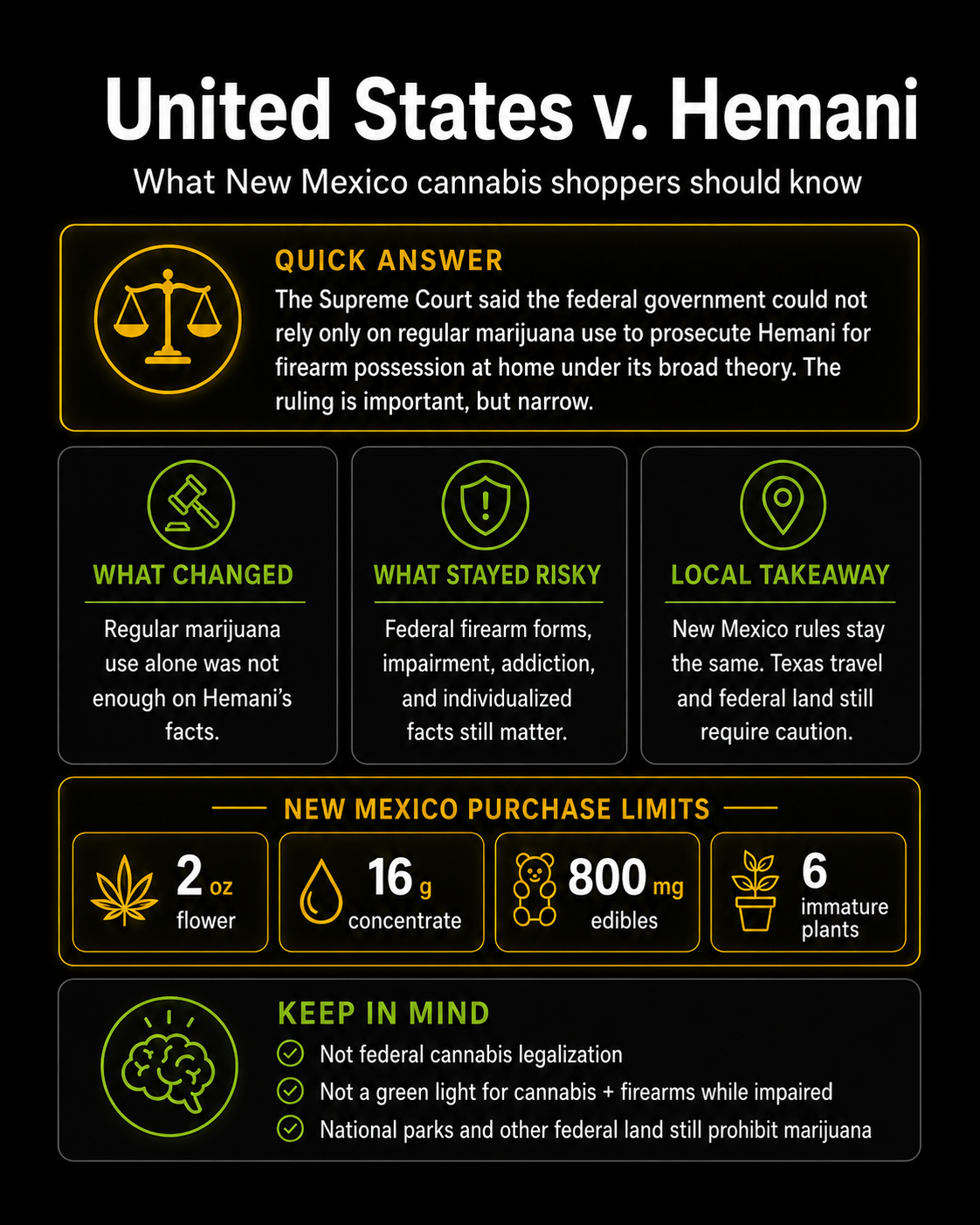
TL;DR: In United States v. Hemani, decided June 18, 2026, the Supreme Court said the federal government could not prosecute Ali Danial Hemani under 18 U.S.C. § 922(g)(3) based only on the theory that regular marijuana use automatically makes someone too dangerous to possess a firearm at home. The ruling is important for cannabis consumers and Second Amendment law, but it is narrow. It does not federally legalize cannabis, does not erase every drug-related firearms restriction, does not change New Mexico or Texas cannabis rules, and does not make it safe or smart to mix cannabis impairment and firearms.
United States v. Hemani is the Supreme Court marijuana and guns ruling cannabis consumers are asking about, especially in states like New Mexico where adult-use cannabis is legal under state law. The case matters, but the headline needs guardrails.
The short version is simple enough: the Court rejected a broad federal theory that regular marijuana use alone automatically strips someone of Second Amendment protection. The longer version has more legal footnotes than a law school backpack, so let’s unpack it without turning your lunch break into a constitutional law final.
This guide explains what the Supreme Court decided, what it did not decide, what New Mexico cannabis consumers should know, what Texas visitors should avoid, and why national parks and federal land still deserve extra caution.
Quick Answer: What Did United States v. Hemani Decide?
The Supreme Court affirmed the Fifth Circuit and held that the government’s prosecution of Hemani under the “unlawful user” provision of 18 U.S.C. § 922(g)(3) was unconstitutional as applied to him.
Hemani admitted he used marijuana a few times a week. The government argued that marijuana use alone made him automatically banned from possessing a firearm. The Court rejected that broad approach because the government did not show that Hemani was addicted, presently intoxicated while armed, dangerous because of his use, trafficking drugs, or misusing the firearm.
Primary source: United States v. Hemani, Supreme Court opinion via Cornell LII
The Most Important Legal Caveat
This ruling is not a universal “cannabis users can ignore federal firearms law now” card. That card does not exist. Please do not look for it in your wallet.
The Court specifically left open several categories of cases. It did not decide whether Congress may restrict firearms for people who are addicted, presently intoxicated while possessing a gun, individually proven dangerous because of drug use, or connected to other firearm-disqualifying facts.
That matters because firearms law is fact-heavy. A small change in facts can change the legal analysis. A blog post can explain the ruling. A lawyer can review your situation.
Why Was Ali Hemani Charged?
According to the Court, federal agents searched the Hemani family home in 2022 during an investigation that began with suspected terrorism-related activity. The charge at issue, though, was not a terrorism charge. It focused on marijuana use and firearm possession.
Hemani was charged under 18 U.S.C. § 922(g)(3), which bars people who are unlawful users of, or addicted to, controlled substances from possessing firearms. The government said his marijuana use made him an unlawful user and therefore automatically disarmed him.
The Supreme Court did not accept that shortcut. The opinion repeatedly stressed that the government’s theory ignored individualized questions like amount used, impairment, danger, safe storage, reason for possessing the gun, and whether the person posed a special risk.
Plain English version: The Court did not say cannabis and guns are always legally fine together. It said the government’s automatic “regular use equals automatic danger” argument went too far on these facts.
Did the Supreme Court Strike Down the Whole Drug-User Gun Ban?
No. The Court ruled on the government’s application of the statute to Hemani under the theory presented. The opinion did not erase § 922(g)(3) from the books.
The Court said the government had not justified applying the law to Hemani based only on his marijuana use a few times per week. It also said the case did not address other scenarios, including addiction, present intoxication, individualized proof of dangerousness, or other firearm restrictions.
So yes, the decision is a big deal. It is also narrower than the most excited social media headline will make it sound. Social media loves a constitutional shortcut. Courts, famously, love footnotes.
What Was Wrong With the Government’s Historical Argument?
The government relied heavily on old laws involving “habitual drunkards.” It argued those historical laws were similar enough to justify disarming unlawful drug users today.
The Supreme Court disagreed. The Court said historical “habitual drunkard” laws targeted different people, worked differently, and did not support automatically disarming everyone who regularly used any controlled substance in any amount.
In regular-person language: the analogy walked into court wearing a fake mustache, and the Court noticed.
Does Hemani Mean Marijuana Users Can Buy Guns Without Worrying About Federal Forms?
No. This is still a serious legal area.
ATF firearm paperwork still asks about unlawful use of, or addiction to, marijuana or other controlled substances. Current ATF materials also warn that a person can be an unlawful user under federal law even when possession is legal under state law, and that federal law does not permit recreational marijuana use or possession.
That may change over time as agencies, courts, and Congress respond to Hemani. As of June 19, 2026, anyone dealing with cannabis and federal firearm paperwork should get legal advice before guessing. Federal forms are not the best place to “vibe it out.”
Official source: ATF Firearms Transaction Record Form 4473 draft/current materials
Does United States v. Hemani Legalize Cannabis Federally?
No. United States v. Hemani is a Second Amendment case. It is not a federal cannabis legalization case.
Federal cannabis law is still moving in pieces. DEA has a rescheduling hearing scheduled to begin June 29, 2026, and conclude no later than July 15, 2026, for the proposed rulemaking to transfer marijuana to Schedule III. That process is separate from the Supreme Court’s firearms ruling.
So the practical answer is: Hemani affects the government’s theory for this firearms prosecution. It does not turn cannabis into federally legal adult-use marijuana nationwide. Legal lasagna remains on the menu. Layers everywhere.
Official source: Federal Register: DEA marijuana rescheduling hearing notice
What Does Hemani Mean for Cannabis Consumers in New Mexico?
For everyday New Mexico cannabis shoppers, the basic state rules have not changed. Adults 21 and older can buy cannabis from licensed retailers within New Mexico’s adult-use limits.
New Mexico says consumers are eligible to buy up to 2 ounces of cannabis, 16 grams of concentrate, 800 milligrams of edibles, or 6 immature cannabis plants at one time. Bring a valid ID, buy from licensed retailers, and keep cannabis use within state rules.
State-legal cannabis does not automatically solve every federal issue. That is especially important for firearms, federal forms, federal land, and travel across state lines.
Official source: New Mexico Cannabis Control Division: Adult Use Cannabis
Helpful Bud Board guide: New Mexico Cannabis Laws for Visitors
What Should Texas Visitors Know After Hemani?
Texas visitors should be careful. New Mexico adult-use cannabis law does not travel across the state line in your glove box.
Texas Health and Safety Code § 481.121 says a person commits an offense if they knowingly or intentionally possess a usable quantity of marihuana, unless authorized by law. In plain English: do not treat a New Mexico purchase as Texas permission.
If your trip involves Carlsbad, Hobbs, or the Texas border, plan ahead. The headline from Hemani is about a federal firearm prosecution. It is not a travel pass for cannabis into Texas.
Legal source: Texas Health and Safety Code § 481.121
Helpful Bud Board guides: Can You Bring Weed from New Mexico to Texas? and Are Cannabis Dispensaries Legal in Texas?
What About Carlsbad Caverns, Guadalupe Mountains, and Federal Land?
This part is simple and important: keep cannabis off federal land.
The National Park Service says possession or use of marijuana inside a National Park Service unit is prohibited. That includes parks, preserves, rivers, and monuments. State cannabis legalization does not override federal land rules.
That matters in southeast New Mexico and west Texas because visitors often connect dispensary stops with Carlsbad Caverns, Guadalupe Mountains, camping, hiking, and road trips. Keep the dispensary rules separate from park rules. They are not travel buddies.
Official source: National Park Service: Marijuana and Other Substances
Helpful Bud Board guide: Things to Do in Carlsbad, NM Near Carlsbad Caverns
Key Takeaways
- United States v. Hemani was decided June 18, 2026, and it is a narrow ruling about marijuana use, firearms, and 18 U.S.C. § 922(g)(3).
- The Supreme Court affirmed dismissal of Hemani’s indictment under the government’s broad theory.
- The ruling limits prosecution based only on regular marijuana use and firearm possession at home on these facts.
- The Court did not erase all drug-related firearm restrictions.
- The Court did not decide cases involving addiction, present intoxication, individualized dangerousness, or every controlled substance scenario.
- Cannabis is still complicated under federal law, and rescheduling activity is separate from this firearms ruling.
- New Mexico adult-use cannabis remains legal for adults 21+ within state rules.
- Texas still criminalizes possession of a usable quantity of marihuana unless authorized by law.
- Cannabis remains prohibited inside National Park Service units and other federal areas.
FAQ: United States v. Hemani and Cannabis Gun Rights
Did the Supreme Court say marijuana users can own guns?
The Court said the government could not prosecute Hemani based only on his regular marijuana use and firearm possession at home under the broad theory presented. It did not announce a blanket rule covering every cannabis user, every firearm owner, or every set of facts.
Is 18 U.S.C. § 922(g)(3) still law?
Yes. The statute remains on the books. Hemani limits how the “unlawful user” provision can be applied, especially when the government relies only on regular marijuana use without more.
Can I use cannabis and carry a firearm while high?
The Court did not decide protections for people who are presently intoxicated while possessing a firearm. From a safety standpoint, mixing impairment and firearms is a terrible idea. That is adult supervision talking.
Does Hemani help medical cannabis patients?
Potentially, yes, especially in future legal challenges. The ruling does not automatically resolve every issue for medical patients, especially when federal firearms paperwork, state law, federal land, or individualized facts are involved.
Does Hemani change New Mexico cannabis purchase limits?
No. New Mexico adult-use purchase limits remain separate from this Supreme Court ruling. Adults 21+ may buy up to 2 ounces of cannabis, 16 grams of concentrate, 800 milligrams of edibles, or 6 immature plants at one time from licensed retailers.
Can I buy cannabis in New Mexico and take it to Texas?
No. Do not treat Hemani as permission to move cannabis across state lines or into Texas. Texas still criminalizes possession of a usable quantity of marihuana unless authorized by law.
Can I bring cannabis to Carlsbad Caverns or another national park?
No. National Park Service units are federal land, and NPS says marijuana possession or use inside parks is prohibited.
Should I rely on Hemani before answering ATF firearm paperwork?
No. Anyone dealing with cannabis and federal firearm forms should talk with a qualified attorney. The ruling is important, but individual facts and current agency requirements still matter.
Friendly Closing Note
If you are shopping in New Mexico, keep it legal, local, and boring in the best way. Bring your ID. Know your limits. Store your products safely. Keep cannabis away from federal land and across-state-line travel.
United States v. Hemani is an important Supreme Court ruling, but it is not a permission slip for risky choices around firearms, cannabis, federal forms, Texas travel, or national parks. Goofy is for vacation photos, not indictments.