
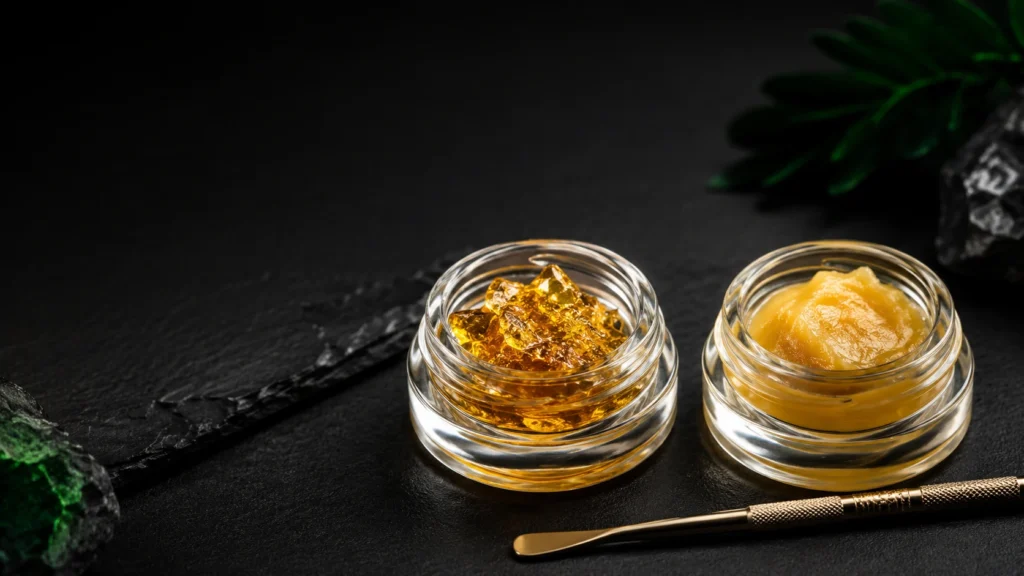
Last Updated: August 2026. Cannabis processing, testing, labels, and product terminology can change. This guide describes common industry use and current New Mexico testing rules.
Live resin vs rosin sounds like a spelling test designed by somebody who had a grudge against vowels. One extra letter changes the whole production method.
Both can show up as glossy, aromatic concentrates. Both may come in tiny jars with very confident branding. But once you know how each one is made, the difference gets much easier to spot.
Live Resin vs Rosin: What Is the Main Difference?
The simplest difference is the extraction method.
Usually begins with fresh-frozen cannabis and uses a solvent-based extraction process to separate cannabinoids and aromatic compounds from the plant material.
Uses heat and mechanical pressure instead of an extraction solvent. It can be pressed from flower, kief, or hash.
A scientific review of cannabis extraction methods covers both solvent-based and solventless methods. Solvent-based methods can use butane or propane. Solventless methods can use water separation, heat, and pressure. The same review describes rosin as a heat-and-pressure process.
So, resin and rosin are not two fancy names for the same jar. The letter “o” is doing surprisingly heavy lifting.
What Is Live Resin?
Live resin usually starts with cannabis that is frozen soon after harvest instead of being dried and cured first. The frozen plant is then extracted, often with a hydrocarbon solvent in commercial production.
The “live” part refers to the fresh-frozen starting material. It does not mean the concentrate is literally alive, newer than every other concentrate on the shelf, or automatically better.
Freezing the plant before drying can help reduce some changes to aromatic compounds. A 2025 cannabis-processing review notes that live resin often uses immediate freezing because drying can affect volatile compounds such as terpenes. See the processing review here.
Live resin can appear in several textures, including badder, sugar, sauce, diamonds-and-sauce, or oil used in compatible cartridges. Texture does not tell you potency by itself.
What Is Rosin?
Rosin is a solventless cannabis concentrate made with heat and pressure. It can be pressed from flower, sift, kief, or hash.
The important word is solventless. Rosin does not use butane, propane, ethanol, or another extraction solvent.
That does not make every rosin the same. Flower rosin, hash rosin, and live rosin can differ in starting material, texture, aroma, yield, and price. The name tells you how it was made, not whether the jar automatically wins a quality contest.
What Is Live Rosin?
This is where people understandably get tangled up.
Live rosin is rosin made from fresh-frozen cannabis. A common process first uses ice water to make bubble hash. That hash is dried and then pressed with heat and pressure.
That means live resin and live rosin may both begin with fresh-frozen cannabis, but the next step is different:
- Live resin: fresh-frozen plant material → solvent-based extraction → live resin
- Live rosin: fresh-frozen plant material → ice-water hash → heat and pressure → live rosin
Regular rosin does not have to be “live.” Flower rosin, for example, can be pressed from dried and cured flower.
Live Resin vs Rosin Comparison Chart
| Feature | Live Resin | Rosin | Live Rosin |
|---|---|---|---|
| Typical starting material | Fresh-frozen cannabis | Flower, kief, sift, or hash | Usually hash made from fresh-frozen cannabis |
| Main process | Solvent-based extraction | Heat and pressure | Ice-water separation, then heat and pressure |
| Solventless? | No | Yes | Yes |
| Common textures | Badder, sugar, sauce, diamonds, oil | Fresh press, badder-like, cured rosin | Fresh press, cold cure, badder-like, jam-style |
| Potency | Varies by product | Varies by product | Varies by product |
| Automatically better? | No | No | No |
Which Has More Flavor or Terpenes: Live Resin or Rosin?
There is no honest universal winner.
Shoppers often choose both types for aroma and flavor. But many things can change the final result. These include temperature, pressure, solvent choice, curing, storage, age, packaging, and the original plant chemistry.
Scientific reviews note that drying, temperature, and extraction method can change terpene recovery. That is why the actual batch matters more than a claim that one type always has “more terpenes.” This review covers terpene extraction methods in more detail.
If aroma matters to you, check the terpene data when it is available and compare the exact batch. For more background, read Bud Board’s cannabinoids and terpenes guide.
Is Live Resin Stronger Than Rosin?
Not automatically. Either category can contain a high concentration of THC, and the numbers can overlap.
The CDC notes that concentrates used for dabbing and vaping can deliver very high levels of THC. Higher-THC products can also raise the chance of overconsumption. See the CDC’s current high-THC guidance.
So do not use “live resin” or “rosin” as a shortcut for potency. Read the tested THC and cannabinoid information on the specific product.
Is Rosin Cleaner or Safer Because It Is Solventless?
Solventless describes the production method. It does not prove that a product is cleaner, purer, healthier, stronger, or safer.
Live resin is made with an extraction solvent, but licensed products must meet testing rules. In New Mexico, concentrates made with volatile solvents require residual-solvent testing before sale. 16.8.7 NMAC lists the testing rules and action levels.
Rosin skips that solvent-extraction step. But quality still depends on the starting material, manufacturing, testing, storage, and handling.
This is also why homemade hydrocarbon extraction is a bad idea. Flammable solvent vapors can create serious fire and explosion hazards. Licensed commercial extraction equipment exists for a reason, and the kitchen does not need another science fair.
Why Does Rosin Often Cost More Than Live Resin?
Rosin, especially live hash rosin, can take more work to make. It may also produce less finished concentrate from the same amount of plant material. That can make it cost more.
But there is no permanent price rule. Brand, batch, yield, starting material, market, promotions, and package size all matter. A fixed “live resin costs X, rosin costs Y” chart would age about as gracefully as milk in a hot car.
Compare the current menu and the actual jar rather than assuming the more expensive option must be better.
How Should You Compare Live Resin and Rosin at a Dispensary?
Start with the label, not the buzzwords.
- Product type: live resin, rosin, hash rosin, or live rosin
- Starting material: fresh-frozen or cured, if listed
- THC and THCA: compare the tested batch, not the category name
- CBD and other cannabinoids: when relevant to what you are shopping for
- Terpene information: if the producer provides it
- Package and production dates: freshness can matter for aromatic concentrates
- Storage instructions: follow the manufacturer guidance
- Ingredients and processing information: especially for cartridges or formulated products
- Testing details: use the batch information rather than judging from color or texture
If cannabis labels still feel like they were written by somebody paid per abbreviation, Bud Board’s guide to reading a cannabis label breaks them down field by field.
What Bud Board Budtenders Wish More Shoppers Knew
“The easiest way to compare resin and rosin is to stop asking which name sounds better and look at the actual batch. Start with how it was made, then check the label.”
“Resin and rosin being one letter apart has probably created more concentrate questions than anything else on the menu. Whoever named them owes budtenders an apology.”
Live Resin vs Rosin: Which Is Better for a Beginner?
Neither type is automatically better for beginners. Both are concentrates, and concentrates can contain much more THC by weight than flower.
If you are new to concentrates, tell the budtender. Choose a clearly labeled product from a licensed dispensary. Follow the product and device instructions. Use a small amount and wait before using more. Do not drive after using THC.
For the wider concentrate family, including wax, shatter, badder, sauce, diamonds, and distillate, read Bud Board’s Cannabis Concentrates Explained guide.
Key Takeaways
- Live resin usually starts with fresh-frozen cannabis and uses a solvent-based extraction process.
- Rosin is made with heat and pressure and does not use an extraction solvent.
- Rosin can be made from flower, kief, sift, or hash.
- Live rosin is usually made by pressing hash produced from fresh-frozen cannabis.
- Live resin and live rosin can both begin with fresh-frozen material but use different processing paths.
- Neither category is automatically stronger, cleaner, safer, or higher quality.
- New Mexico requires residual-solvent testing for concentrates made with volatile solvents.
- Compare the exact batch, label, freshness, storage, cannabinoid information, and terpene data when available.
Research and Official Sources
- Processing and extraction methods of medicinal cannabis: a narrative review
- 2025 review of cannabis processing stages and extraction techniques
- Review of terpene extraction from Cannabis sativa
- CDC: high-THC cannabis and cannabis concentrates
- New Mexico 16.8.7 NMAC: cannabis product testing requirements
Live Resin vs Rosin FAQ
What is the difference between live resin and rosin?
Live resin usually starts with fresh-frozen cannabis and is made with a solvent-based extraction process. Rosin is made with heat and pressure without an extraction solvent.
Is live resin the same thing as live rosin?
No. Both commonly start with fresh-frozen cannabis, but live resin is generally solvent-extracted. Live rosin is solventless and is usually pressed from hash made from fresh-frozen cannabis.
Is all rosin live rosin?
No. Rosin can be pressed from dried flower, kief, sift, or hash. “Live” rosin refers to rosin made from fresh-frozen starting material, usually through an ice-water-hash step before pressing.
Is rosin stronger than live resin?
Not automatically. Potency varies by batch, starting material, processing, and formulation. Compare the tested cannabinoid information on the specific product.
Does live resin have residual solvents?
Live resin is generally made using a solvent-based extraction process. Licensed New Mexico volatile-solvent concentrates are subject to residual-solvent testing and must meet the state’s action limits before retail sale.
Does solventless mean safer?
No. Solventless describes how a product was made. It does not guarantee safety or quality. Testing, manufacturing, potency, storage, handling, and individual use all matter.
Which is better, live resin or rosin?
Neither is universally better. Live resin may appeal to someone who wants a fresh-frozen extract in a wider range of textures or formats. Rosin may appeal to someone who specifically wants solventless processing. The best choice depends on the exact batch and your preferences.
Still Deciding Between Live Resin and Rosin?
Check the current menu or visit a Bud Board location in Carlsbad or Hobbs. Ask the budtender how the product was made, what the tested label says, and how it compares with the other concentrate beside it. You do not need a chemistry degree. You just need someone willing to translate the tiny jar.