Cannabis Concentrates Explained: Wax, Shatter, Live Resin, Rosin & More
Last Updated: July 2026. Cannabis concentrates can be considerably more potent than flower. Read the label, start small, wait before consuming more, and do not drive after using THC.
TL;DR: Cannabis concentrates collect cannabinoids and aromatic compounds from the plant while leaving much of the leafy material behind. Wax, shatter, badder, crumble, and sugar often describe texture. Meanwhile, live resin usually starts with fresh-frozen cannabis and is generally solvent-extracted, while rosin is made with heat and pressure. No single texture, color, extraction method, or THC number automatically proves quality. The tiny jar may be confident, but the label still has to do the talking.
If the concentrate shelf looks like someone combined a chemistry set with a dessert menu, you are not alone. Wax, badder, crumble, sugar, sauce, diamonds, shatter, resin, and rosin sound like entirely different worlds. Sometimes they describe different processing categories. In other cases, they mostly describe texture. Occasionally, the name is simply doing a little marketing cardio.
A useful way to understand cannabis concentrates is to separate four questions: What was the starting material? How was the resin collected? What is the final consistency? And, most importantly, what does the tested label actually say?
In this guide, we explain wax, shatter, live resin, live rosin, hash, distillate, diamonds, sauce, and other concentrate formats in normal language. You will also learn how to compare labels, spot questionable products, store concentrates properly, and ask better questions at a dispensary.
“The name tells you part of the story, but the label tells you the rest. Two products can both say wax and still have very different potency, aroma, freshness, and handling.”
One of our budtenders
Quick Answer: What Are Cannabis Concentrates?
Cannabis concentrates are products that collect and concentrate resin-rich compounds from cannabis. Those compounds are found largely in tiny plant structures called trichomes, which contain cannabinoids such as THC and CBD along with aromatic compounds such as terpenes.
During production, much of the plant’s leafy material is left behind. As a result, the finished concentrate may be glass-like, creamy, oily, crumbly, sticky, crystalline, or sauce-like, depending on the starting material, process, composition, temperature, and storage.
Concentrates generally contain more THC by weight than cannabis flower. Therefore, a physically small portion may feel more significant than a new consumer expects.
Official source: National Institute on Drug Abuse: Marijuana Concentrates
Concentrate, Extract, Dab, and Vape Oil: What Do the Words Mean?
- Concentrate: The broad category for products containing concentrated cannabis compounds.
- Extract: Generally refers to a concentrate made through an extraction process, often with a solvent.
- Dab: Usually means a portion of concentrate or the act of consuming that portion with a compatible device.
- Vape oil: A formulation made for a compatible cartridge or vaporizer.
- Infused product: Flower, a pre-roll, food, beverage, or another manufactured item with concentrate added.
Although these words overlap, they are not interchangeable. For example, a cartridge is not automatically a dab product, and a concentrate sold for dabbing should not automatically be placed into a cartridge. Always follow the product and device instructions.
Solvent-Based vs. Solventless Concentrates
The biggest processing distinction is how cannabinoids, terpenes, and resin are separated from the plant material.
Solvent-Based Extracts
Licensed manufacturers may use controlled extraction systems involving hydrocarbons, ethanol, carbon dioxide, or other authorized methods. Products in this broad category can include shatter, wax, badder, live resin, sauce, diamonds, and distillate.
Importantly, the finished product should come from a licensed manufacturer and include the labeling and testing required under applicable rules.
Solventless Concentrates
Solventless methods rely primarily on physical separation, ice water, filtration, heat, pressure, or combinations of those processes.
Common examples include kief, dry-sift hash, bubble hash, flower rosin, hash rosin, and live rosin.
However, “solventless” only describes processing. It does not automatically mean cleaner, purer, safer, stronger, tastier, or better. Starting material, manufacturing skill, sanitation, testing, handling, storage, and personal preference still matter.
Homemade solvent extraction is a different matter entirely. Because flammable solvents can create serious fire, explosion, and contamination hazards, extraction should be left to licensed professionals using regulated equipment. No kitchen science fair, please.
What Is Cannabis Wax?
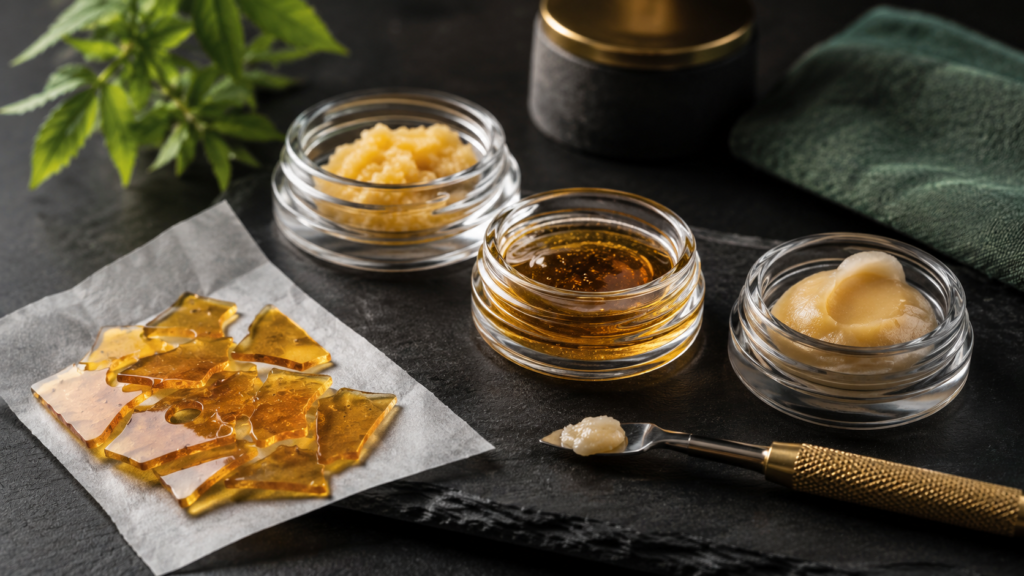
Wax is a broad term for soft or semi-solid cannabis concentrates. Depending on the product, it may be sticky, creamy, crumbly, dense, or whipped.
Similar consistencies may be labeled wax, badder, batter, budder, or crumble. However, producers do not always use those terms in exactly the same way.
Several factors can change the consistency, including cannabinoid composition, terpene content, processing, temperature, age, and storage. Therefore, wax is not automatically stronger or weaker than shatter, live resin, or rosin.
Basically, the concentrate aisle borrowed a surprising number of words from bakeries. Thankfully, nobody expects you to spread badder on toast.
What Is Shatter?
Shatter is generally thin, brittle, translucent, and glass-like. At cooler temperatures it may snap into pieces, while warmer conditions can make it softer or stickier.
Its clarity and texture are influenced by processing, composition, temperature, age, and molecular stability. Even so, clear golden shatter is not automatic proof of purity, strength, freshness, or safety. Darker shatter is not automatically defective, either.
Is shatter stronger than wax?
Not necessarily. Wax and shatter mainly describe consistency, so compare the tested cannabinoid information instead of guessing from appearance.
Why does shatter turn cloudy or sugary?
Over time, cannabinoids may begin crystallizing and create a cloudy or sugary appearance. That change does not automatically mean the product is spoiled. Instead, damaged packaging, contamination, unusual odors, missing labels, or an unknown source are more meaningful warning signs.
One practical downside is that brittle shatter can be difficult for beginners to portion. It occasionally launches a tiny piece toward another dimension.
What Is Live Resin?
“Live” generally means the cannabis was frozen soon after harvest rather than being dried and cured first. Live resin is then usually produced from that fresh-frozen material through a solvent-based extraction process.
Fresh-frozen material is used with the goal of retaining a different range of volatile aromatic compounds. Consequently, live resin may be sold as badder, sugar, sauce, diamonds and sauce, or cartridge oil.
Despite the name, live resin is not literally alive. It is also not automatically stronger, safer, newer at the time of purchase, or better than a concentrate made from dried and cured flower.
Ultimately, the final aroma and terpene profile depend on the plant material, extraction, formulation, packaging, age, handling, and storage.
For more on cannabinoids and aromatic compounds, read Bud Board’s cannabinoids and terpenes guide .
Live Resin vs. Live Rosin
Resin and rosin are different words. Swapping one letter changes the processing category, which feels unnecessarily sneaky but is important.
| Feature | Live Resin | Live Rosin |
|---|---|---|
| Typical starting material | Fresh-frozen cannabis | Usually hash made from fresh-frozen cannabis |
| Processing category | Generally solvent-based extraction | Solventless heat-and-pressure processing |
| Common forms | Badder, sugar, sauce, diamonds, cartridges | Fresh press, cold cure, badder-like consistency |
| Aroma and flavor | Depends on material, process, age, and storage | Depends on material, process, age, and storage |
| Potency | Varies by product | Varies by product |
| Automatically better? | No | No |
In short, live resin is generally an extract, while live rosin is generally produced by pressing hash made from fresh-frozen material. Neither category wins by default.
“Once someone explained that resin and rosin describe different processes, the menu stopped looking like it was written in a secret language.”
A customer
Other Cannabis Concentrate Types
Badder, Budder, or Batter
These are soft, whipped, frosting-like consistencies. Producers may use the terms somewhat interchangeably.
Crumble
This drier concentrate breaks apart easily. It may be convenient to portion, although it can scatter when handled carelessly.
Sugar
Sugar typically contains small cannabinoid crystals suspended in softer, terpene-containing material.
Diamonds and Sauce
This format combines crystalline cannabinoid material, often rich in THCA, with a liquid aromatic fraction. Large crystals do not automatically mean better quality.
Distillate
Distillate is highly refined cannabinoid oil commonly used in cartridges, edibles, syringes, and infused products. Terpenes may be added after refinement.
Kief
Kief is loose trichome material separated from cannabis flower.
Hash
Hash is a broad traditional category made from collected and often compressed cannabis resin glands.
Bubble Hash
Bubble hash is produced through ice-water separation and filtration.
Rosin
Rosin is a solventless concentrate made by applying heat and pressure to flower or hash.
Full-Melt Hash
Full-melt hash is highly refined hash intended to melt with relatively little plant residue. However, not every bubble hash qualifies as full melt.
Wax vs. Shatter vs. Live Resin: Quick Comparison
| Question | Wax | Shatter | Live Resin |
|---|---|---|---|
| General texture | Soft, sticky, creamy, or crumbly | Thin, brittle, and glass-like | May be badder, sugar, sauce, or oil |
| Typical category | Often solvent-based | Often solvent-based | Generally solvent-based |
| Starting material | Often dried or cured cannabis | Often dried or cured cannabis | Generally fresh-frozen cannabis |
| Aroma and flavor | Varies widely | Varies widely | Often selected for aromatic character |
| Handling | Often easier to portion | Can snap or scatter | Depends on consistency |
| Potency | Varies | Varies | Varies |
| Storage | Follow the product label | Protect from excessive heat and light | Follow label-specific storage instructions |
In practice, the right choice depends less on which name sounds fanciest and more on potency, cannabinoid profile, aroma, freshness, testing, handling, device compatibility, and your experience level.
Are Cannabis Concentrates Stronger Than Flower?
Generally, yes. Concentrates usually contain a higher percentage of THC than cannabis flower. As a result, a small-looking portion may deliver more THC than an inexperienced consumer expects.
Still, higher THC does not automatically mean higher quality. Nor does it predict the full experience by itself. Portion size, tolerance, product format, cannabinoid composition, terpenes, equipment, setting, and individual sensitivity all matter.
Source: CDC: Cannabis Health Effects
How Are Cannabis Concentrates Used?
Legal retail concentrates appear in several formats:
- Dab rigs intended for compatible concentrates
- Electronic concentrate vaporizers
- Prefilled vape cartridges
- Infused flower and pre-rolls
- Edibles and beverages manufactured with concentrate
However, these products are not interchangeable. A concentrate sold for dabbing may not belong in a cartridge, and a cartridge should not be opened and treated like loose concentrate. Follow the instructions for both the cannabis product and the device.
Likewise, excessive heat should not be treated as automatically better. Higher temperatures can change flavor and increase thermal degradation. Therefore, concentrate inhalation should not be described as harmless.
For cartridge and vaporizer basics, read Bud Board’s straightforward weed-vape guide .
What Should Beginners Know Before Trying Concentrates?
First, tell the budtender you are new. Seriously. There is no trophy for pretending you have a graduate degree in sauce.
Next, choose a clearly labeled product from a licensed dispensary. Check the tested cannabinoid information and any serving or portion guidance. Then use a very small amount, wait before consuming more, and use only a compatible device.
Finally, avoid mixing cannabis with alcohol or other impairing substances. Stay somewhere comfortable, do not drive, and keep cannabis securely stored away from children and pets.
“New concentrate shoppers sometimes focus on the size of the jar because the portion looks tiny. That is exactly why the THC information and serving guidance matter so much.”
One of our budtenders
This is not the category where “go big or go home” deserves a motivational poster.
How Do You Read a Cannabis Concentrate Label?
Look for:
- Product name and concentrate type
- THC, THCA, CBD, and total cannabinoid information
- Serving or portion guidance
- Ingredients
- Processing or extraction description
- Batch or lot information
- Testing details
- Packaging date and best-by guidance
- Storage instructions
- Required warnings
- Manufacturer information
Above all, do not judge a product only by THC percentage, color, texture, price, trendiness, or the number of times the package says “live,” “premium,” or “full spectrum.”
Why are THC and THCA listed separately?
THCA is the acidic precursor to THC found in raw cannabis. When heat is applied, part of the THCA converts into THC. Because that conversion is not one-to-one by weight, a total-THC calculation is not simply the two printed numbers added together.
Fortunately, you do not need to do chemistry in the dispensary aisle. Instead, use the tested total information provided on the compliant label rather than estimating by appearance.
How Can You Judge Concentrate Quality?
Useful signs include:
- Licensed and traceable origin
- Intact, compliant packaging
- Clear cannabinoid and ingredient information
- Batch, testing, and manufacturer details
- Storage consistent with the product label
- A consistency that reasonably matches the named format
By contrast, warning signs include:
- Unknown or unlicensed origin
- Missing labels or testing information
- Broken seals or damaged packaging
- Visible debris or contamination
- Unexpected burnt, rancid, chemical, or musty odors
- Medical guarantees or cure claims
Appearance and smell can raise useful questions, but neither one certifies safety. After all, a shiny slab is not a laboratory report.
How Should Cannabis Concentrates Be Stored?
Start with the product label. Keep the container tightly closed and protect it from excessive heat, light, air, moisture, and contamination.
Whenever possible, use the original child-resistant packaging. Also, handle the concentrate with clean tools instead of repeatedly touching it with your fingers. Store it securely away from children and pets.
Some live resin and rosin products include specific cool-storage instructions. If a chilled product is brought to room temperature, keeping the container closed while it adjusts may help reduce condensation. Even so, manufacturer directions take priority.
Bud Board’s safe cannabis storage guide for New Mexico homes covers household storage in more detail.
Common Concentrate Mistakes to Avoid
- Assuming every concentrate is basically the same
- Shopping only by THC percentage
- Confusing live resin with live rosin
- Assuming clear shatter is automatically purer
- Taking more because the portion looks small
- Using the wrong device
- Applying excessive heat
- Consuming more before assessing the first portion
- Mixing cannabis with alcohol
- Driving afterward
- Buying unlicensed products
- Attempting homemade solvent extraction
- Leaving concentrates accessible to children or pets
What Should You Ask a Budtender?
- Is this wax, shatter, live resin, rosin, hash, or distillate?
- Is it solvent-based or solventless?
- What do the THC and THCA numbers mean?
- Is this especially potent compared with similar products?
- Is it appropriate for someone new to concentrates?
- What device is compatible with it?
- Is it intended for dabbing, vaping, or infusing another product?
- How should it be stored?
- How is it different from the similar-looking product beside it?
- What aromatic characteristics stand out?
- When was it packaged?
- Are the batch and testing details available?
Budtenders provide product education. In other words, they can help explain labels, formats, and equipment, but they are not substitutes for healthcare professionals.
“I appreciated being able to say, ‘I have no idea what I’m looking at,’ and getting a normal explanation instead of a sales pitch. That made it much easier to compare the products.”
A customer
Responsible Concentrate Use in New Mexico
This article provides general cannabis education, not medical advice. Purchase regulated cannabis from licensed New Mexico retailers, follow product and device instructions, and keep concentrates securely stored.
New Mexico permits eligible adult-use consumers to purchase up to 16 grams of concentrate at one time. However, state rules governing possession, consumption, and transportation still apply.
Do not drive after using THC. Cannabis can impair reaction time, judgment, coordination, lane tracking, and multitasking. In addition, cannabis purchased legally in New Mexico cannot legally be transported across state lines.
Official sources: New Mexico Cannabis Control Division: Adult Use and NHTSA: Drug-Impaired Driving
For a broader overview, read Bud Board’s New Mexico cannabis laws for visitors and guide to bringing cannabis from New Mexico to Texas .
Key Takeaways
- Cannabis concentrates collect cannabinoids and aromatic compounds from resin-rich cannabis trichomes.
- Concentrates generally contain more THC by weight than flower.
- Wax, shatter, badder, crumble, and sugar often describe consistency rather than potency.
- Live resin generally begins with fresh-frozen cannabis and is usually solvent-extracted.
- Rosin is produced with heat and pressure rather than hydrocarbon extraction.
- Live rosin is commonly pressed from hash made with fresh-frozen material.
- Solventless does not automatically mean safer, stronger, cleaner, or better.
- Color, clarity, texture, price, and THC percentage do not prove quality on their own.
- Use only compatible products and devices.
- Read the label, begin with a very small amount, and wait before consuming more.
- Do not drive after using THC.
- Do not attempt homemade solvent extraction.
Cannabis Concentrates FAQ
What are cannabis concentrates?
Cannabis concentrates are products containing concentrated cannabinoids and other compounds collected from cannabis trichomes. Much of the leafy plant material is removed, leaving a product that may be solid, creamy, oily, crumbly, sticky, or crystalline.
What is the difference between wax and shatter?
The main difference is consistency. Wax is generally soft, sticky, whipped, or crumbly, while shatter is usually thin and brittle. Either may contain more THC than the other, so compare labels rather than guessing from texture.
What is live resin?
Live resin is generally a solvent-based extract made from cannabis frozen soon after harvest. Depending on the product, it may be sold as badder, sauce, sugar, diamonds, or cartridge oil.
What is the difference between live resin and live rosin?
Live resin is typically solvent-extracted from fresh-frozen cannabis. By contrast, live rosin is solventless and is commonly pressed from hash made with fresh-frozen cannabis.
Is shatter stronger than wax?
Not necessarily. Shatter and wax describe consistency rather than a fixed potency level. Therefore, check the tested THC, THCA, total cannabinoid, and serving information.
Are concentrates stronger than flower?
Generally, yes. Concentrates commonly contain a higher percentage of THC than cannabis flower, so a physically small portion may deliver more THC than a beginner expects.
What does “dab” mean?
A dab usually means a portion of concentrate or the act of consuming that portion with a compatible device. Concentrate describes the product category, while dab often describes the portion or method.
What is the best concentrate for a beginner?
There is no universal best concentrate. A clearly labeled product that is easier to portion may be more manageable. However, tested potency, device compatibility, tolerance, and personal sensitivity matter more than the product name.
Is solventless concentrate automatically safer?
No. Solventless describes the production method. It does not guarantee cleanliness, testing, purity, potency, proper storage, or a better experience.
Does clearer shatter mean higher quality?
No. Clarity and color may be influenced by starting material, processing, composition, age, temperature, and storage. Appearance alone cannot confirm safety, purity, or potency.
What are diamonds and sauce?
Diamonds are cannabinoid crystals, often rich in THCA, paired with or sold alongside an aromatic liquid called sauce. Composition and potency vary by product.
What is cannabis distillate?
Distillate is highly refined cannabinoid oil commonly used in vape cartridges, edibles, syringes, and infused products. During refinement, much of the original aromatic profile may be reduced, so terpenes may be added afterward.
How should cannabis concentrates be stored?
Follow the product label, close the container tightly, protect it from excessive heat and light, handle it with clean tools, and keep it securely stored away from children and pets.
Do cannabis concentrates expire?
Concentrates can degrade over time. For example, aroma, consistency, cannabinoid composition, and overall quality may change with exposure to heat, light, oxygen, moisture, or contamination. Follow packaging and best-by guidance.
Can Texas visitors buy concentrates in New Mexico?
Eligible adults with valid identification may purchase adult-use cannabis from licensed New Mexico retailers. However, all New Mexico rules still apply while possessing or consuming the product.
Can concentrates be taken from New Mexico into Texas?
No. Cannabis cannot legally be transported across state lines. Therefore, a lawful New Mexico purchase does not become lawful to carry into Texas.
Where can adults find cannabis concentrates in Carlsbad or Hobbs?
Bud Board has three Carlsbad locations and one Hobbs location. Since concentrate inventory changes, check the relevant location page and current menu before visiting.
The Bottom Line on Wax, Shatter, Resin, and Rosin
Wax and shatter usually tell you about consistency. Meanwhile, live resin points to fresh-frozen starting material and a generally solvent-based extraction category. Rosin, on the other hand, tells you the product was made with heat and pressure.
None of those names automatically proves strength or quality. Instead, check the tested label, product origin, packaging, freshness, storage, and device compatibility.
Still staring at the concentrate menu like it just handed you a chemistry final? Stop by Bud Board Dispensary and talk with one of our budtenders. We can help you compare wax, shatter, live resin, rosin, hash, and other concentrates without pretending the highest THC number automatically wins.
Pingback: What Is Infused Cannabis Flower? A New Mexico Buyer's Guide
Pingback: Live Resin vs Rosin: What’s the Real Difference?
Pingback: Live Resin vs Distillate: Carts, Flavor & Potency
Pingback: THCA vs THC: Heat, Labels & Total THC Explained