
Information reviewed: October 26, 2026. These are common cannabis-industry terms, and individual manufacturers may use them differently. Product availability and batch results can change.
Live resin. Cured resin. Cured rosin. Live rosin. The concentrate menu is starting to sound like a vocabulary quiz with extra credit for spelling.
There is a simple way through it: find out what happened to the cannabis after harvest, then find out how the extract was made. Those are separate questions, and the names don’t always answer both.
Cured Resin vs Live Resin: Quick Comparison
The main difference happens before extraction begins. The finishing choices, laboratory results and actual product condition still matter.
Swipe sideways to read all four columns.
| Feature | Cured resin | Live resin | Does the name prove this? |
|---|---|---|---|
| Starting cannabis | Dried and cured after harvest | Usually frozen shortly after harvest | Yes, this is the central naming distinction in common industry use |
| Extraction | Commonly solvent-based | Commonly solvent-based | Not the exact solvent, process or finished formulation |
| Aroma profile | Reflects cured starting material and processing | Aims to retain compounds associated with fresh-frozen starting material | Not the final terpene amount or whether you will prefer the smell |
| THC content | Varies by product and batch | Varies by product and batch | No universal strength ranking |
| Appearance | Can be sugar, badder, sauce or other textures | Can also be sugar, badder, sauce or other textures | No fixed color, texture or freshness standard |
| Shopping clue | Check the tested label and production information | Check the tested label and production information | Neither label guarantees a better product |
What Do “Cured” and “Live” Actually Mean?
Cured resin begins with dried, cured cannabis
After harvest, cannabis flower typically loses moisture during drying. Curing follows as a controlled storage stage that can change aroma and other chemical characteristics. A producer can then extract the resin-rich compounds from that material.
So cured resin does not mean an old jar of concentrate. The word describes the cannabis used to make it. A fresh batch of cured resin may have been extracted and packaged recently.
Live resin begins with fresh-frozen cannabis
For live resin, producers usually freeze cannabis soon after harvest instead of sending it through the normal dry-and-cure process first. This gives extraction a different starting material with a different mix of volatile aroma compounds.
“Live” does not mean the oil is alive, freshly packaged or automatically more potent. Fortunately, nobody needs to water the concentrate jar.
Both terms usually describe the input material used for a solvent-based extract. For the larger category, including how wax, badder and other formats fit in, see Cannabis Concentrates Explained.
Does Live Resin Have More Terpenes or Better Flavor?
Fresh-frozen material is intended to preserve a different aroma profile, but “live resin” is not proof of a higher terpene percentage or better flavor. The starting strain, harvest timing, storage and extraction all affect the finished oil.
There is a useful distinction in the research that often gets lost in shopping guides.
Drying changes aroma compounds in measurable ways
A 2024 laboratory study compared drying and storage methods and measured changes in cannabis aroma compounds and cannabinoids. Its results show that preservation depends on the method and storage conditions. No single drying method preserved every measured compound equally well.
A 2026 study of one pharmaceutical cannabis cultivar found that drying approaches changed terpene composition more than cannabinoid composition. Vapor-pressure-controlled drying best preserved certain native aroma characteristics in that experiment, while freeze-drying preserved other features and lost some volatile monoterpenes.
Fresh-freezing and freeze-drying are different
Fresh-freezing means quickly freezing harvested plant material for later processing. Freeze-drying removes water from material under controlled low-temperature, low-pressure conditions. They are not interchangeable steps.
Those studies examined post-harvest plant handling, not a head-to-head contest between every live resin and cured resin product on store shelves. They help explain why starting material matters, but they cannot rank finished concentrates you have not tested.
A useful question for a label: Is there an actual terpene profile for this batch? “Live” can explain the production approach. The measured results tell you more about the finished product.
Cured Resin vs Cured Rosin: Why One Letter Matters
This is probably the most expensive spelling mistake on a concentrate menu. Resin and rosin are related cannabis products, but the words usually point to different extraction methods.
Resin, in the cured or live resin categories, is commonly extracted with solvents such as hydrocarbons. Rosin uses heat and mechanical pressure to express cannabis resin from flower, hash or other trichome-rich material. Scientific reviews describe this solvent-based versus solventless distinction. Cannabis extraction-method review.
Swipe sideways to read all three columns.
| Name | Starting material | Extraction approach |
|---|---|---|
| Cured resin | Dried/cured cannabis | Commonly solvent-based |
| Live resin | Fresh-frozen cannabis | Commonly solvent-based |
| Cured rosin | Dried/cured flower or hash made from cured material | Mechanical heat and pressure, without an extraction solvent |
| Live rosin | Commonly hash made from fresh-frozen cannabis | Mechanical processing and pressing, without an extraction solvent |
“Cured rosin” alone does not always reveal whether the producer pressed flower, dry sift or hash. That extra ingredient detail matters when comparing two products under the same label.
For more on the methods, see Live Resin vs Rosin. Our Bubble Hash guide explains how water-separated hash can become a starting material for rosin.
Is Live Resin Stronger Than Cured Resin?
Neither name guarantees more THC. Concentration depends on the original cannabis, the process and the finished formulation. A cured resin can test higher than a live resin, or the reverse.
That is not just a technical distinction. Search data shows that “which is stronger” is a question people ask about these two categories. The responsible answer is to compare the actual tested cannabinoids instead of picking a winner from the word on the lid.
Look closely at what the THC number means. Some labels show delta-9 THC, some show calculated Total THC, and other totals may include additional cannabinoids. Bud Board’s TAC vs THC guide explains why adding unlike numbers can give you an answer nobody’s lab actually reported.
And no: a larger total does not guarantee a better experience or higher quality. The published framework for cannabis product quality and safety stresses checking product type and relevant testing information rather than using potency alone as a quality judgment.
Cured Resin vs Live Resin Carts: Is the Difference the Same?
Usually, yes. The cured/live distinction still refers to the starting cannabis, even when the extract is formulated for a vape cartridge. But a cart adds a new question: what else was added to make that oil work in the hardware?
Some finished cartridges contain blends or other added ingredients, so the marketing name cannot replace the ingredients list. A cured resin cart and a live resin cart may even use the same type of battery. Hardware compatibility is a separate issue.
Our Live Resin Carts guide covers cartridge ingredients, 510-thread compatibility and label checks in more detail. This page is about the cured-versus-live starting material, so we will leave the battery troubleshooting to that one. Batteries have enough personality already.
Can Color, Texture or the Word “Cured” Tell You How Fresh a Jar Is?
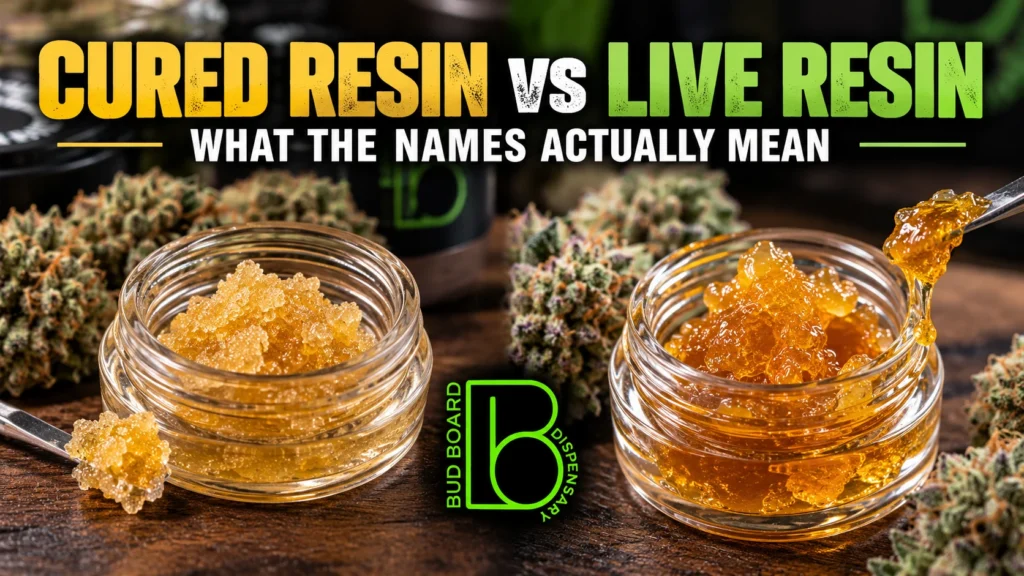
No single color or texture reliably proves whether a concentrate was made from fresh-frozen or cured cannabis. Both categories can be sold as badder, sugar, sauce and other consistencies after processing.
Likewise, cured does not mean stale, and live does not mean recently manufactured. A jar labeled live resin may have spent longer on a shelf than a newly made cured resin. The names tell you about the crop after harvest, not the day the product was packaged.
Color may change with cultivar, extraction, processing and storage. If freshness matters, look for batch details and dates. If aroma matters, use verified terpene information when available rather than assuming pale oil wins the beauty contest.
How to Compare Cured and Live Resin Labels
Two similar-looking jars can have different lab results. This short checklist helps you compare them without needing to memorize a chemistry textbook.
- Confirm the product name. Cured resin, live resin, rosin or something blended? Ask for the ingredient details if the label is vague.
- Check the cannabinoid numbers. Compare the same type of THC measure and the same units across both products.
- Look at terpenes if listed. A tested terpene profile is more specific than the words “live” or “extra flavorful.” It still cannot predict a person’s experience.
- Find the batch and dates. Manufacturing, packaging and expiration information can help put the product’s age in context.
- Review applicable testing. Depending on product and state, a COA may include potency and contaminant panels. A high THC percentage is not a safety test.
- Check storage directions. Follow the maker’s instructions. Some concentrates need special temperature handling to maintain their condition.
A small decision example
Imagine a live resin and a cured resin on the same menu. The live one has a lower tested THC percentage, while the cured one has a higher listed terpene percentage. Those hypothetical numbers are possible because the category names do not set either result.
What can you actually conclude? One used fresh-frozen starting material, the other cured material. You have two separate measured values. You still cannot declare an overall winner, predict the effects, or judge safety without the rest of the product information.
If a cannabis label feels like it has more columns than a spreadsheet, our Cannabis Label guide is the next useful read.
Exploring Cannabis Concentrates at Bud Board?
Adults 21+ can browse Bud Board’s cannabis concentrates page and choose a Carlsbad or Hobbs location to view its current menu. Live resin, cured resin, rosin and other concentrate availability can vary by store and batch.
Check the specific product listing before visiting. The category name can help you narrow the search; the current menu and product label tell you what is actually available.
Cured Resin vs Live Resin FAQ
Product Names and Processing
Is cured resin the same as live resin?
No. They usually differ in what happened to the flower after harvest. Cured resin begins with dried and cured cannabis. Live resin begins with fresh-frozen cannabis. The exact extraction and final product still vary.
Is cured resin the same as cured rosin?
No. Cured resin commonly uses a solvent-based extraction. Cured rosin uses heat and mechanical pressure on cured flower or material derived from it. The shared word “cured” describes the starting material, while resin and rosin describe different processing categories.
Is fresh-frozen cannabis the same as freeze-dried cannabis?
No. Fresh-freezing stores recently harvested cannabis in frozen form. Freeze-drying removes moisture under low-temperature, low-pressure conditions. Studies of freeze-drying should not be treated as direct tests of every fresh-frozen live resin product.
Choosing a Concentrate
Does live resin always taste better or contain more terpenes?
No. The starting material matters, but cultivar, extraction, handling and storage also affect aroma compounds. Check a tested terpene profile if available and treat flavor preference as personal, not a fixed category ranking.
Can both cured resin and live resin come in vape carts?
Yes. Either extract type can be formulated for a cartridge. The cured/live label describes the cannabis used to make the extract, while hardware type, added ingredients and compatibility require separate checks.
Does “cured” mean the resin is old?
No. It refers to cannabis that was dried and cured before extraction. A newly packaged cured resin may be newer on the shelf than a live resin product. Check batch and packaging information for actual dates.
Does “solventless” mean a concentrate is automatically safer?
No. Solventless describes the extraction approach. It does not replace tests for contaminants or other relevant safety checks. Look at the finished product’s lab information and intended use.
Key Takeaways
- Cured resin usually begins with dried, cured cannabis. Live resin begins with fresh-frozen cannabis.
- The names describe the starting material. They do not establish a universal THC or terpene percentage.
- Resin versus rosin introduces another distinction: common solvent-based extraction versus mechanical heat-and-pressure pressing.
- Fresh-freezing and freeze-drying are different. Research on plant drying does not directly rank finished live and cured resin jars.
- Appearance and color cannot establish potency, safety or freshness. Compare the actual batch and label.
- For current products in Carlsbad and Hobbs, use Bud Board’s store-specific concentrate menus rather than assuming an item is in stock.
Research and Reference Sources
- Journal of Cannabis Research (2026): Post-harvest drying and cannabinoid/volatile composition. A cultivar-specific study of different drying techniques and chemical profiles.
- Analytical and Bioanalytical Chemistry (2024): Drying, storage, aroma and cannabinoids. Evidence that post-harvest methods affect measured profiles.
- Cannabis drying and curing study (2025). Research on drying, curing and stability in cannabinoid-type hemp; its results should not be assumed to apply unchanged to every THC-rich cultivar.
- Journal of Cannabis Research: Processing and Extraction Methods of Medicinal Cannabis. Reviews solvent-based processing and solventless rosin methods.
- A Clinical Framework for Evaluating Cannabis Product Quality and Safety. Discusses product type, processing and testing considerations.
- Bud Board: Cannabis Concentrates Explained and Live Resin vs Rosin for related educational comparisons.
Sources reviewed October 26, 2026. Scientific studies of post-harvest handling describe measured samples and methods; they do not prove the composition or quality of any untested store product.