Last Updated: September 2026. Cannabis products, terminology, regulations, and retail availability can change. This article is educational and written for adults 21+.
Blunt vs joint sounds like one of those cannabis questions everyone is somehow expected to know already. Nobody hands you the glossary at the door.
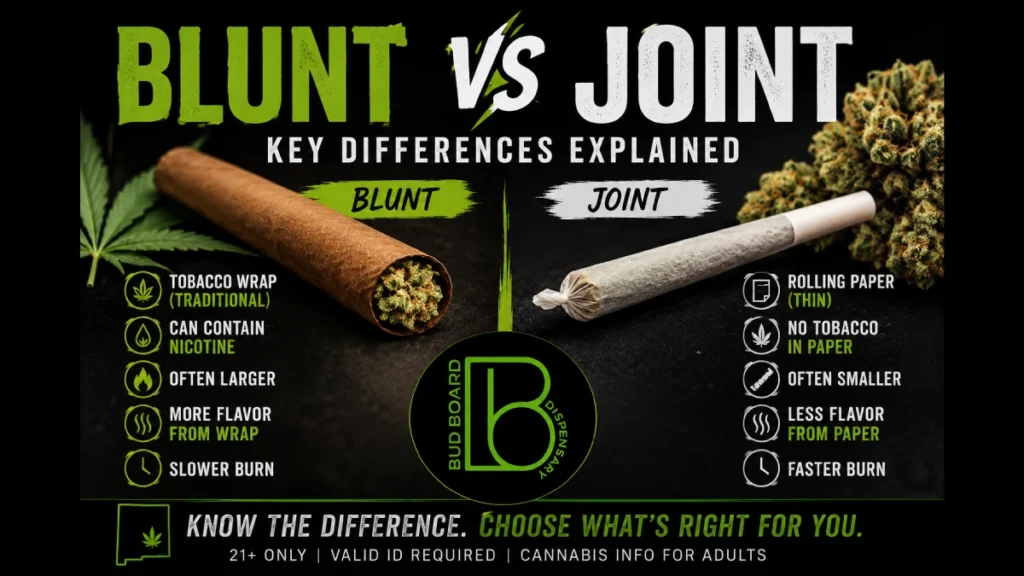
The useful answer is simple: joints are usually cannabis in thin rolling paper, while traditional blunts use a tobacco-based cigar or blunt wrap. That wrap can change the flavor, size, burn, and nicotine exposure.
There is one catch worth knowing early: tobacco-free blunt wraps are now common enough that “blunt” does not always mean tobacco. Check the wrap, not just the name.
Blunt vs Joint at a Glance
| What to compare | Joint | Blunt |
|---|---|---|
| What it contains | Usually cannabis flower | Usually cannabis flower |
| Wrap | Thin rolling paper | Traditionally a cigar shell or tobacco-based blunt wrap; tobacco-free alternatives also exist |
| Tobacco | Normally not part of the wrap | Traditional wraps contain tobacco; modern blunt-style wraps may not |
| Nicotine | Rolling paper itself normally does not supply nicotine | Traditional tobacco-derived wraps can contain nicotine |
| Typical size | Often smaller, but size varies | Often larger, but there is no universal size |
| Flavor influence | Paper usually contributes less flavor | The wrap can add a noticeable flavor or aroma |
| Burn characteristics | Depends on paper, moisture, airflow, size, and how it was rolled | The thicker wrap and larger size can change the burn, but results vary |
| Pre-rolled availability | Very common as dispensary pre-rolls | Pre-made blunt-style products also exist, depending on the market |
What Is the Main Difference Between a Blunt and a Joint?
The wrap is the key difference. A joint is generally cannabis rolled in paper. A traditional blunt is cannabis wrapped in tobacco leaf, a cigar shell, or another tobacco-based blunt wrap.
That sounds almost too simple, but the wrap changes several things at once. It can affect flavor, nicotine exposure, size, thickness, and the way the finished product burns.
The part people miss: modern hemp, palm, banana-leaf, and other tobacco-free blunt-style wraps have blurred the old definition. Research on blunt terminology has specifically warned that assuming every modern blunt contains tobacco can be inaccurate.
What Is a Joint?
A joint is cannabis flower rolled in a thin paper designed for smoking. Papers can be made from materials such as hemp, rice, or other plant fibers, and both the paper and finished joint can vary considerably in size.
Many dispensary flower pre-rolls are essentially ready-made joints. Some include a paper filter or crutch at one end, while others do not.
The important distinction is what is inside. A standard joint is generally flower in paper. Once concentrates or other cannabis materials are added, retailers may describe it as an infused pre-roll instead.
What Is a Blunt?
A traditional blunt is cannabis placed inside a cigar shell or tobacco-based wrap after some or all of the loose cigar tobacco has been removed.
That history is why blunts are closely linked with tobacco and nicotine. CDC describes cigars as tobacco wrapped in leaf tobacco or another tobacco-containing material, and cigars contain nicotine.
But language has moved faster than the dictionary.
Today, products sold as blunt wraps can also be made from hemp and other non-tobacco plant materials. Two people can both say “blunt” while talking about wraps with very different ingredients.
If avoiding tobacco or nicotine matters to you, the front of the package is not enough. Read what the wrap is actually made from.
Blunt vs Joint: The Key Differences
1. The Wrap
A joint uses thin rolling paper. A traditional blunt uses the outer tobacco portion of a cigar or a tobacco-based wrap.
That is the cleanest blunt and joint difference, but even this one now needs an asterisk because tobacco-free blunt-style wraps exist.
The practical rule is easy: paper usually points toward a joint; a thicker cigar-style wrap points toward a blunt-style product. Then check the material.
2. Tobacco and Nicotine
Traditional tobacco blunt wraps can expose the user to nicotine even when the loose tobacco inside the cigar has been removed.
CDC notes that cigars contain nicotine and that cigar smoke contains harmful chemicals. Peer-reviewed research has also documented nicotine exposure from cannabis smoked in tobacco-derived cigar shells.
This is not a minor wording issue. Someone may think they are consuming only cannabis because the filling is cannabis, while the wrap itself is still tobacco.
Tobacco-free blunt-style wraps change that equation, but check the ingredient list rather than assuming a product is nicotine-free from appearance alone.
3. Size and Amount of Cannabis
Blunts are often larger than joints, but there is no official blunt ruler hiding behind the dispensary counter.
A small blunt can contain less cannabis than a large joint. Hand-rolled products vary. Pre-rolled products vary. Different brands use different formats.
Because of that, the word “blunt” does not tell you how much cannabis is inside or how potent the product is. Check the package weight and cannabinoid label instead.
4. Flavor and Aroma
Thin rolling papers tend to stay more in the background, allowing the flower’s aroma to play the larger role.
A traditional blunt wrap contributes more of its own character. Tobacco leaf, flavored cigar shells, and flavored blunt wraps can all change what you smell and taste.
Neither is objectively better. One person may want as little wrap flavor as possible. Another may specifically like the flavor a blunt-style wrap adds.
If you are trying to understand why different flower smells the way it does, Bud Board’s cannabinoids and terpenes guide covers the aromatic side in more detail.
5. Burn Characteristics
Blunts and joints can burn differently, but exact burn-time promises are mostly noise.
The thickness of the wrap matters. So do moisture, airflow, grind, packing, size, storage, and how evenly the product was rolled.
A thicker traditional blunt wrap and larger format may burn differently from thin joint paper, but “blunts always burn for X minutes longer” is not a useful rule.
Real products are messier than internet charts. Shocking, we know.
6. Preparation and Convenience
Both joints and blunt-style products can be hand-rolled or purchased pre-made where permitted.
For many dispensary customers, convenience is the bigger difference. A pre-roll skips the paper, grinder, and small engineering project taking place on the coffee table.
We are keeping this article focused on the difference between the products, not turning it into a rolling tutorial.
7. Tobacco-Free Blunt Wraps
This is where the traditional definition gets fuzzy.
A 2023 peer-reviewed study examining blunt terminology specifically found that tobacco-free blunt wraps can be made from materials such as hemp and other plant leaves. The researchers warned that automatically classifying all blunt use as cannabis plus tobacco can be inaccurate.
The Better Question
Instead of asking only, “Is this a blunt?” ask “What is the wrap made from?”
That tells you far more about possible tobacco or nicotine exposure than the slang term on its own.
Joint vs Blunt vs Spliff: What’s the Difference?
A joint is generally cannabis in rolling paper. A traditional blunt is cannabis in a cigar or tobacco-style wrap. A spliff usually contains cannabis mixed with tobacco inside rolling paper.
| Product | Typical filling | Typical wrap |
|---|---|---|
| Joint | Cannabis | Rolling paper |
| Traditional blunt | Cannabis | Cigar shell or tobacco-based wrap |
| Spliff | Cannabis mixed with tobacco | Rolling paper |
Terminology can vary by region and community, especially around the word “blunt.” When tobacco matters to the decision, ingredients beat slang every time.
Is a Pre-Roll the Same as a Joint?
Many dispensary pre-rolls are ready-made joints, but “pre-roll” is a broader retail term.
A standard flower pre-roll is usually cannabis flower packed into rolling paper before sale. In that sense, yes, it functions as a pre-made joint.
But the pre-roll category can also include infused products and other formats. That is why the package may say more than simply “pre-roll.”
What About Infused Pre-Rolls?
An infused pre-roll combines cannabis flower with additional cannabis concentrate or another cannabis-derived ingredient.
That could involve kief, hash, rosin, resin, distillate, or another concentrate depending on the product. Because formulations differ, check the label instead of assuming every infused pre-roll is built the same way.
We already have a full guide for that topic, so we will spare you the sequel inside the sequel. See Bud Board’s guide to infused pre-rolls for the deeper comparison.
Which Is Better: A Blunt or a Joint?
Neither is universally better. The better fit depends on what you actually care about.
If you want to avoid tobacco or nicotine, a standard paper joint or a verified tobacco-free blunt-style wrap may better match that preference. If wrap flavor matters, traditional blunt and joint papers create different experiences.
Size and convenience matter too. So does the flower itself.
In fact, the cannabis inside usually tells you more about the product than the shape around it. Freshness, cure, aroma, cannabinoid content, storage, and product quality still count.
If you are comparing flower rather than wraps, Bud Board’s guide to spotting quality cannabis flower is the better rabbit hole.
Quick shopping rule: Do not choose based on “joint” or “blunt” alone. Check the flower, product weight, cannabinoid label, wrap material, and whether the wrap contains tobacco.
Key Takeaways
- A joint usually contains cannabis flower rolled in thin rolling paper.
- A traditional blunt uses a cigar shell or tobacco-based blunt wrap.
- Traditional tobacco-derived blunt wraps can contain nicotine.
- Tobacco-free blunt-style wraps also exist, so not every modern blunt contains tobacco.
- Blunts are often larger than joints, but size and cannabis amount vary.
- Wrap material can influence flavor and burn characteristics.
- A product’s label and ingredients are more reliable than slang when tobacco, nicotine, or potency matters.
Blunt vs Joint FAQ
Do blunts have tobacco in them?
Traditional blunts involve tobacco even when the filling is cannabis. The loose cigar tobacco may be removed, but the cigar shell or traditional blunt wrap itself is made from tobacco. Modern tobacco-free blunt-style wraps also exist, so check the wrap material instead of assuming every blunt contains tobacco.
Do blunts contain nicotine?
Traditional tobacco-derived cigar and blunt wraps can contain nicotine. CDC states that cigars contain nicotine, and research has documented nicotine exposure from cannabis smoked in tobacco cigar shells. Tobacco-free blunt wraps may differ, so read the package and ingredient information.
Is a blunt stronger than a joint?
Not automatically. The words “blunt” and “joint” describe format, not a guaranteed potency level. Effects depend on the cannabis, cannabinoid content, amount consumed, individual response, and other factors. A larger product may contain more cannabis, but the format name alone does not establish strength.
Are joints and pre-rolls the same thing?
Many standard dispensary pre-rolls are essentially ready-made joints: cannabis flower already packed into rolling paper. “Pre-roll” is a broader retail category, however, and can also include infused or specialty products.
What is the difference between a blunt, joint and spliff?
A joint is typically cannabis in rolling paper. A traditional blunt is cannabis in a cigar shell or tobacco-based wrap. A spliff generally mixes cannabis and tobacco together inside rolling paper. Regional terminology can vary.
Which lasts longer, a blunt or a joint?
There is no reliable universal burn time. Blunts are often larger and traditional blunt wraps are thicker than joint papers, which can change how they burn. Actual burn depends on size, moisture, packing, airflow, wrap material, and how the product was rolled.
Can a blunt be tobacco-free?
Yes. Modern blunt-style wraps can be made from hemp and other non-tobacco plant materials. Because the term “blunt” is now used for both tobacco and tobacco-free products, check the package if avoiding tobacco or nicotine is important to you.
Shopping for Flower or Pre-Rolls in New Mexico?
Bud Board has locations in Carlsbad and Hobbs where adults 21+ with valid identification can browse current menus and compare flower, standard pre-rolls, infused products, and label information.
Inventory changes, so check the current Bud Board locations and menus before making a special trip.
Sources and References
One Word Should Not Make the Decision for You
“Joint” and “blunt” describe useful differences, but the label finishes the story. Look at the wrap material, cannabis weight, cannabinoid information, ingredients, and product format before deciding what fits your preferences.
Adults 21+ can find a Bud Board location in Carlsbad or Hobbs and check current menus before visiting.