
Last Updated: August 31, 2026. Product formulations, testing rules, laws, and store inventory can change. This article is educational and is not medical or legal advice.
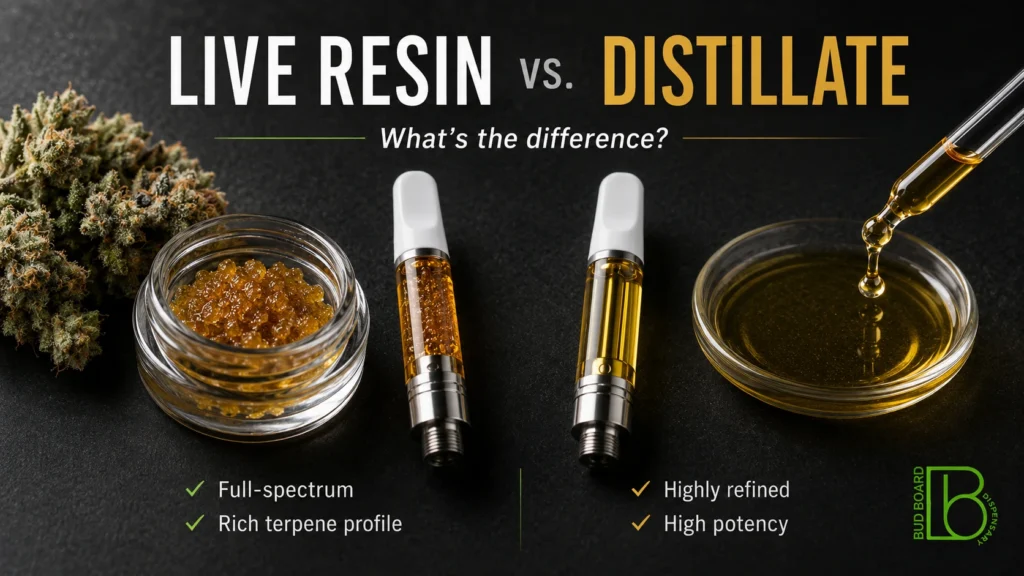
Live resin vs distillate sounds like a matchup between two science-fiction characters, but the real difference is much less dramatic: live resin tries to carry more of the original plant profile forward, while distillate focuses on refining cannabinoids into a highly purified oil.
That difference affects how the products are made, what can appear on the label, how they may be formulated in carts, and what shoppers should compare before buying. It does not create an automatic winner.
Live Resin vs Distillate: Quick Comparison
| What to compare | Live resin | Distillate |
|---|---|---|
| Typical starting material | Usually fresh-frozen cannabis | Cannabis extract that is further refined; starting material and earlier extraction steps can vary |
| General processing approach | Extraction designed to capture cannabinoids while retaining more volatile plant compounds | Additional purification and distillation to concentrate cannabinoids |
| Degree of refinement | Generally less refined than distillate | Highly refined |
| Cannabinoid profile | Varies by source material, batch, and process | Often centered on a highly purified cannabinoid fraction; formulation varies |
| Terpene or aromatic profile | Production commonly aims to retain more plant-derived volatile compounds | Refinement can remove volatile compounds; some products add terpenes back afterward |
| Common formats | Badder, sugar, sauce, other concentrates, and compatible cartridges | Cartridges, disposables, edibles, and infused products |
| Vape cartridge availability | Common | Common |
| Appearance and consistency | Can vary widely by product type | Often a thick, refined oil before final formulation |
| Potency | Can be high; check the tested batch | Can be highly concentrated; check the tested batch |
| Flavor and aroma | May reflect more of the starting material’s aromatic profile | Depends heavily on final formulation and whether terpenes were added |
| Storage considerations | Heat, light, oxygen, age, and storage can affect aromatic compounds and consistency | Heat, light, age, hardware, and formulation can affect the finished product |
| Price tendencies | Varies by producer, batch, process, market, and package size | Varies by producer, formulation, market, and package size |
| Automatically better? | No | No |
What Is Live Resin?
Live resin is a cannabis extract that typically begins with fresh-frozen plant material rather than fully dried and cured flower. In the commercial cannabis market, the production goal is usually to capture cannabinoids while retaining more of the volatile aromatic compounds associated with the original material.
Live resin can appear as badder, sugar, sauce, other concentrate textures, or as an ingredient in compatible vape cartridges. The name alone does not tell you the exact cannabinoid or terpene content. Those numbers can vary with the plant material, extraction process, storage, age, and final formulation.
For the bigger picture on concentrate categories, use Bud Board’s Cannabis Concentrates Explained guide.
What Is Cannabis Distillate?
Cannabis distillate is a highly refined cannabinoid oil produced by further purifying an extracted cannabis oil. Technical literature describes molecular or short-path distillation as a post-extraction refinement method used to separate and concentrate cannabinoid fractions.
That extra refinement is why distillate is often used when manufacturers want a concentrated cannabinoid base for cartridges, edibles, and other infused products. Volatile compounds can be reduced during refinement, so some finished distillate formulations add terpenes or other permitted ingredients afterward.
That does not make distillate “fake,” synthetic, low quality, or automatically inferior. It simply describes a different processing and formulation approach.
How Are Live Resin and Distillate Made Differently?
The biggest difference is what the processor is trying to preserve or separate. Live resin production generally starts with fresh-frozen cannabis and uses an extraction process intended to carry a broader portion of the plant’s volatile profile into the extract. Distillate goes further in the opposite direction by refining an extract to separate and concentrate cannabinoids.
Scientific reviews of cannabis processing show why this matters. Extraction method, temperature, pressure, solvent choice, drying, and purification can all change the chemical profile of a final extract. Distillation adds another separation step, which can produce a much more purified cannabinoid fraction.
In Plain English
Live resin asks: How much of the starting plant’s aromatic character can we keep?
Distillate asks: How cleanly can we separate and concentrate the cannabinoid fraction we want?
Those are general commercial concepts, not home-extraction instructions. Solvent-based cannabis manufacturing can involve flammable materials and specialized equipment and should be left to licensed, regulated manufacturers.
Live Resin vs Distillate Carts: What Changes in a Vape Cartridge?
A live resin cart and a distillate cart can use similar-looking hardware while containing very different oil formulations. The cartridge body does not tell you what is inside, so the package and tested label matter more than the appearance of the device.
A live resin cartridge may be formulated around an extract intended to retain more plant-derived aromatic compounds. A distillate cartridge generally uses a more refined cannabinoid oil and may include terpenes or other ingredients added during formulation.
When comparing live resin vs distillate carts, check:
- Product identity and extract type
- THC, THCA, CBD, and other reported cannabinoid information
- Terpene information when it is actually tested and provided
- Ingredient list
- Manufacturer and batch information
- Testing and traceability information
- Device or hardware instructions
- Storage directions and package date
Do not assume one cartridge type is universally safer than the other. In New Mexico, regulated cannabis products are subject to state testing requirements, and volatile-solvent concentrates are among the categories subject to residual-solvent testing. Buying from a licensed retailer gives you a regulated product pathway that an unregulated cartridge does not provide.
For batteries, cartridges, disposables, and broader device basics, read Bud Board’s weed vape guide.
Does Live Resin Have More Terpenes Than Distillate?
Live resin production typically aims to retain more volatile aromatic compounds from fresh-frozen cannabis, but the product name does not guarantee a specific terpene level.
Actual terpene content can vary because starting material, extraction conditions, formulation, storage temperature, oxygen exposure, age, and packaging all matter. Distillate formulations can also contain terpenes added after refinement.
That means “live resin” should not be treated as shorthand for “this product definitely has more terpenes than that distillate.” Check the actual batch information when terpene data is available.
If you want a clearer explanation of what terpenes are and what a terpene percentage can and cannot tell you, use Bud Board’s guide to cannabinoids and terpenes.
Is Distillate Stronger Than Live Resin?
Not automatically. Distillate can contain a very concentrated cannabinoid fraction, but live resin products can also test at high THC levels. The only reliable way to compare potency is to compare the tested products or batches in front of you.
This is where marketing shorthand gets people into trouble. “Distillate” describes a refinement approach. “Live resin” describes a different style of starting material and extraction goal. Neither term is a universal potency number.
THC percentage also is not an overall quality score. Higher concentration does not automatically mean better flavor, better storage, better manufacturing, or a better fit for every shopper.
Live Resin vs Distillate: Flavor and Aroma
Live resin may preserve a broader aromatic profile from the starting cannabis, while distillate’s greater refinement can remove more volatile compounds before the final product is formulated.
That distinction helps explain why the two categories are often marketed differently, but it still does not justify saying every live resin tastes better than every distillate.
A final distillate product may contain added terpenes. A live resin can lose aromatic compounds through age or poor storage. Different batches can begin with different plant chemistry. Your best comparison is the tested label plus the actual manufacturer and formulation information.
Live Resin vs Distillate: Which One Is Better?
Neither is universally better. They are different tools for different product designs.
A shopper interested in a product that stays closer to the aromatic profile of fresh-frozen starting material may pay more attention to live resin. Someone comparing a highly refined cannabinoid formulation may be looking at distillate. Neither preference proves one category is higher quality across the board.
Compare what actually matters for the specific product:
- Processing approach
- Cannabinoid information
- Terpene information when available
- Ingredients and formulation
- Product format
- Cartridge or device compatibility
- Manufacturer
- Batch and testing information
- Freshness and storage
- Your own preferences
How to Compare Live Resin and Distillate at a Dispensary
The package is more useful than the product nickname. New Mexico finished-product labels are required to carry tested potency and other information, while additional required details can appear on an information panel or an allowed static QR code.
Before choosing between live resin and distillate, look for:
- Product type: Confirm whether you are comparing a cartridge, concentrate, edible, or another format.
- Potency: Read the unit and the tested THC, THCA, CBD, or other listed cannabinoids.
- Terpenes: Use terpene data when it is actually tested and reported, not because the front label uses a strain name.
- Ingredients: Check what else is in the finished formulation.
- Processing information: New Mexico labeling rules require applicable solvents, processing aids, and chemicals used in manufacturing to be identified in required label information.
- Dates: Check manufacture, package, or expiration information where provided or required.
- Traceability: Look for the manufacturer and the state tracking information.
- Cartridge instructions: Follow the manufacturer’s device and storage directions.
Bud Board’s New Mexico cannabis label guide walks through the package field by field.
Live Resin vs Distillate vs Rosin
Live resin, distillate, and rosin describe three different processing ideas.
- Live resin: typically starts with fresh-frozen cannabis and generally uses solvent-based extraction.
- Distillate: a highly refined cannabinoid oil produced through additional purification and distillation.
- Rosin: a solventless concentrate made using heat and pressure rather than an extraction solvent.
That is all the rosin detour we need here. For the deeper comparison, use Bud Board’s live resin vs rosin guide.
Responsible Cannabis Shopping in New Mexico
Adult-use cannabis in New Mexico is for adults 21 and older after age and identity are verified with valid identification. Licensed retailers may only sell regulated cannabis products that have completed the testing required for their product category.
New Mexico’s rules require testing of cannabis concentrates and extracts before retail sale when applicable, and volatile-solvent concentrates are subject to residual-solvent testing. Finished-product labels also include tested potency and required manufacturing or traceability information.
Keep the basics boring, because boring is good here: do not drive while impaired, do not take cannabis across state lines, and keep cannabis secured away from children and pets.
New Mexico RLD states that cannabis bought in New Mexico should stay in New Mexico because crossing state lines with cannabis remains federally illegal. The state also advises purchasing from licensed retailers and storing cannabis out of reach of children and pets.
Looking for Live Resin or Distillate in Carlsbad or Hobbs?
Product availability changes, so the useful answer is the current menu, not a promise written into a blog post months ago.
Adults 21+ can check Bud Board’s locations page for current menus and store details in Carlsbad and Hobbs. Individual location pages include Pierce Street, Canyon Street, National Parks Highway, and Marland Boulevard in Hobbs.
If you are comparing two products, bring the labels into the conversation. A real batch number beats a broad category assumption every time.
Key Takeaways
- Live resin and distillate are different cannabis extract categories with different processing goals.
- Live resin typically starts with fresh-frozen cannabis and aims to retain more volatile plant compounds.
- Distillate is a highly refined cannabinoid oil produced through additional purification.
- Neither product is automatically stronger, safer, cleaner, healthier, or better.
- Live resin carts and distillate carts can look similar, so read the package rather than judging the hardware.
- Terpene content, potency, ingredients, freshness, and formulation can vary by product and batch.
- Some distillate products add terpenes after refinement.
- New Mexico regulated cannabis products are subject to product-specific testing and labeling requirements.
- Product-specific tested information is more useful than assumptions based on names like “live resin” or “distillate.”
Live Resin vs Distillate FAQ
What is the main difference between live resin and distillate?
Live resin typically starts with fresh-frozen cannabis and is produced with the goal of retaining more of the original plant’s volatile aromatic compounds. Distillate is an extract that goes through additional purification and distillation to create a highly refined cannabinoid oil.
Is live resin stronger than distillate?
Not necessarily. Live resin can contain high levels of THC, but potency varies by product and batch. Compare the tested cannabinoid information instead of assuming “live resin” automatically means stronger.
Is distillate stronger than live resin?
Distillate can be highly concentrated, but that does not mean every distillate is stronger than every live resin. Actual THC and other cannabinoid levels vary, so use the tested label for the product you are considering.
Are live resin carts better than distillate carts?
Neither cartridge type is universally better. Compare the formulation, tested cannabinoids, terpene information, ingredients, manufacturer, storage, freshness, and hardware instructions. A category name cannot tell you all of that.
Does live resin have more terpenes than distillate?
Live resin production generally aims to retain more volatile compounds from fresh-frozen cannabis, but actual terpene content varies. Distillate formulations may also have terpenes added after refinement. Check product-specific terpene information when available.
Does distillate contain terpenes?
It can. Distillation and refinement can remove volatile compounds, but some finished distillate products are formulated with terpenes afterward. Read the ingredient and product information rather than assuming all distillate formulations are the same.
Is live resin the same as rosin?
No. Live resin generally uses solvent-based extraction and often starts with fresh-frozen cannabis. Rosin is produced without an extraction solvent by using heat and pressure. Bud Board’s live resin vs rosin guide covers that comparison in detail.
Which is better for beginners, live resin or distillate?
There is no universal beginner winner. Start by understanding the product format, tested potency, serving or device instructions, ingredients, and label. The product-specific information matters more than whether the package says live resin or distillate.
How can you tell if a vape cartridge contains live resin or distillate?
Read the package and ingredient information. A cartridge’s appearance does not reliably identify its oil. In New Mexico, use the required product identity, manufacturer information, ingredients, potency, and other label details to understand what you are buying.
Where can adults find live resin or distillate products in Carlsbad or Hobbs?
Adults 21+ can check Bud Board’s current Carlsbad and Hobbs menus through the locations page. Inventory changes, so confirm the live menu rather than assuming a specific live resin or distillate product is currently available.
Research and Official Sources
- Processing and Extraction Methods of Medicinal Cannabis: A Narrative Review
- Cannabis Extraction Technologies: Impact of Research and Value Addition
- Aerosol Gas-Phase Components from Cannabis E-Cigarettes and Dabbing
- Process Development for GMP-Grade Full Extract Cannabis Oil
- New Mexico 16.8.7 NMAC: Quality Control, Inspection, and Testing
- New Mexico 16.8.3 NMAC: Packaging and Labeling Requirements
- New Mexico Cannabis Control Division FAQs
- New Mexico RLD: Safe Storage of Cannabis
Compare the Product, Not Just the Category
Live resin and distillate tell you something useful about how a cannabis product was made, but they do not tell you everything. Read the tested label, check the ingredients and formulation, and compare the actual batch before deciding what fits your preferences.
Adults 21+ can find a Bud Board location in Carlsbad or Hobbs and check the current menu before visiting.