
Last Updated: September 2026. Cannabis research, testing, labels, and product formulations can change. This guide is educational and does not make medical or therapeutic claims.
Terpene charts have a bad habit of turning into tiny chemistry textbooks. That is not especially helpful when you are just trying to figure out why one flower smells like lemons and another smells like a pine cabinet that got into a pepper fight.
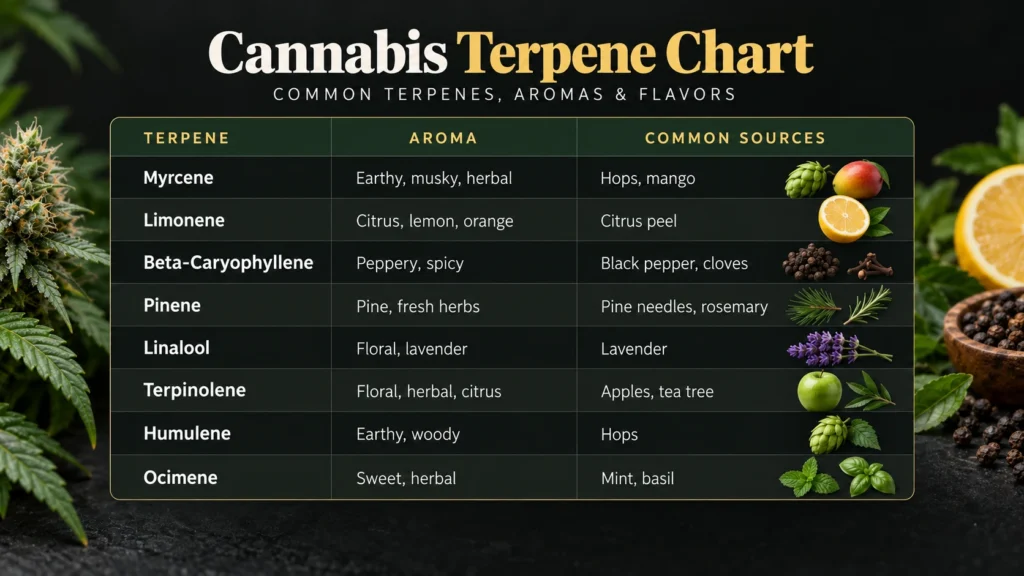
So the chart comes first. Use it to connect common terpene names with their typical aromas and familiar plant sources. The “associations” column needs more caution. Those descriptions are common in cannabis retail, but they are not reliable predictions of a specific effect.
Cannabis Terpene Chart
| Terpene | Common aroma | Also found in | Commonly described association |
|---|---|---|---|
| Myrcene | Earthy, musky, herbal, mildly fruity | Hops, lemongrass, bay | Often marketed or described as relaxing |
| Limonene | Lemon, orange, bright citrus | Citrus peel and citrus oils | Often described as bright or uplifting |
| β-Caryophyllene | Peppery, spicy, woody | Black pepper, cloves, hops | Usually associated with warm, spicy profiles |
| Pinene | Pine, resinous, fresh herbs | Rosemary, basil, conifers | Often described as fresh or alert |
| Linalool | Floral, lavender, lightly spicy | Lavender, coriander, bay | Often described as calming |
| Terpinolene | Floral, herbal, citrusy | Tea tree and other aromatic plants | Often described as lively or complex |
| Humulene | Earthy, woody, hoppy | Hops and aromatic herbs | Known mainly for an earthy, herbal aroma profile |
| Ocimene | Sweet, herbal, woody, lightly fruity | Basil, mint, parsley | Bright, sweet aromatic character |
| Bisabolol | Soft floral, sweet | Chamomile and other aromatic plants | Soft floral aroma rather than a reliable effect prediction |
| Nerolidol | Woody, floral, lightly citrusy | Several fragrant plants used in food and perfumery | Woody and floral aromatic profile |
About the “effects” language: the aroma chemistry is measurable. The personal outcome is not nearly as simple. A terpene can be commonly marketed as “calming” or “uplifting” without that label being a clinical promise or a dependable prediction for a particular person.
What Are Cannabis Terpenes?
Terpenes are volatile compounds that help give cannabis its aroma. They are also common throughout the plant world. Citrus peel, hops, lavender, rosemary, black pepper, and basil all contain terpenes that also show up in cannabis.
They are important, but they do not deserve all the credit. Recent aroma research has found that smaller non-terpene compounds can also help create some of the sweet, savory, sulfur-like, or unusual smells found in cannabis. In other words, a terpene panel is useful, but it is not the entire scent recipe.
That is where a lot of online charts get too confident. Myrcene is not a “sleep switch.” Limonene is not bottled happiness. Pinene does not turn a flower jar into a focus button. Those shortcuts sound tidy. Biology rarely is.
Myrcene
Earthy, Musky, Herbal
Myrcene often sits near the top of cannabis terpene panels. Its aroma can lean earthy, musky, herbal, or mildly fruity, depending on what else is present.
You will often see myrcene paired with the word “relaxing.” That is a common retail association, not a dependable effect forecast. The flower still contains cannabinoids, other terpenes, and many smaller compounds. The person using it brings another set of variables.
Limonene
Citrus, Lemon, Orange
Crack a lemon peel and you already know the general idea. Limonene is strongly associated with bright citrus aroma and is common in the oils of lemons, oranges, and other citrus fruits.
In cannabis, it can help push an aroma toward lemon or orange. The phrase “uplifting” often appears beside it on menus and terpene guides. Treat that as descriptive shorthand, not a result you can calculate from a percentage.
Beta-Caryophyllene
Peppery, Spicy, Woody
If a flower has a dry peppery edge, beta-caryophyllene is one possible reason. The terpene is also found in black pepper, cloves, and hops, which makes its spicy reputation easy to understand.
Caryophyllene gets extra attention because researchers have studied its activity at CB2 receptors. Interesting chemistry, yes. A medical promise printed on a terpene chart, no. For shoppers, its clearest use is still sensory: pepper, spice, wood, and warmth.
Pinene
Pine, Resin, Fresh Herbs
Pinene is the easy one to remember. Pine needles, resin, rosemary, and some fresh herbs all live in the same general aroma neighborhood.
One detail is worth catching: alpha-pinene and beta-pinene are different compounds. A detailed lab panel may list them separately. Cannabis marketing sometimes connects pinene with “alert” or “clear” effects, but human evidence is not strong enough to turn that into a reliable shopping rule.
Linalool
Floral, Lavender, Lightly Spicy
Linalool brings the floral side of the chart. Lavender is the comparison most people know, though the aroma can also carry light spice and herbal notes.
“Calming” is almost glued to linalool in cannabis marketing. That does not mean a linalool number can tell you exactly how a product will feel. Think of it first as an aroma clue. That is the claim the chemistry supports most cleanly.
Terpinolene
Floral, Herbal, Citrus
Terpinolene refuses to pick one lane. It can smell floral, herbal, citrusy, or slightly woody, which is why terpene-rich products containing it can come across as layered instead of obvious.
Retail descriptions sometimes call terpinolene “lively” or “energetic.” Keep those words in the association column. They are not clinical outcomes hiding in a lab report.
Humulene
Earthy, Woody, Hoppy
Humulene shares a strong connection with hops, and its aroma fits: dry, earthy, woody, and herbal. If a cannabis flower smells more like a hoppy beer ingredient than a fruit stand, humulene may be part of the mix.
This is also a good place to ignore internet folklore. A humulene percentage does not reliably predict appetite, mood, or a medical effect. Aroma is the safer and more useful takeaway.
Ocimene
Sweet, Herbal, Woody
Ocimene can bring sweet, herbal, woody, and lightly fruity notes. It also appears in familiar kitchen herbs such as basil, mint, and parsley.
It may show up below the top terpene on a lab panel and still matter to aroma. Smell is not a simple “highest percentage wins” contest. Some compounds can have a noticeable sensory impact even when they are not the biggest number on the page.
Bisabolol and Nerolidol: Two Less-Famous Names
Bisabolol is associated with soft floral notes and is well known from chamomile chemistry. Nerolidol leans woody and floral and occurs in several fragrant plants used in food and perfumery.
They usually get less attention than myrcene, limonene, or caryophyllene. That is fine. A terpene profile is a blend, not a popularity contest.
How to Read a Cannabis Terpene Profile
The fastest useful approach is to start with the batch in front of you, not the strain name from memory. Genetics matter, but so do cultivation, harvest timing, drying, storage, processing, and product format.
A 30-second terpene check:
- Find the top two or three reported terpenes.
- Match those names to aroma families such as citrus, floral, pine, pepper, herbal, or earthy.
- Look at the units. Percentages and milligrams per gram are not interchangeable.
- Confirm that the numbers belong to the current batch.
- Use effect words as context, not as a promise.
That gives you something concrete to compare without pretending a terpene panel can predict the rest of your evening.
Do Terpenes Determine How Cannabis Feels?
No single terpene reliably predicts how a cannabis product will affect a person. Researchers continue to study how cannabis compounds may interact, but the popular version of the “entourage effect” is much more settled in marketing copy than it is in human evidence.
Laboratory and animal studies can suggest interesting biological activity. They do not automatically prove that myrcene means “relaxed,” pinene means “focused,” or limonene means “happy” in people using a finished cannabis product.
THC, CBD and other cannabinoids matter. So do dose, route of use, tolerance, product format, expectations, and individual biology. That is a lot of moving parts for one terpene to boss around.
Use the Chart Like a Map, Not a Horoscope
Aroma chemistry gives you useful clues. It does not give you a fortune cookie for your nervous system. Start with smell and flavor. Be much more cautious with claims about mood, energy, sleep, or medical outcomes.
Terpenes vs Cannabinoids: What’s the Difference?
Terpenes and cannabinoids are different chemical families. Terpenes are best known for aroma. Cannabinoids include THC, CBD, CBG, and related compounds.
THC is the primary intoxicating cannabinoid in cannabis. Terpenes are not weaker forms of THC, and a terpene percentage does not replace cannabinoid information on the label.
For the broader chemistry, see Bud Board’s Cannabinoids and Terpenes Guide. That page stays focused on how both groups fit together, while this one is built around the terpene chart itself.
Do Sativa and Indica Tell You the Terpene Profile?
Not reliably. Sativa, indica, and hybrid can be useful retail categories, but they are not complete chemical descriptions.
Two products labeled “sativa” can have different dominant terpenes. Two products sold under different categories can overlap chemically. The name gives you context. The current lab data gives you evidence.
Bud Board’s Sativa vs Indica vs Hybrid guide goes deeper into where those labels help and where they start getting fuzzy.
How Do Terpenes Show Up on Cannabis Labels?
A terpene percentage is useful when it has actually been tested and reported for that product or batch. New Mexico requires core finished-product information such as product identity, quantity, potency, warnings, manufacturer details, expiration information, and traceability. A detailed terpene panel is not a universal statewide label requirement.
So if one package lists ten terpenes and another does not, the second product did not suddenly lose all its aroma compounds. The information may simply not be presented on the retail label.
Our New Mexico cannabis label guide explains the required fields and helps separate tested information from marketing language.
Key Takeaways
- Terpenes help shape cannabis aroma and flavor, but they are not the only aroma compounds involved.
- Myrcene, limonene, beta-caryophyllene, pinene, linalool, terpinolene, humulene, and ocimene are common names to know.
- “Uplifting,” “calming,” and “relaxing” are common associations, not guaranteed outcomes.
- A current batch test is more useful than assuming a strain name always has the same terpene profile.
- Sativa, indica, and hybrid labels do not tell you the full chemistry.
- Terpenes and cannabinoids are different chemical families.
- New Mexico does not require every finished cannabis package to display a full terpene panel.
Cannabis Terpene Chart FAQ
What is the strongest terpene?
There is no single scientifically recognized “strongest terpene.” Strongest could mean highest concentration, strongest odor at a low concentration, or greatest biological activity. Those are different measurements. For shopping, the tested terpene profile is more useful than looking for one universal winner.
What are the most common cannabis terpenes?
Myrcene, limonene, pinene, beta-caryophyllene, and humulene frequently appear in cannabis research samples. Terpinolene, linalool, ocimene, and many others can also be present. The dominant profile changes with genetics, cultivation, processing, storage, and batch.
Which terpene smells like citrus?
Limonene is the classic citrus-associated terpene and is abundant in citrus peels and oils. Other compounds can contribute citrus notes too, so a lemon-smelling flower does not necessarily contain only limonene.
Which terpene smells like pine?
Pinene is the terpene most closely associated with pine and resin-like aromas. Alpha-pinene and beta-pinene are separate compounds and may appear as separate entries on a detailed laboratory report.
What is the difference between terpenes and cannabinoids?
Terpenes are volatile compounds known mainly for aroma and flavor. Cannabinoids are a different chemical family that includes THC, CBD, and CBG. THC is the primary intoxicating cannabinoid. Terpenes should not be treated as substitutes for cannabinoid information.
Do terpenes make you high?
Terpenes are not the primary cause of cannabis intoxication. THC is the main intoxicating cannabinoid. Researchers continue to study possible interactions between terpenes and cannabinoids, but current evidence does not support assigning a predictable “high” to one terpene.
Can two strains have similar terpene profiles?
Yes. Different strain names can share several dominant terpenes, and products sold under the same strain name can vary from batch to batch. Current tested chemistry is more useful than relying on the name alone.
Does a higher terpene percentage mean better cannabis?
No. A higher percentage tells you about terpene concentration, not overall product quality. Freshness, cure, storage, cannabinoid profile, contamination testing, product format, and personal preference still matter.
Research and Official Sources
- Exploring Aroma and Flavor Diversity in Cannabis sativa L.: A Review of Scientific Developments and Applications
- The Terroir of Cannabis: Terpene Metabolomics as a Tool to Understand Cannabis sativa Selections
- Minor, Nonterpenoid Volatile Compounds Drive the Aroma Differences of Exotic Cannabis
- Does the “Entourage Effect” in Cannabinoids Exist? A Narrative Scoping Review
- The Entourage Effect in Cannabis Medicinal Products: A Comprehensive Review
- Myrcene: Potential Health Benefits of This Flavouring and Aroma Agent
- New Mexico 16.8.3 NMAC: Cannabis Packaging and Labeling Requirements
Smell First. Read the Label. Skip the Fortune-Telling.
A terpene chart is best at putting names to aromas you already recognize. After that, check the actual batch and product label instead of expecting one terpene to explain the whole experience.
Adults 21+ can find a Bud Board location in Carlsbad or Hobbs and browse current menus before visiting.
Pingback: Weed Trichomes Explained: Clear, Cloudy & Amber Trichomes