
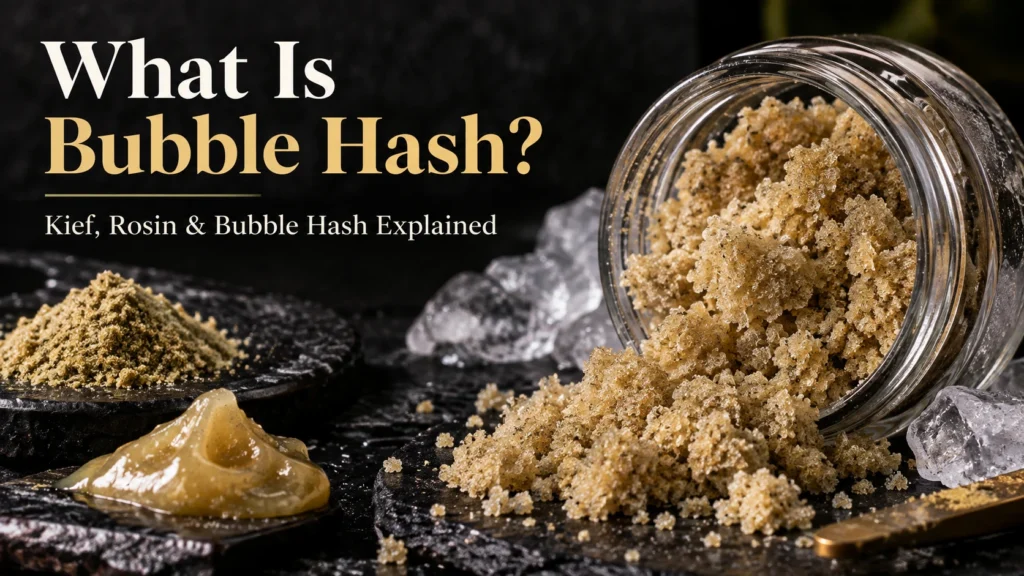
Last Updated: September 2026. Cannabis product terminology, processing methods, testing practices, and retail labels can vary by producer and market. This guide focuses on adult consumer education.
Bubble hash sits in an interesting spot on the concentrate family tree.
It starts with the same tiny resin glands that make cannabis flower look frosty. How producers separate those trichomes, and what they do next, determines whether they become kief, dry sift, bubble hash, or starting material for rosin.
That is also why a dispensary menu can make four related products sound like four completely different species.
This guide sorts out the names, explains what “full melt” and micron labels actually tell you, and shows what shoppers can learn from the package without needing to become a hash maker first.
What Is Bubble Hash?
Bubble hash is a concentrated collection of cannabis trichome heads separated from plant material with ice-cold water and screens. In retail language, bubble hash and ice-water hash usually refer to the same product category.
The important word is trichomes.
Peer-reviewed cannabis research shows that glandular trichomes on female flowers produce and store cannabinoid- and terpene-rich resin. Bubble hash concentrates those resin-bearing structures by physically separating them from the rest of the plant. Research on cannabis glandular trichomes describes the trichome head as a storage site for cannabinoids, terpenes, and other specialized compounds.
If you want the plant anatomy first, start with Bud Board’s Weed Trichomes guide. If you already understand the frost and want to know what happens after it comes off the flower, you are in the right place.
Fast definition: Flower grows the trichomes. Bubble hash separates and collects them.
Why is it called “bubble” hash?
The name comes from the way resin-rich hash can bubble and melt when heated. That reaction became so closely associated with ice-water hash that “bubble hash” stuck as the common name.
Do not read too much into the name, though. A package labeled bubble hash can represent different grades, different trichome fractions, and different starting materials.
How Is Bubble Hash Made?
The production concept is simple enough to understand without turning this into a kitchen tutorial.
1. Cold separates the resin more easily
Producers gently work cannabis material in very cold water so resin-bearing trichomes detach more readily.
2. Movement releases trichomes
Controlled agitation helps the trichome heads separate. The goal is to release resin, not grind the plant into tiny pieces.
3. Screens sort the material
The water and separated material pass through fine mesh filters. Different screen openings collect different size fractions.
4. The collected hash is dried
Producers remove the water from the collected resin before they package it, grade it, or use it as input for another concentrate.
The cannabis industry generally calls this a solventless process because producers physically separate the resin instead of dissolving it in a hydrocarbon, alcohol, or similar extraction solvent. Water is doing transport and separation work here, not serving as the kind of chemical extraction solvent used to make many other concentrates.
That distinction helps explain why bubble hash belongs next to kief and rosin in the solventless side of the concentrate conversation, even though the three products are not interchangeable.
Shopper takeaway: “Solventless” tells you something about the processing method. It does not automatically tell you potency, freshness, cleanliness, melt quality, or whether one product is better than another.
Bubble Hash vs Kief, Dry Sift, Rosin and Live Rosin
This is the part worth saving.
The easiest way to understand the category is to ask two questions: How were the trichomes separated? And was the separated resin processed again afterward?
| Term | What it usually describes | Water used? | Pressed with heat and pressure? | Common shopper clue |
|---|---|---|---|---|
| Kief | Loose trichome-rich material separated from cannabis flower. | Usually no | No | Loose, powdery or sandy material. |
| Dry sift | Trichome-rich material intentionally separated from dry cannabis through screens. | No | Not necessarily | Often more deliberately screened or graded than casual grinder kief. |
| Bubble hash | Trichomes separated with cold water, agitation, and mesh filtration, then dried. | Yes | Not required | May be loose, sandy, granular, soft, or lightly pressed. |
| Rosin | Resin expressed from flower, kief, sift, or hash with heat and pressure. | Depends on the starting material | Yes | Sticky, sap-like, badder-like, jam-like, or other pressed concentrate textures. |
| Live rosin | Rosin commonly pressed from hash made from fresh-frozen cannabis. | Commonly during the hash step | Yes | “Live” points to fresh-frozen starting material, not a different cannabinoid. |
Bubble hash vs kief
Kief is the broader loose trichome-rich material most shoppers know from the bottom chamber of a grinder. Commercial producers can also collect kief with screening equipment.
Bubble hash adds a different separation step: cold water plus mesh filtration. That process can create a more selectively separated resin fraction, but shoppers should still judge the actual batch rather than the category name.
For the full kief breakdown, see What Is Kief?
Bubble hash vs dry sift
Both are mechanical ways of separating resin from plant material.
Dry sift stays dry. Producers work cannabis material across screens that sort trichome-rich particles by size.
Bubble hash uses cold water. The separated resin moves through water before screens sort the collected fractions.
The two methods can produce products that look surprisingly similar in a jar, especially when they are loose and sandy. That is why appearance alone cannot tell you which process was used.
Bubble hash vs rosin
Bubble hash is separated trichome material. To make rosin, producers press suitable cannabis material with heat and pressure to express resinous oil.
That starting material can be flower, kief, dry sift, or hash. When producers press bubble hash into rosin, the result is generally called hash rosin.
One product can therefore become the ingredient for the next. Concentrate terminology enjoys nesting dolls.
What Does “Full Melt” Mean?
Full melt describes how cleanly a hash sample melts when heated. High-melt bubble hash liquefies with very little solid residue left behind. More plant material and non-melting particles usually mean more residue.
Here is the important part for shoppers: full melt is not a THC percentage.
It is also not a government purity grade, a universal laboratory certification, or a guarantee that the product will have the highest cannabinoid number in the case.
Some hash makers use a one-to-six-star scale, with the highest stars associated with cleaner melt behavior. Current industry references describe that system as common but informal. There is no single universal star-rating standard that every producer must apply the same way.
Full melt tells you more about melt behavior than potency
Melt behaviorResin cleanlinessResidue
It does not automatically tell you:
Exact THCTerpene percentageFreshnessSafetyYour preferred experience
That distinction is useful because “six-star” can sound like a complete quality score. In practice, it is mostly shorthand about refinement and melt.
What Do Micron Numbers Mean on Bubble Hash?
You may see numbers such as 45µm, 73µm, 90µm, 120µm, or a range printed on a hash description.
A micron number refers to the size of the openings in the filtration screen used to separate resin fractions. One micron is one-millionth of a meter.
The number is useful processing information. It is not a potency score.
A smaller number does not automatically mean stronger hash, and a larger number does not automatically mean worse hash. Cannabis cultivars can produce trichome heads with different size distributions. A collected fraction can also contain different amounts of intact heads, stalks, plant particles, and broken material.
How to read a micron label without overthinking it
- Micron = screen opening size.
- Micron ≠ THC percentage.
- Micron ≠ automatic quality grade.
- A listed range can tell you which screen fractions the producer combined.
- The tested label and actual condition of the product still matter more to a shopper than chasing one “magic” micron number.
This is one of the easiest places for marketing shorthand to outrun the science. The number has real meaning. It just does not mean everything.
What Does Bubble Hash Look Like?
Bubble hash does not have one mandatory appearance.
Depending on starting material, collected fraction, drying, handling, age, and whether the hash has been pressed, it may look:
- loose and sandy
- fine and granular
- slightly clumped
- soft or greasy
- lightly pressed into a small mass
- blonde, tan, golden, brown, or darker
Lighter color often gets associated with premium solventless hash, but color by itself is a weak shopping shortcut. Genetics, maturity, oxidation, processing, and plant-material content can all influence appearance.
A darker sample is not automatically bad. A pale sample is not automatically full melt.
Texture has the same problem. Loose sand, soft resin, and a pressed puck can all belong to the bubble-hash family.
Better question than “Is the color good?” Ask what the product is, what starting material was used, whether a micron range or melt grade is listed, when it was packaged, how it should be stored, and what the tested label says.
How Bubble Hash Relates to Live Rosin
This relationship causes a lot of concentrate confusion, so here is the clean version:
Fresh-frozen cannabis → ice-water hash → heat and pressure → live rosin.
That is a common live-rosin production path.
Producers freeze freshly harvested cannabis instead of fully drying and curing it first. They then separate the trichome-rich resin into ice-water hash and press suitable hash with heat and pressure to produce rosin.
Three details matter:
- Not all bubble hash is “live.” Bubble hash can also be made from dried or cured cannabis.
- Not all rosin is live rosin. Producers can press rosin from cured flower, kief, dry sift, or hash.
- Bubble hash can be the finished product. It does not have to become rosin.
For the next step in that family tree, read Live Resin vs Rosin. That guide also explains why live resin and live rosin are not the same thing despite being one letter apart.
What Should Shoppers Look for on a Bubble Hash Label?
A good label saves you from trying to judge a tiny jar like a gemologist.
1. Product type
Look for bubble hash, ice-water hash, full melt, live bubble hash, hash rosin, or another specific format. Those names describe different points in the processing chain.
2. Starting material
If the producer lists fresh-frozen, cured flower, trim, or another source, that gives you useful context. “Live” commonly points toward fresh-frozen starting material.
3. Micron range, if listed
Treat it as filtration information, not a trophy score. A range can tell you which resin fractions the producer combined.
4. Melt or star grade, if listed
Use it as the producer’s description of melt quality. Because star grading is informal, do not assume two brands use the label in exactly the same way.
5. Tested cannabinoids
Check the actual THC, THCA, CBD, and other reported cannabinoid information instead of guessing potency from color, star rating, or micron number.
6. Ingredients
For a simple hash product, the ingredient list may be short. Still check it. A category name should not replace reading the package.
7. Batch, dates, producer, and storage directions
Traceability and freshness matter with resin-heavy products. Follow the package storage instructions, especially when a producer specifies refrigeration or freezing.
If you want a broader package-reading checklist, Bud Board’s How to Read a Cannabis Label guide walks through the rest.
How Should Bubble Hash Be Stored?
Start with the manufacturer’s directions. Different bubble-hash grades and textures can be packaged for different storage conditions.
As a general rule, protect resin products from excess heat, light, air exposure, and contamination. Research on cannabis resin and other cannabis preparations has found that time, light, temperature, and oxygen can change cannabinoid composition during storage. A four-year study of hashish and cannabis material found faster THC degradation under warmer and light-exposed conditions than under colder, dark storage. See the storage study on PubMed.
Some full-melt and live solventless products are sold with cold-storage instructions because their texture and aromatic compounds can be especially sensitive to warmth. Follow the label rather than assuming every hash product belongs in the same place.
Simple storage checklist: keep the container closed, keep it away from direct light and heat, follow the package directions, and secure all cannabis away from children and pets.
Is Bubble Hash Stronger Than Kief or Flower?
Bubble hash is a concentrate, so it commonly contains a higher concentration of cannabinoids than ordinary cannabis flower. That does not mean every bubble-hash batch is automatically stronger than every kief, rosin, or other concentrate.
The tested package wins this argument.
Two products that look almost identical can have different cannabinoid profiles. The same goes for micron size and melt grade. Neither one replaces laboratory results.
If the wider concentrate shelf still feels like a glossary with a checkout button, Cannabis Concentrates Explained maps out wax, resin, rosin, shatter, distillate, hash, and other major categories.
How Is Bubble Hash Used?
How you use a bubble-hash product depends on its grade and packaging. Producers may sell some hash for use with flower, while highly refined full-melt products may suit compatible concentrate vaporizers. Other batches become starting material for rosin.
Check the product instructions and make sure the format matches the hardware you plan to use. Do not assume every hash texture belongs in every concentrate device.
For the terminology around concentrate vaporization, see What Is a Dab?
Key Takeaways
- Bubble hash and ice-water hash usually refer to the same solventless cannabis concentrate.
- It is made by mechanically separating resin-rich trichomes with cold water, movement, and mesh filtration, then drying the collected resin.
- Kief and dry sift are dry-separated trichome products. Bubble hash uses water. Rosin adds a heat-and-pressure pressing step.
- Hash rosin is rosin pressed from hash. Live rosin is commonly made from hash produced from fresh-frozen cannabis.
- Full melt describes clean melting behavior and low residue. It is not a fixed THC percentage or regulated purity certification.
- One-to-six-star hash grading is widely used but informal, so labels can vary between producers.
- Micron numbers describe filtration screen openings. They are not potency scores, and shoppers should not treat them as a universal quality ranking.
- Bubble hash can be sandy, granular, soft, pressed, blonde, tan, brown, or darker. Color and texture alone do not prove quality.
- Compare the product type, starting material, tested cannabinoids, batch information, dates, storage instructions, and producer details.
What Is Bubble Hash? FAQ
Bubble Hash Basics
What is bubble hash?
Bubble hash is a solventless cannabis concentrate made by separating trichome heads from cannabis with cold water, agitation, and mesh filtration. It is also commonly called ice-water hash.
Is bubble hash the same as ice-water hash?
In common cannabis retail terminology, yes. Bubble hash and ice-water hash usually describe the same basic category of water-separated hash.
Is bubble hash the same as kief?
No. Kief is loose trichome-rich material usually collected through dry separation. Bubble hash uses cold water and mesh filtration to separate and collect resin fractions.
Is dry sift the same as bubble hash?
No. Dry sift separates trichome-rich material from dry cannabis with screens. Bubble hash uses cold water during the separation process.
Is bubble hash the same as rosin?
No. Bubble hash is separated trichome material. Producers make rosin by applying heat and pressure to suitable cannabis material such as flower, kief, sift, or hash. They can also press bubble hash into hash rosin.
Full Melt, Stars and Micron Sizes
What does full melt bubble hash mean?
Full melt describes highly refined hash that melts very cleanly when heated and leaves little solid residue. It refers mainly to melt behavior and refinement, not a fixed THC percentage.
What does six-star bubble hash mean?
Six-star is an informal industry term commonly used for very high-melt hash. The one-to-six-star system is not a universal regulated grading standard, so shoppers should still compare the tested label and producer information.
What do micron numbers mean on bubble hash?
Micron numbers describe the openings in filtration screens used to separate different size fractions of resin. They do not directly tell you THC percentage, and one micron size is not automatically the best across every cultivar or batch.
Live Hash, Rosin and Appearance
What is live bubble hash?
Live bubble hash generally refers to ice-water hash made from fresh-frozen cannabis rather than fully dried and cured starting material.
How does bubble hash become live rosin?
A common live-rosin pathway starts with fresh-frozen cannabis, separates the trichomes into ice-water hash, dries that hash, and then presses suitable hash with heat and pressure to produce rosin.
Does lighter bubble hash always mean better quality?
No. Starting material, maturity, processing, plant-material content, oxidation, and storage can all affect color. A lighter color alone does not prove higher potency, full-melt quality, or freshness.
Storage and Shopping in New Mexico
How should bubble hash be stored?
Follow the manufacturer’s storage directions. In general, protect cannabis resin products from excess heat, light, air exposure, and contamination. Some full-melt and live products may come with specific cold-storage instructions.
Can adults buy bubble hash in New Mexico?
Licensed New Mexico cannabis retailers may sell cannabis concentrates to adult-use customers who are 21 or older with valid identification. Availability varies by location and current inventory.
Research & Official Sources
- Cannabis Glandular Trichomes: A Cellular Metabolite Factory — peer-reviewed review of cannabis trichomes, cannabinoids, terpenes, and resin storage.
- Gene Networks Underlying Cannabinoid and Terpenoid Accumulation in Cannabis — research describing glandular trichomes as primary sites for cannabinoid- and terpene-rich resin.
- Weedmaps: Ice Water Hash — current industry terminology for bubble hash, ice-water separation, full melt, and the informal star system.
- Leafly: Bubble Hash — industry reference for bubble-hash terminology and common appearance.
- The Role of Time and Storage Conditions on the Composition of Hashish and Marijuana Samples — four-year study of light, temperature, and storage effects.
- New Mexico Cannabis Control Division FAQs — current adult-use age, ID, purchase, and consumption guidance.
Looking for Cannabis Concentrates in Carlsbad or Hobbs?
Adults 21+ can browse Bud Board’s current Carlsbad and Hobbs menus online and place a pickup order with their preferred location. Inventory changes, so check the live menu for current bubble hash, rosin, kief, and other concentrate options.