Last Updated: September 2026. Cannabis concentrate terminology, formulations, testing, and retail labels can vary by producer and market. This guide focuses on adult consumer education.
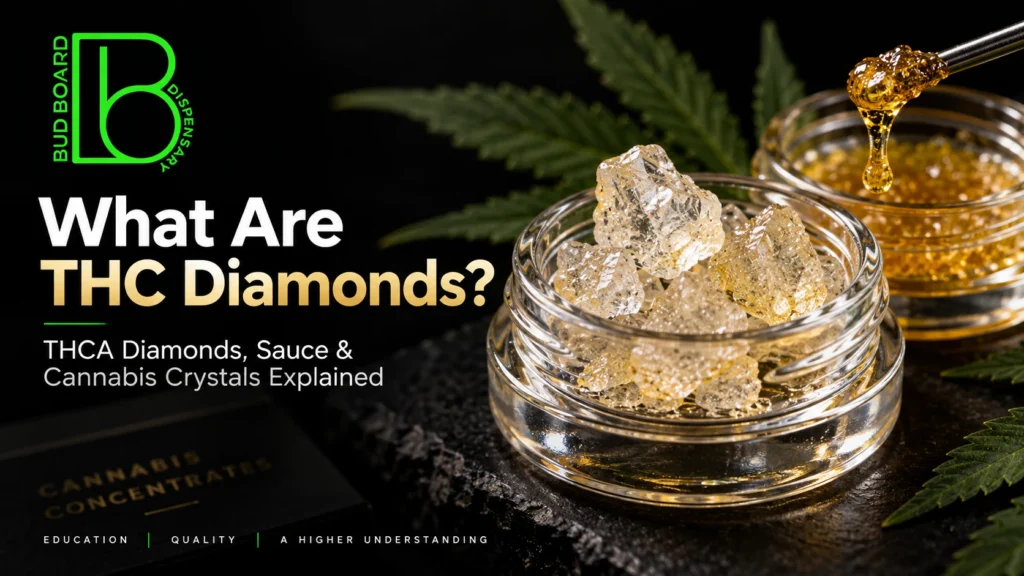
A jar of cannabis diamonds can look like somebody dropped tiny pieces of rock candy into the concentrate case.
That resemblance is real. The crystals form because THCA molecules can organize into a solid crystalline structure under the right conditions.
The confusing part is the name.
Shops and brands may say THC diamonds, THCA diamonds, diamonds and sauce, live resin diamonds, or liquid diamonds. Those phrases are related, but they can describe different products or different stages of processing.
This guide untangles those names first, then compares diamonds with shatter, badder, live resin, and rosin so the label makes more sense before you buy.
What Are THC Diamonds?
THC diamonds are hard, crystal-like cannabis concentrates made primarily of highly concentrated THCA. “THC diamonds” is common retail shorthand, but “THCA diamonds” is chemically more precise for solid, undecarboxylated crystals.
THCA is tetrahydrocannabinolic acid, the acidic precursor to THC. Cannabis naturally produces much of its potential THC in this acidic form. When enough heat reaches THCA, decarboxylation removes part of the molecule and converts it into THC.
That is why the same jar can be described casually as “THC diamonds” while the laboratory panel shows a very large THCA number.
Simple version: In the jar, the diamonds are usually mostly THCA. When heated during compatible use, THCA can convert to THC.
For the chemistry and New Mexico label math behind that conversion, see THCA vs THC.
Are THC Diamonds Actually THC or THCA?
Usually THCA, before heating.
This is the terminology problem hiding in plain sight. Cannabis retailers often use “THC” as a broad consumer-facing word for intoxicating cannabis products. Chemistry is fussier.
A solid cannabis diamond commonly consists mostly of THCA, not already-decarboxylated delta-9 THC. Weedmaps and Leafly both describe cannabis diamonds as crystalline concentrates commonly made from highly purified THCA. When heat triggers decarboxylation, THCA converts into THC.
THCA diamonds
The more chemically specific name for solid crystals containing concentrated THCA before decarboxylation.
THC diamonds
A common retail or conversational name that emphasizes the THC produced after the THCA is heated.
That does not mean every product labeled “THC diamonds” has the same formulation. Read the cannabinoid panel instead of treating the front-label name as a laboratory result.
Why Do Cannabis Diamonds Look Like Crystals?
Because they really are crystals.
Crystallization happens when molecules in a concentrated solution organize into a repeating solid structure. Under controlled commercial conditions, concentrated THCA can nucleate and grow into visible crystalline formations.
The same broad physical idea explains why sugar can form rock candy or why salt can form crystals as conditions change. The substance is different, but the idea of molecules organizing into a crystal lattice is similar.
Crystal size can range from tiny sugar-like grains to larger chunks. Size alone does not tell you potency, purity, freshness, or quality.
Looks are only part of the story: a larger diamond is not automatically stronger than a smaller one. Compare the tested cannabinoid panel and the rest of the product information.
What Is Diamond Sauce?
Diamond sauce, diamonds and sauce, or diamonds in sauce generally describes THCA crystals suspended in a terpene-rich liquid concentrate.
The two components play different roles in the jar. The crystals provide a concentrated cannabinoid fraction. The surrounding sauce contains much of the product’s aromatic character and may contain additional cannabinoids.
That explains why isolated THCA crystals can have relatively little aroma on their own, while a jar of diamonds and sauce can smell much more like the cannabis material it came from.
Some live resin products naturally separate into a crystal-rich portion and a terpene-rich liquid during controlled processing. Producers may package those components together as diamonds and sauce.
Do not assume every product called “sauce” contains large visible diamonds, though. “Sauce” can also describe a loose, terpene-rich concentrate texture.
THC Diamonds, THCA Diamonds, Diamond Sauce and Liquid Diamonds: What Changes?
This is where menu language gets slippery.
| Term | What it usually describes | Typical form | Important caveat |
|---|---|---|---|
| THCA diamonds | Highly concentrated crystalline THCA. | Solid crystals | THCA converts to THC when sufficiently heated. |
| THC diamonds | Common retail shorthand for cannabis diamonds that produce THC after heating. | Solid crystals | The unheated crystals may test primarily as THCA. |
| Diamonds & sauce | THCA crystals combined with a terpene-rich liquid concentrate. | Crystals in a syrupy or oily sauce | Crystal-to-sauce ratio varies by product. |
| Live resin diamonds | THCA crystals formed within or paired with a live resin-derived terpene-rich fraction. | Crystals, often with sauce | “Live” refers to fresh-frozen starting material. |
| Liquid diamonds | A pourable or vape-compatible formulation derived from highly refined cannabinoids associated with THCA diamonds, often blended with terpenes. | Oil or vape formulation | The term is not standardized, so formulas can vary by brand. |
Why “liquid diamonds” deserves an extra label check
A solid crystal and a liquid cannot literally be the same physical form at the same time. “Liquid diamonds” therefore describes a processed formulation, not a jar full of somehow-liquid crystals.
Current industry usage often refers to cannabinoid material derived from THCA crystals that producers melt, dissolve, decarboxylate, or otherwise formulate into a pourable oil, frequently with terpenes added back. Weedmaps specifically notes that the term is not standardized and that production methods can vary.
If you see “liquid diamonds” on a cartridge, check the ingredient list and cannabinoid panel. The front label alone does not tell you whether the formulation resembles converted THCA oil, diamonds blended with terpene sauce, live resin components, or another brand-specific recipe.
THC Diamonds vs THCA Diamonds
In ordinary dispensary conversation, these names often refer to the same solid crystalline product.
- THCA diamonds describes what the crystal primarily contains before heat.
- THC diamonds describes the product in the language many shoppers use for high-THC cannabis concentrates.
After decarboxylation, some of the THCA converts to THC. That means a package can show a high THCA percentage while also reporting Total THC or potential THC differently.
Do not add THCA and THC together as though they were identical measurements. New Mexico’s Total THC calculation accounts for the molecular change during decarboxylation. The detailed explanation lives in the THCA vs THC guide linked above.
THC Diamonds vs Shatter
Diamonds and shatter can both come from solvent-based cannabis extraction, but their final structures look very different.
Shatter is usually a thin, brittle, glass-like concentrate. Producers generally try to maintain a relatively uniform solid sheet.
Diamonds form when THCA crystallizes into distinct solid structures. Instead of a flat sheet, you get individual crystals or crystalline chunks.
Neither texture guarantees a specific potency. A diamond-heavy product may test very high in THCA, but a shopper should still use the batch label rather than assuming every crystal beats every piece of shatter.
THC Diamonds vs Wax or Badder
Wax and badder describe softer concentrate consistencies. Diamonds describe crystalline structure.
Badder may look creamy, whipped, or frosting-like. Wax can range from sticky to crumbly. Diamonds stay visibly crystalline unless they are processed into another formulation.
The names tell you more about physical form than about which product is “better.” Processing, starting material, terpene content, cannabinoid concentration, freshness, and storage all matter.
For the larger texture map, Cannabis Concentrates Explained compares shatter, wax, badder, sauce, resin, rosin, diamonds, and other formats.
THC Diamonds vs Live Resin
Live resin is a broad processing category. Diamonds are a crystalline form that can appear within that category.
Live resin usually starts with fresh-frozen cannabis and uses commercial solvent-based extraction. Depending on how the extract develops, it can finish as badder, sugar, sauce, or a product containing THCA diamonds.
A jar of live resin can contain diamonds. “Live resin” tells you about starting material and processing. “Diamonds” tells you that a cannabinoid fraction crystallized.
For a cleaner comparison of the major processing families, see Live Resin vs Rosin.
THC Diamonds vs Rosin
Traditional THCA diamonds and rosin take different processing routes.
Commercial cannabis diamonds commonly come from solvent-based extracts that producers refine and allow to crystallize under controlled conditions.
Rosin uses heat and mechanical pressure instead of an extraction solvent. Producers can press flower, kief, dry sift, or hash to make rosin. Live rosin commonly begins with bubble hash made from fresh-frozen cannabis.
So “diamond” does not mean solventless, and “rosin” does not mean crystalline.
Neither process automatically makes the final product cleaner, safer, stronger, or better. Those claims require more information than the category name provides.
How Are Cannabis Diamonds Made?
At a high level, licensed manufacturers first create and refine a cannabinoid-rich cannabis extract. Under carefully controlled commercial conditions, concentrated THCA can begin forming crystal nuclei and growing into larger crystals.
As the THCA-rich fraction crystallizes, a more liquid terpene-rich fraction may separate around it. Producers can separate those components or package them together as diamonds and sauce.
The chemistry has a simple headline: concentration plus controlled crystallization allows THCA molecules to organize into a solid crystal structure.
The actual manufacturing process involves specialized extraction equipment, pressure-rated systems, solvent handling, purification, and safety controls. Hydrocarbon solvents can create serious fire and explosion hazards, so commercial diamond production belongs in properly licensed facilities rather than a home setup.
This is intentionally not a DIY extraction guide. Understanding why crystals form is useful. Recreating commercial solvent extraction at home is not.
If you want to understand where the resin compounds begin before extraction, Weed Trichomes explains the resin-producing structures on cannabis flower.
How Are THC Diamonds Typically Used?
Solid diamonds and diamonds-and-sauce products are commonly sold as concentrates for compatible concentrate devices. Some products may also be formulated with flower or used as ingredients in manufactured cannabis products.
The right method depends on the product.
A jar of solid concentrate is not automatically interchangeable with cartridge oil. A “liquid diamonds” vape formulation is not the same physical product as loose THCA crystals. Follow the product label and the device manufacturer’s instructions.
If the vocabulary around rigs, pens, and concentrate vaporizers is the confusing part, What Is a Dab? separates those device categories without turning the explanation into an instruction manual.
What Should Shoppers Look for on a Cannabis Diamonds Label?
The sparkly jar gets attention. The label gets the final vote.
1. THCA, THC and Total THC
Check which cannabinoid numbers the package actually reports. Solid diamonds may show a very high THCA concentration before heating. Do not assume the front-label phrase “THC diamonds” means the jar contains that same percentage of already-decarboxylated THC.
2. Diamonds alone or diamonds and sauce
A crystal-heavy jar and a sauce-heavy jar can handle, smell, and taste very differently. Look at the product description rather than assuming every “diamond” jar has the same ratio.
3. Starting material and “live” language
If the product says live resin diamonds, the “live” language generally refers to fresh-frozen starting material. Plain THCA diamonds do not have to come from live resin.
4. Terpenes and ingredients
Pure crystalline THCA contains far fewer aromatic compounds than a terpene-rich sauce. For formulated products, especially cartridges, check whether the label identifies added terpenes or other ingredients.
5. Batch, manufacturer and testing information
Use the tested batch information to compare products. New Mexico requires cannabis products sold through licensed retailers to meet applicable testing, packaging, and labeling rules.
6. Dates and storage directions
Check packaging or production dates when available and follow the manufacturer’s storage directions. Heat and time can change concentrate texture and cannabinoid composition.
Five words that should trigger a closer look
THC diamondsTHCA diamondsdiamond saucelive diamondsliquid diamonds
None of those phrases replaces the cannabinoid panel, ingredient list, or product type.
How Should Cannabis Diamonds Be Stored?
Follow the manufacturer’s directions first.
As a general rule, keep cannabis concentrates closed, protected from direct light and excess heat, and secured away from children and pets. Products containing terpene-rich sauce may change texture or lose aromatic compounds more quickly when exposed to warmth or air.
Cold storage may make sense for some concentrate products when the manufacturer recommends it, but not every jar needs the same treatment. Temperature swings can also create handling issues such as condensation.
In other words, the refrigerator is not a universal concentrate commandment. Read the package.
Are THC Diamonds Available in New Mexico?
New Mexico’s regulated adult-use market allows licensed retailers to sell cannabis extracts and concentrates to adults age 21 or older after verifying age and identity.
The state’s current adult-use purchase limit is up to 16 grams of cannabis extract at one time. Cannabis products sold by licensed retailers must also comply with applicable testing, packaging, and labeling requirements.
That does not mean every dispensary carries diamonds every day. Inventory changes by store and batch.
Adults 21+ can check Bud Board’s current Carlsbad and Hobbs menus for available concentrates rather than assuming a specific diamonds product is in stock.
THC Diamonds FAQ
Diamonds and THCA Basics
What are THC diamonds?
THC diamonds are crystalline cannabis concentrates that usually consist primarily of highly concentrated THCA before heating. “THC diamonds” is common retail shorthand, while “THCA diamonds” is generally more chemically precise for the solid crystals.
Are THC diamonds the same as THCA diamonds?
In many dispensary contexts, the terms point to the same crystalline product. THCA diamonds is the more precise description before heat converts some THCA into THC.
Why do THC diamonds look like crystals?
Under controlled conditions, concentrated THCA molecules can organize into a repeating solid structure. That crystallization creates the clear, translucent, or amber crystal-like appearance associated with cannabis diamonds.
Sauce, Live Resin and Liquid Diamonds
What is diamond sauce?
Diamond sauce generally combines solid THCA crystals with a terpene-rich liquid concentrate. The crystals supply a concentrated cannabinoid fraction, while the sauce contributes much of the aroma, flavor, and additional cannabis compounds.
Are live resin diamonds the same as live resin?
Live resin is the broader category. A live resin product can contain THCA diamonds when part of the extract crystallizes. Live resin can also appear as badder, sugar, sauce, or other consistencies without large diamonds.
What are liquid diamonds?
Liquid diamonds is a non-standardized industry term usually used for a pourable or vape-compatible cannabinoid formulation derived from highly refined THCA crystal material and often combined with terpenes. Because brands use the term differently, check the cannabinoid panel and ingredients.
Potency, Use and Shopping
Are THC diamonds stronger than shatter?
Not automatically. THCA diamonds often contain a very high concentration of THCA, but potency varies by product. Compare the tested cannabinoid information rather than using texture or crystal size as a potency shortcut.
Are THC diamonds solventless?
Traditional commercial THCA diamonds are commonly produced from solvent-based extracts. They should not be confused with rosin or other solventless concentrate categories.
Do bigger cannabis diamonds mean better quality?
No. Crystal size does not prove potency, purity, freshness, terpene content, or overall quality. The tested label and product condition provide more useful information.
Can adults buy cannabis diamonds in New Mexico?
Licensed New Mexico retailers may sell compliant cannabis extracts and concentrates to adult-use customers age 21 or older with valid identification. Whether a specific diamonds product is available depends on current store inventory.
Key Takeaways
- Solid “THC diamonds” are usually more accurately described as THCA diamonds before heating.
- THCA converts to THC through decarboxylation when enough heat is applied.
- Diamonds are true crystalline structures, not merely concentrate shaped to look like gems.
- Diamonds and sauce combines THCA crystals with a terpene-rich liquid fraction.
- Live resin can contain diamonds, but not every live resin product is a diamonds product.
- Liquid diamonds is not a standardized formulation name, so shoppers should check ingredients and cannabinoid data carefully.
- Shatter, wax, badder, live resin, rosin, and diamonds describe different structures, processing routes, or both.
- Crystal size, clarity, and front-label terminology do not replace laboratory-tested cannabinoid information.
- Commercial diamond production commonly involves solvent-based extraction and specialized equipment. It is not a home extraction project.
- New Mexico adults 21+ may purchase compliant cannabis extracts from licensed retailers, subject to state purchase limits.
Research & Official Sources
Shopping for Cannabis Concentrates in Carlsbad or Hobbs?
Adults 21+ can browse Bud Board’s current Carlsbad and Hobbs menus online and place a pickup order with their preferred location. Concentrate inventory changes, so check the live menu for current diamonds, live resin, rosin, wax, badder, and other available formats.