Last Updated: September 2026. Edible timelines vary widely between people and products. This guide provides general adult-use cannabis education and is not personalized dosing or medical advice.
Edibles have a timing problem.
You eat one, nothing dramatic happens right away, and the clock starts feeling suspicious.
That delay is normal. Unlike inhaled cannabis, an edible has to move through the digestive system before much of its THC reaches the bloodstream. The liver also changes part of that THC into an active metabolite called 11-hydroxy-THC.
The result is a slower, less predictable timeline that can last much longer than smoking or vaping.
This guide separates onset, peak or full effects, and total duration so those terms do not get mashed into one misleading number.
How Long Do Edibles Last?
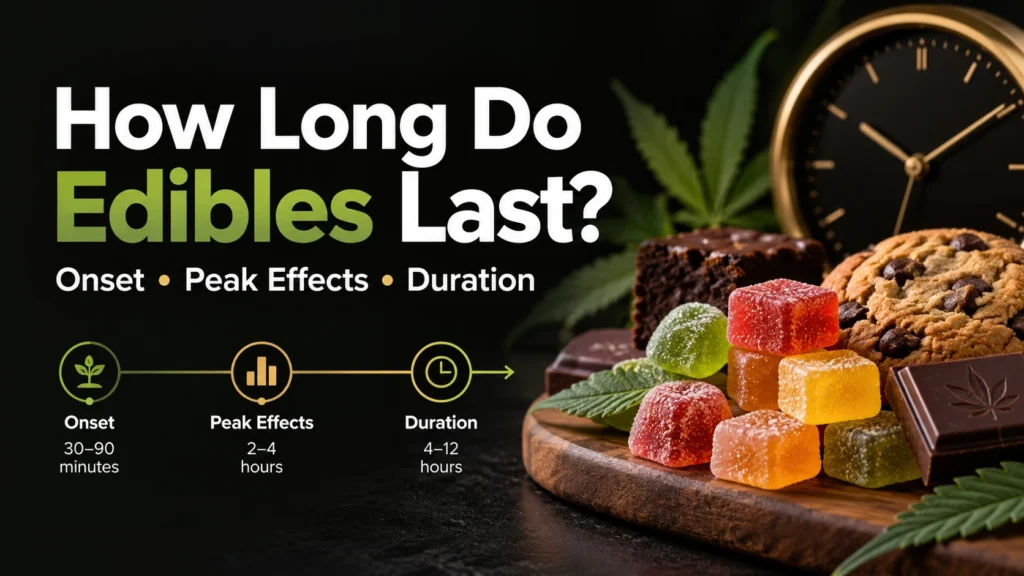
For many people, the main effects of a THC edible can last roughly 4 to 8 hours, but the range can extend longer. Health Canada advises that effects from eating or drinking cannabis can last up to 12 hours, with some residual effects lasting up to 24 hours.
A controlled U.S. study of cannabis brownies found subjective and cognitive effects generally peaked about 1.5 to 3 hours after consumption and lasted about 6 to 8 hours. A broader systematic review found oral THC timing varies substantially across formulations and people.
| Time after eating | What may be happening | What to remember |
|---|---|---|
| 0–30 minutes | Some people may feel little or nothing yet. | A quiet first half-hour does not mean the edible failed. |
| 30 minutes–2 hours | Effects may begin to appear. | CDC notes that intoxicating effects can take 30 minutes to 2 hours to begin. |
| About 1.5–4 hours | Effects may become strongest or reach their full level. | Controlled research found peaks around 1.5–3 hours; public-health guidance allows up to 4 hours for full effects. |
| About 4–8 hours | Main effects may continue and gradually fade. | The controlled brownie study cited in this guide observed effects lasting about 6 to 8 hours; that is not a guaranteed endpoint for every person or product. |
| Up to 12 hours | Some acute effects may still be present. | Higher exposure and individual differences can stretch the timeline. |
| Up to 24 hours | Residual effects are possible for some people. | Feeling mostly normal is not the same thing as having a universal “safe to drive” clock. |
One useful distinction: “How long an edible lasts” is not the same as “how long THC can be detected.” Drug-testing windows can extend well beyond noticeable effects and answer a different question.
How Long Do Edibles Take to Kick In?
A common onset window is about 30 minutes to 2 hours. CDC uses that range when explaining why edible overconsumption can happen.
An edible does not move straight from your mouth to your brain. The product has to break down, THC must be absorbed through the gastrointestinal tract, and then much of it travels through the liver before reaching systemic circulation.
That process introduces more variables than inhalation.
The systematic review of oral THC studies found delayed peak concentrations and substantial variability between formulations. Brownies, cookies, oils, capsules, and tablets did not all behave the same way.
The useful answer is a window, not a countdown: an edible may begin to feel noticeable within 30 minutes, but taking 2 hours or longer is still within established public-health guidance.
When Do Edibles Usually Peak?
“Peak” can mean two different things, and articles often mix them up.
Peak blood concentration
Researchers can measure when THC or its metabolites reach their highest concentration in blood. That timing varies with the product, amount, food, and the person.
Peak subjective effects
This is when someone reports the strongest felt effects or shows the greatest measured changes in performance.
Those two peaks do not have to occur at exactly the same minute.
In a controlled brownie study, subjective and performance effects generally peaked about 1.5 to 3 hours after eating. Health Canada takes a more conservative consumer-safety approach and warns that it can take up to 4 hours to feel the full effects.
That distinction matters. A person can notice something happening before the edible has reached its strongest point.
How Long Can the Effects of Edibles Last?
In one controlled U.S. brownie study, subjective and cognitive effects lasted about 6 to 8 hours. That study gives us a useful research reference point, but it should not be treated as a universal duration for every edible or every person.
Health Canada states that acute effects can last up to 12 hours and some residual effects may last up to 24 hours.
That does not mean everyone who eats an edible will feel strongly intoxicated for 12 hours. It means the tail of the timeline can be longer than the “four to six hours” shorthand often repeated online.
Someone may feel the strongest effects for a few hours, then feel mostly normal while still noticing sleepiness, slowed thinking, or another residual effect later. That is one reason cannabis safety guidance does not provide a universal number of hours after use when driving becomes safe.
Do not use a blog timeline as a driving countdown. Cannabis can impair coordination, attention, and decision-making. If effects are still present, do not drive or operate machinery.
Why Do Edibles Last Longer Than Smoking or Vaping?
Inhaled THC reaches the bloodstream quickly through the lungs. Oral THC takes a slower route through digestion and the liver.
That route changes the timeline.
First, absorption takes longer
Food has to move through the digestive system before much of the THC reaches circulation. That slows onset compared with inhalation, where effects can begin within minutes.
Then the liver changes part of the THC
During first-pass metabolism, the liver converts some delta-9 THC into 11-hydroxy-THC, an active metabolite that contributes to the oral cannabis experience.
This does not mean every edible is automatically “stronger” than every inhaled product. It means oral THC follows a different pharmacokinetic path.
If the cannabinoid names are starting to look like a password reset code, Bud Board’s Cannabinoids & Terpenes guide covers the larger compound family.
What Can Change How Long an Edible Lasts?
There is no single edible clock because several variables move at once.
Amount consumed
Higher THC exposure can produce stronger or longer-lasting effects, but oral cannabis is variable enough that the relationship is not perfectly predictable. In controlled brownie research, effects were generally dose-dependent, yet blood concentrations still showed considerable variation.
The label tells you more than the size of the food. A tiny edible can contain more THC than a much larger one.
Metabolism and individual biology
People absorb and process oral THC differently. Human studies repeatedly show wide person-to-person variation in blood concentrations and timing after the same oral amount.
Body size alone does not solve the puzzle. One study comparing five commercial edible products found no body-composition measure that consistently predicted pharmacokinetics across every product.
Food intake
Eating with food can change both timing and total exposure.
In a controlled study of oral THC capsules, a high-fat meal delayed the time to peak concentration and increased overall cannabinoid exposure compared with fasting. That is a good reminder that “empty stomach equals faster” is too simple to use as a rule.
Tolerance and prior cannabis exposure
People who use cannabis frequently may experience the same amount differently from someone with little or no tolerance. Tolerance can change how noticeable or intense effects feel.
It does not create a reliable shortcut for predicting exactly when an edible will peak or wear off.
Product type and formulation
Brownies, gummies, chocolates, capsules, beverages, and newer emulsion-based products can absorb differently.
A systematic review found meaningful variability across oral THC formulations. A small recent randomized study also found one microencapsulated “fast-acting” edible reached peak THC concentration about 30 minutes earlier than a standard edible.
That does not mean every gummy or beverage is fast acting. The formulation matters more than the shape.
Why Should You Wait Before Taking More?
The most important timing mistake with edibles happens before the first serving has finished arriving.
CDC warns that edible effects can take up to 2 hours to begin. Health Canada notes that full effects may take up to 4 hours.
Those are not the same milestone.
Feeling very little at 45 minutes does not prove the product failed. Feeling something at 90 minutes does not prove you have reached the peak.
Taking additional THC during that delayed window can stack exposure before the earlier serving has fully developed. That is one reason edible overconsumption can lead to severe anxiety, confusion, panic, vomiting, or other unpleasant reactions.
What the timeline is really telling you
Onset is delayed Full effects take longer Duration can be long
Follow the product directions. Do not treat an early lack of effects as proof that nothing is happening.
If someone has a severe reaction, loses consciousness, has trouble breathing, or has another medical emergency, call 911. For questions about a possible cannabis poisoning, U.S. Poison Control is available at 1-800-222-1222.
How Do THC Gummies Compare With Other Edibles?
Gummies are popular because the servings can be easy to see and the package is portable. Pharmacologically, though, the word “gummy” does not guarantee a particular onset time.
Gummy is a food format, not a speed rating.
Commercial edible research has found different THC concentration curves even when products contained the same labeled amount of THC. Formulation can matter.
Standard gummies
A conventional gummy still behaves like an orally ingested cannabis product. It generally belongs inside the broader 30-minute-to-2-hour onset guidance.
“Fast-acting” gummies and beverages
Some manufacturers use emulsions, microencapsulation, or other formulation technologies designed to change absorption. Early research suggests some of these products can reach peak blood concentrations sooner than standard edibles.
Do not generalize that finding to every product carrying a “fast” label. Check the manufacturer’s directions and the regulated label.
Baked goods and chocolates
The food matrix, fat content, portion size, and digestion can all influence absorption. A systematic review found particularly high variability in some baked-good and oil formulations.
So the useful comparison is not “gummy versus brownie” by itself. It is specific product, specific formulation, specific label.
What Should New Mexico Shoppers Look for on an Edible Label?
New Mexico gives shoppers more useful edible information than the front of the package alone.
Current state rules require edible labels to show Total THC and CBD in milligrams per serving, along with product identity and required cannabis warnings. Additional required information can appear on the information panel or through an approved QR code or peel-back label.
Start with milligrams per serving
Do not confuse the amount in one serving with the amount in the whole container.
Under current New Mexico rules, adult-use edible products packaged for commercial sale may contain no more than 10 mg Total THC per serving and 100 mg Total THC per container.
Then check how many servings are in the package
A package can contain multiple servings. If the product is solid and multi-serving, New Mexico packaging rules require servings to be identifiable and separable.
Read ingredients and allergen information
New Mexico requires an ingredient list and major-allergen disclosure. This matters because an edible is both a cannabis product and a food product.
Check the expiration date and storage directions
State rules require an expiration date, and perishable products that require refrigeration must say so on the label.
Bud Board’s How to Read a Cannabis Label in New Mexico guide walks through the fields one by one.
Package limit and purchase limit are different rules. A standard adult-use edible package can contain up to 100 mg Total THC under the current packaging rule. New Mexico’s adult-use purchase limit allows up to 800 mg of edible cannabis in one transaction.
How Should Edibles Be Stored?
Start with the package directions.
Edibles should stay in their original or clearly labeled child-resistant packaging and remain secured away from children and pets. New Mexico specifically emphasizes safe storage because cannabis food products can be mistaken for ordinary snacks.
Storage also depends on the food itself. A shelf-stable gummy and a fresh baked item do not have the same spoilage risk.
Check the expiration date, refrigeration instructions, packaging condition, and changes in smell, texture, or appearance. For the full shelf-life breakdown, see Do Cannabis Edibles Expire?
If a child accidentally eats a cannabis edible: New Mexico RLD advises contacting a medical professional or Poison Control at 1-800-222-1222. For a severe reaction, call 911 or go to an emergency room.
Edibles and New Mexico Visitors
Adults 21 and older can purchase adult-use cannabis in New Mexico after age and identity verification. Visitors do not need to be New Mexico residents.
Buying it legally here does not make it legal to carry across a state line.
New Mexico prohibits cannabis consumption in public spaces, but adults may consume cannabis at a private residence or a licensed cannabis consumption lounge . Impaired driving remains illegal. If you are visiting Carlsbad or Hobbs from Texas or another state, read New Mexico Cannabis Laws for Visitors before planning around an edible.
Brand new to cannabis formats in general? The Beginner’s Guide to Cannabis in New Mexico covers the bigger picture without assuming you already speak dispensary.
How Long Do Edibles Last? FAQ
Timing Basics
How long do edibles usually last?
Main effects often last several hours. In one controlled U.S. brownie study, subjective and cognitive effects lasted about 6 to 8 hours. Public-health guidance notes that acute effects can last up to 12 hours and residual effects may continue longer for some people.
How long does it take for an edible to kick in?
A common onset range is about 30 minutes to 2 hours. Food, product formulation, individual metabolism, and other factors can shift that timing.
When do edibles peak?
Controlled brownie research found subjective and performance effects often peaked about 1.5 to 3 hours after ingestion. Public-health guidance warns that full effects may take up to 4 hours to develop.
Can an edible take more than two hours to fully hit?
Yes. Two hours is commonly used as an onset window, not a guaranteed full-effect deadline. Health Canada advises that full effects may take up to 4 hours.
Why the Timeline Changes
Does eating food change how long an edible takes?
It can. Controlled oral THC research found that a high-fat meal delayed the time to peak concentration and increased overall exposure compared with fasting. Food effects are not simple enough to turn into one universal timing rule.
Do THC gummies kick in faster than brownies?
Not automatically. Product formulation matters more than the food shape. Commercial edible studies show timing can vary between products even at the same labeled THC amount.
Are fast-acting edibles really faster?
Some specialized formulations may be. A small randomized study found one microencapsulated fast-acting edible reached peak THC concentration about 30 minutes earlier than a standard edible. That result does not mean every product marketed as fast acting has the same timing.
Does tolerance make edibles wear off faster?
Tolerance can change how strong or noticeable cannabis feels, but it does not provide a reliable formula for predicting edible onset, peak, or duration.
Safety, Storage and New Mexico Labels
Why is taking more too early a problem?
Edibles can begin slowly and continue building for hours. Taking more before the earlier serving has fully developed can stack THC exposure and increase the chance of an unpleasant or severe reaction.
How much THC can an adult-use edible serving contain in New Mexico?
Current New Mexico packaging rules cap adult-use edible products packaged for commercial sale at 10 mg Total THC per serving and 100 mg Total THC per container.
How long do THC gummies stay good?
Shelf life depends on the product, ingredients, packaging, and storage conditions. Follow the printed expiration date and storage directions rather than using one shelf-life number for every gummy.
How long should someone wait before driving after an edible?
There is no universal number of hours that makes driving safe after cannabis. Do not drive while impaired or while effects remain. Edible effects can last much longer than people expect.
Key Takeaways
- Edible cannabis commonly begins to take effect about 30 minutes to 2 hours after consumption.
- Strongest or full effects may take roughly 1.5 to 4 hours to develop.
- One controlled U.S. brownie study found subjective and cognitive effects lasting about 6 to 8 hours, while public-health guidance allows for acute effects lasting up to 12 hours.
- Residual effects may last longer, sometimes into the next day.
- How long you feel an edible is different from how long cannabinoids can be detected in a drug test.
- Food intake, formulation, individual metabolism, amount consumed, and tolerance can all change the timeline.
- A gummy is not automatically faster than a brownie. “Fast acting” depends on formulation, not shape.
- New Mexico adult-use edible packages may contain up to 10 mg Total THC per serving and 100 mg per container under current packaging rules.
- New Mexico’s 800 mg adult-use edible purchase limit is a transaction limit, not a single-package potency limit.
- Follow product directions, store edibles securely, and do not drive while impaired.
Research & Official Sources
- CDC: Cannabis and Poisoning
- Health Canada: What You Need to Know if You Choose to Consume Cannabis
- Pharmacokinetic Profile of Oral Cannabis in Humans
- Oral Administration of Cannabis and THC Preparations: A Systematic Review
- Fed vs Fasted Oral THC Pharmacokinetics
- Pharmacokinetic Investigation of Commercial Edible Cannabis Products
- Pharmacokinetic Differences Between Fast-Acting and Standard Cannabis Edibles
- New Mexico 16.8.3 NMAC
- New Mexico Cannabis Control Division FAQs
Shopping for Edibles in Carlsbad or Hobbs?
Adults 21+ can browse Bud Board’s current Carlsbad and Hobbs menus online and place a pickup order with their preferred location. Edible inventory changes, so check the live menu for current gummies, chocolates, beverages, baked products, and other available formats.