Last Updated: October 10, 2026. Product formulations and regional packaging can change. This guide uses current U.S. manufacturer examples and New Mexico labeling rules for adult-use education.
Browse WyldA Wyld package can look straightforward until the numbers start competing for attention.
The fruit name is easy to spot. The label may also list THC, CBD, CBG, CBN, a ratio, a serving amount, and a container total.
That is where a quick glance turns into a small math assignment.
For adults in Carlsbad and Hobbs, this guide explains how to read those details without assuming every Wyld gummy has the same formulation. The flavor examples below come from Wyld’s current U.S. product pages. Your actual New Mexico package still gets the final say.
What Are Wyld Gummies?
Wyld is a cannabis gummy brand with multiple fruit flavors and cannabinoid formulations in its U.S. catalog. Some current product pages are THC-focused, while others pair THC with cannabinoids such as CBD, CBG, or CBN. The manufacturer pages are useful for comparing formulations, but they do not establish every cannabinoid that may appear on every batch test.
The fruit name is the easiest part to remember, which is probably why it gets most of the attention. It does not tell you the whole formula.
A better habit is to read the flavor name and the cannabinoid line together. If the package says Pear and lists THC:CBG, both details matter. If it says Elderberry and lists THC:CBN, the ratio matters too.
Wyld Flavor Examples and Their Formulations
These are examples from Wyld’s current U.S. product pages, checked October 10, 2026. They are not a Bud Board inventory list, and Wyld states that packaging and dosing may vary by state.
| Flavor | Manufacturer-listed formulation | What to notice |
|---|---|---|
| Raspberry | THC-focused example; New Mexico regional page lists 10 mg THC per gummy, 100 mg THC per container, and 10 gummies per container | This one package makes the per-gummy versus full-container distinction easy to see |
| Huckleberry | THC-focused example; U.S. page lists 10 mg THC per gummy | Different flavors can show the same listed THC amount |
| Pear | 1:1 THC:CBG; U.S. page lists 10 mg THC and 10 mg CBG per gummy | Read both cannabinoid names and both milligram amounts |
| Elderberry | 2:1 THC:CBN; U.S. page lists 10 mg THC and 5 mg CBN per gummy | The ratio compares the two named cannabinoid amounts |
| Pomegranate | 1:1 THC:CBD; U.S. page lists 10 mg THC and 10 mg CBD per gummy | A 1:1 ratio means equal listed amounts of the two named cannabinoids |
| Peach | 2:1 CBD:THC; U.S. page lists 10 mg CBD and 5 mg THC per gummy | Ratio order matters: the first named cannabinoid is the larger amount here |
The table shows why flavor alone is not enough. Pomegranate and Peach both include CBD and THC, yet their ratios and listed milligrams differ. The physical New Mexico package remains the best source for the product you actually have.
Raspberry gives us a clean New Mexico example
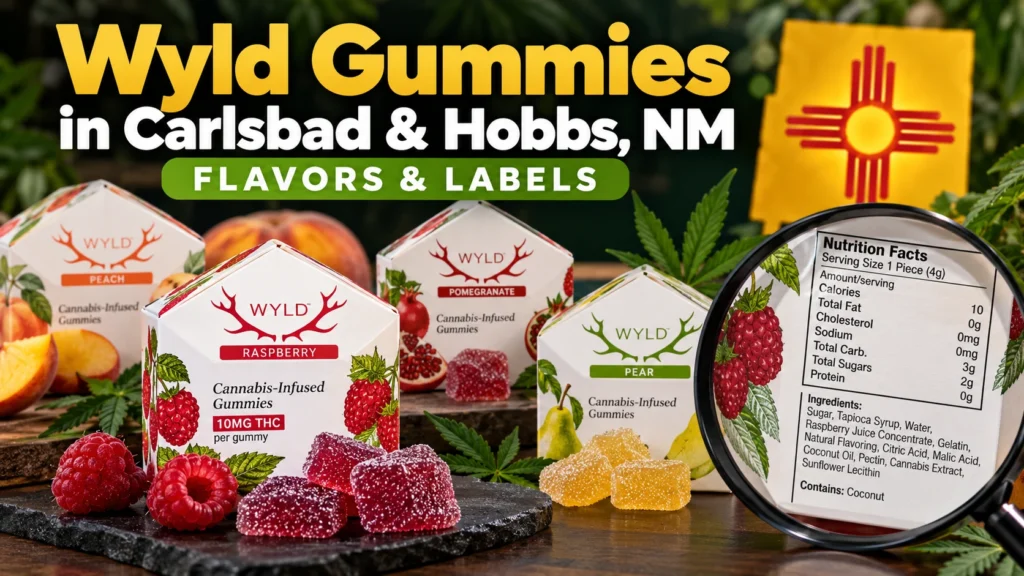
On Wyld’s New Mexico regional Raspberry page, the adult-use listing shows 10 mg THC per gummy, 10 gummies per container, and 100 mg THC per container. The same page lists one piece as the nutrition serving and 2 g total sugars per piece.
The ingredient panel shown on that page includes gelatin and coconut oil, with Contains: Coconut. That makes Raspberry useful for both the package-math lesson and the dietary section below.
THC Per Gummy, Per Serving, and Per Package
These numbers answer different questions.
Per gummy tells you what the manufacturer assigns to one whole piece. Per serving tells you what the package defines as a serving. Per package is the total amount across the container.
A simple hypothetical example
Imagine a fictional package with 10 gummies. Each gummy is labeled 5 mg THC.
5 mg per gummy10 gummies50 mg THC in the package
That is package arithmetic, not a recommendation about how much someone should consume.
A piece and a labeled serving also need separate attention. Wyld’s Pear U.S. page, for example, shows a half-piece nutrition serving while listing cannabinoid amounts per whole gummy. Nutrition serving size and cannabinoid amount per piece are not automatically the same thing.
Bud Board’s How to Read a Cannabis Label in New Mexico guide goes deeper into the label fields.
Understanding Cannabinoid Ratios
A ratio only makes sense when the cannabinoids are named.
If a fictional label says 1:1 THC:CBG and lists 5 mg THC plus 5 mg CBG, the two cannabinoids are present in equal amounts. Together they add up to 10 mg of cannabinoids, with 5 mg of that total coming from THC.
The ratio alone cannot tell you the THC amount. A 1:1 product could use 5 mg and 5 mg, 10 mg and 10 mg, or another equal pair.
It also does not guarantee a particular experience. Product names and cannabinoid pairings can describe a formulation without proving what someone will feel from it.
Are Wyld Gummies Vegan or Gluten-Free?
Dietary questions need product-specific answers. A fruit flavor or cannabinoid ratio does not tell you whether a gummy fits a particular diet.
Are Wyld gummies vegan?
Do not assume the whole Wyld cannabis line is vegan. Wyld’s current Raspberry U.S. product page lists gelatin and identifies coconut in its contains statement. That is enough to rule out a blanket vegan claim for the catalog.
Recipes can vary by product and region, so the exact ingredient panel is still the right place to check.
Are Wyld gummies gluten-free?
An ingredient list by itself is not enough to prove a universal gluten-free claim. It does not establish certification, manufacturing controls, or possible cross-contact. If gluten matters for medical or dietary reasons, use the exact package and current manufacturer information for that product rather than relying on a brand-wide assumption.
How much sugar is in Wyld gummies?
Sugar information can also vary by product. As one specific example, Wyld’s current Raspberry U.S. page lists 2 g total sugars per one-piece nutrition serving. That figure describes Raspberry on that page. It should not be copied across every Wyld flavor without checking.
Nutrition facts and cannabinoid facts answer different questions. Calories, sugars, ingredients, and allergens belong to the food side of the package. THC, CBD, CBG, CBN, ratios, and milligram figures describe the cannabis formulation.
What New Mexico Shoppers Should Look for on the Label
New Mexico’s current cannabis rules require edible labels to show laboratory-confirmed Total THC and CBD in milligrams per serving.
Required supplementary information includes ingredients, relevant allergens, manufacturer information, manufacture and expiration details, and other regulated product information. Some of that can appear on an information panel, peel-back label, or permitted static QR code.
For adult-use products packaged for commercial sale, New Mexico currently limits edible products to 10 mg Total THC per serving and 100 mg Total THC per container. Medical provisions are different.
Those limits describe the package format. They are not a personal-use recommendation.
Flavor gets your attention. The label gives you the answer.
Check the cannabinoid names, milligrams per serving, total container amount, ingredients, allergens, and the exact New Mexico package before drawing conclusions from the fruit name alone.
Adult-Use vs Medical Wyld Packaging in New Mexico
The same flavor name can appear on packages with very different cannabinoid amounts. Raspberry gives us a real New Mexico example.
Wyld’s current New Mexico adult-use Raspberry page lists 10 mg THC per gummy and 100 mg THC per container. The original Bud Board photo below shows a New Mexico medical Raspberry package labeled 50 mg THC per serving and 1,000 mg THC per container, with 20 gummies in the package.
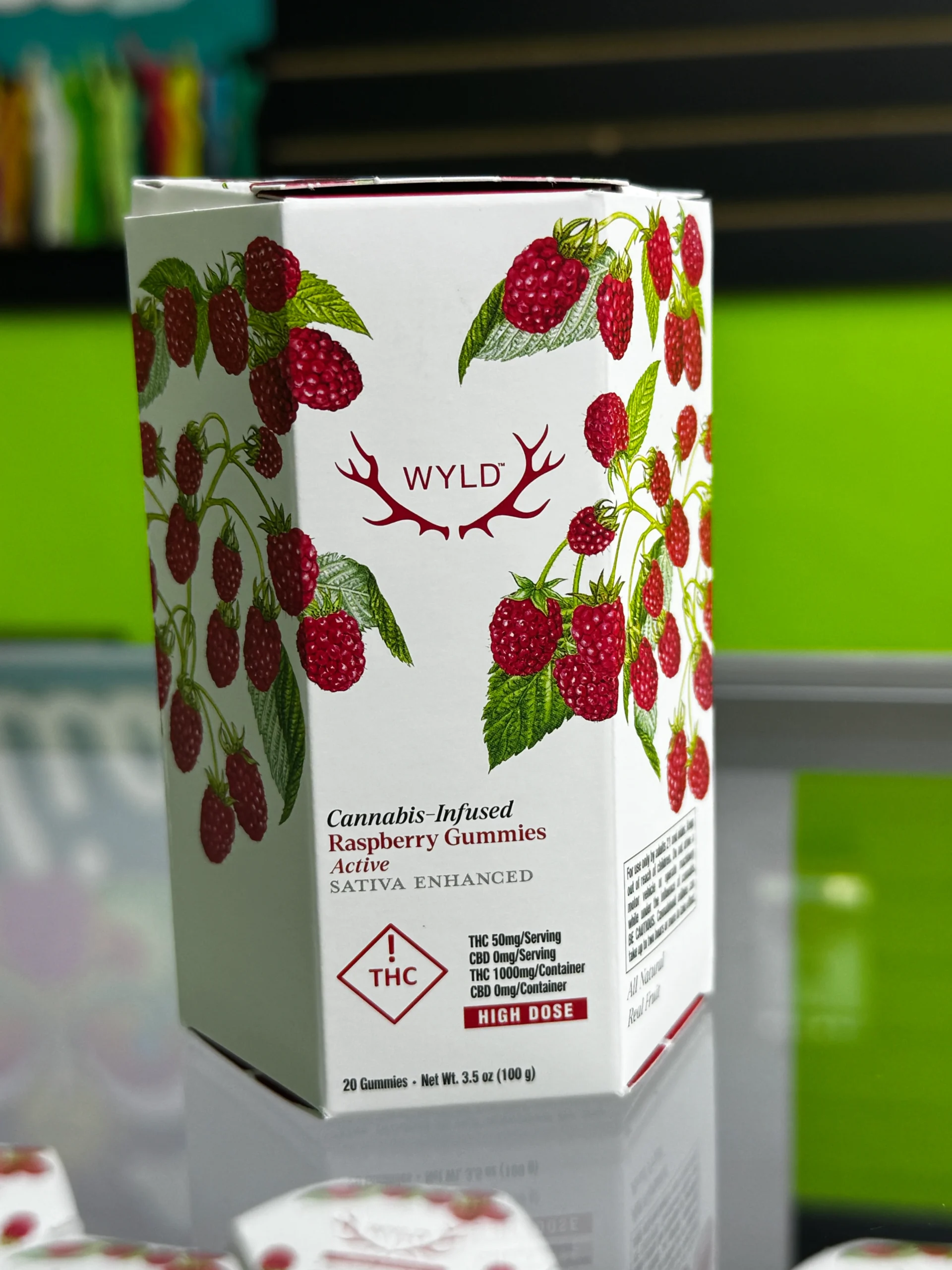
That difference is exactly why the fruit name should never be used as a potency shortcut. Raspberry identifies the flavor. The package tells you whether you are looking at an adult-use or medical product and what the labeled cannabinoid amounts actually are.
The medical package also uses descriptors such as “Active,” “Sativa Enhanced,” and “High Dose.” Those are package descriptors. They should not be read as a guarantee of a specific mood, effect, or medical outcome.
Storage and Delayed Effects
Keep cannabis edibles in their original, clearly labeled, child-resistant packaging and secure them away from children and pets. New Mexico RLD recommends locked storage such as a cabinet or lockbox.
Edible effects can also take time to appear. CDC gives a general onset range of about 30 minutes to 2 hours for edible cannabis. That is public-health guidance, not a Wyld-specific promise and not a safe-driving countdown.
For the fuller timing discussion, see How Long Do Edibles Last? For shelf life, expiration dates, and storage differences between edible formats, see Do Cannabis Edibles Expire?
A Personal Experience During Chemotherapy
Shared anonymously for this article: “During chemotherapy, Wyld gummies were one of the things I personally found helpful with nausea and mood. That experience is part of why I pay close attention to these products and what their labels actually say.”
That is one person’s experience. It is not evidence that Wyld gummies treat chemotherapy side effects or that another person will respond the same way. The National Cancer Institute says cannabinoids have been studied for chemotherapy-related nausea and vomiting. Two prescription cannabinoid medicines, dronabinol and nabilone, are FDA-approved for chemotherapy-related nausea and vomiting in patients who have not responded to standard anti-nausea treatment. Cannabis gummies are not the same as those prescription medicines.
Anyone going through cancer treatment should discuss cannabis products with their oncology team because treatment plans, medications, and individual risks differ.
Wyld Gummies FAQ
Flavors and Cannabinoids
Do all Wyld gummies contain the same cannabinoids?
No. Wyld’s current U.S. catalog includes THC-focused examples such as Raspberry and Huckleberry, plus ratio products such as Pear THC:CBG, Elderberry THC:CBN, Pomegranate THC:CBD, and Peach CBD:THC. Check the cannabinoid line on the exact package instead of treating the flavor name as the formulation.
How much THC is in a Wyld gummy?
There is no single brand-wide answer. Several current U.S. pages list 10 mg THC per whole gummy, while Peach lists 5 mg THC alongside 10 mg CBD. Wyld states that packaging and dosing may vary by state, so read the actual New Mexico package.
Can the flavor name tell me the full formulation?
No. The fruit name identifies the flavor. The cannabinoid names, ratio, and milligram figures explain the cannabis formulation. Pear and Elderberry, for example, use different named cannabinoid ratios on Wyld’s current U.S. pages.
Why does the medical Raspberry package show much more THC?
The medical package photographed for this article is a different New Mexico product format from the adult-use Raspberry example. It lists 50 mg THC per serving and 1,000 mg per container, while the adult-use regional page lists 10 mg per gummy and 100 mg per container. Always read the exact package type and label.
Ingredients and Dietary Questions
Are Wyld gummies vegan?
Do not generalize across the whole brand. Wyld’s current U.S. Raspberry page lists gelatin, so that specific example should not be treated as vegan. Ingredients can vary by product and region, making the exact ingredient panel the better source.
Are Wyld gummies gluten-free?
Do not make a universal gluten-free claim from an ingredient list alone. Certification and cross-contact information require product-specific confirmation. Check the exact package and current manufacturer information if gluten avoidance is important to you.
How much sugar is in Wyld gummies?
It varies by product. Wyld’s current Raspberry U.S. page lists 2 g total sugars per one-piece nutrition serving. Use that as a Raspberry example, not a brand-wide sugar value.
Is every Wyld Hemp product THC-free?
No. Wyld Hemp currently maintains a CBD-only collection, while the broader site also lists products containing THC. Check the exact collection and formulation rather than treating the entire Wyld Hemp catalog as CBD-only.
Serving and Package Numbers
Does a package total describe one serving?
No. The container total is the amount across the entire package. Per-serving and per-piece numbers need their own check. A package with ten fictional 5 mg THC gummies, for example, would contain 50 mg THC total while each gummy would still contain 5 mg.
Key Takeaways
- A flavor name identifies the flavor. It does not replace the cannabinoid formulation on the label.
- Check milligrams per gummy or serving separately from the total amount in the container.
- Read the exact ingredient and allergen panel before making vegan, gluten-free, or other dietary assumptions.
- Adult-use and medical versions of the same flavor can carry very different labeled THC amounts, so check the exact package type.
- Keep the original package available. It carries the state-specific information that matters most.
Research & Official Sources
- Wyld U.S. Products
- Wyld Raspberry
- Wyld Huckleberry
- Wyld Pear
- Wyld Elderberry
- Wyld Pomegranate
- Wyld Peach
- Wyld Hemp CBD-Only Collection
- New Mexico 16.8.3 NMAC
- CDC: Cannabis and Poisoning
- National Cancer Institute: Cannabis and Cannabinoids
- New Mexico RLD: Safe Storage of Cannabis
- Bud Board Original Photo: New Mexico Medical Wyld Raspberry Package