
Last Updated: September 2026. Cannabis vape formulations, labels, hardware, testing rules, and store inventory can change. This guide is for adult cannabis education and purchase consideration, not medical advice.
You are staring at a dispensary menu. One cart says distillate. Another says live resin. A third says live resin sauce, and somebody decided the product name also needed three fruit words and a lightning bolt.
The useful question is much simpler: what is actually inside the cartridge?
That is the job of this guide.
We will keep the chemistry understandable, show you where live resin fits next to distillate and cured resin, and turn the package into a shopping checklist instead of a tiny cardboard riddle.
What Is a Live Resin Cart?
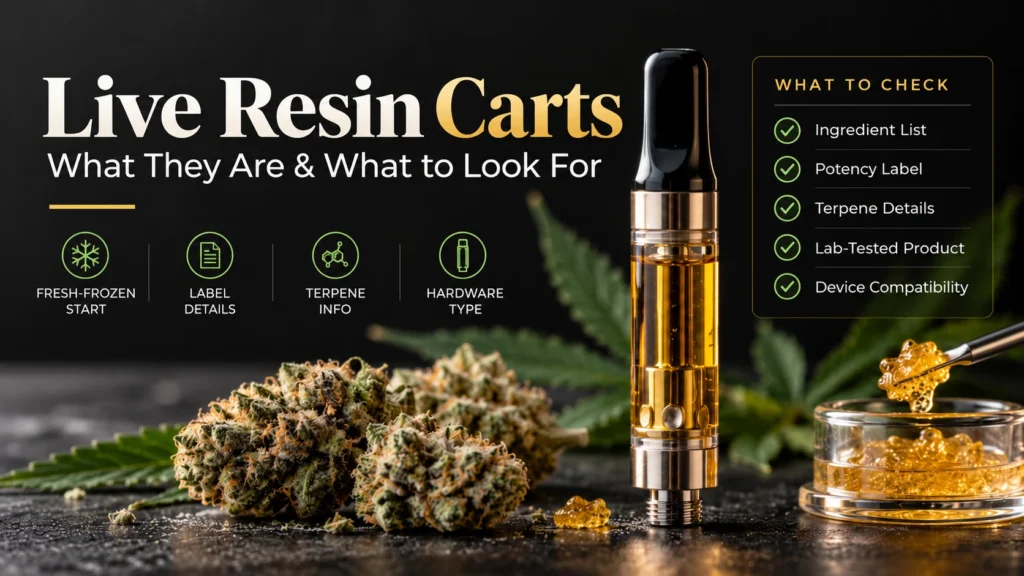
A live resin cart is a prefilled cannabis vape cartridge containing a vape-compatible live resin formulation. Live resin typically begins with freshly harvested cannabis that is frozen soon after harvest rather than dried and cured first.
That fresh-frozen starting material is what separates the category from many other cannabis extracts. Research on cannabis post-harvest handling shows that drying conditions can change volatile compounds, including terpenes. Live resin production tries to capture a profile closer to the fresh plant by moving from harvest into freezing before the conventional drying-and-curing stage.
The word cart tells you about the delivery hardware. The words live resin tell you about the concentrate inside.
Fast definition: “Live” describes the starting material. “Resin” describes the extract category. “Cart” describes the cartridge holding the vape oil.
That three-part definition is more useful than treating “live resin cart” as one mysterious product name.
If you want the broader device family first, Bud Board’s Weed Vapes Guide explains cartridges, disposables, vape pens, and dry-herb vaporizers.
What Does “Live” Actually Mean on a Vape Cart?
It does not mean the oil is alive. It does not mean the cartridge was manufactured yesterday. And it is not a government quality grade.
“Live” generally refers to the fresh-frozen cannabis used as the starting material.
Traditional cannabis flower is harvested, dried, and cured. Live resin skips that normal post-harvest route by freezing the plant before extraction. Because volatile compounds can change during drying and storage, the fresh-frozen approach gives processors a different chemical starting point.
The front label still does not tell the whole story
This is where shopping gets more interesting.
A package may use live-resin language while the full formulation includes more than one ingredient. New Mexico requires finished cannabis products to identify ingredients, including the cannabis extract or concentrate and isolated cannabinoids, and to list solvents, processing aids, and chemicals used in manufacturing. Some of that information may appear through a QR code or peel-back label.
So if the ingredients list live resin extract, that tells you something different from a formula that also lists distillate, isolated cannabinoids, or added terpenes.
Information-gain shortcut: The phrase “live resin” on the front tells you where to start. The ingredient panel tells you what formulation you are actually buying.
How Are Live Resin Carts Made?
The high-level process starts with cannabis that is frozen soon after harvest.
Licensed manufacturers then use a controlled extraction process, commonly a hydrocarbon-based method, to separate cannabinoids, terpenes, and other resin components from the frozen plant material. The extract is refined and prepared into a viscosity and composition that can function in compatible vape hardware.
That last part matters. A jar of live resin concentrate and a live resin cartridge are related products, but they are not automatically interchangeable.
A cartridge formulation has to move through small oil channels and a heating element. Producers may separate, recombine, decarboxylate, or otherwise formulate portions of an extract so the finished oil works in the device.
This is not a home-extraction project. Commercial live resin production can involve flammable solvents, pressure-rated equipment, ventilation, purification, and laboratory testing. This guide intentionally stays at the shopper level.
For the bigger concentrate family tree, see Cannabis Concentrates Explained.
Live Resin Cart vs Distillate Cart
Both can sit in nearly identical cartridges. The oil got there by a very different route.
| Feature | Live resin cart | Distillate cart |
|---|---|---|
| Typical starting point | Fresh-frozen cannabis | Cannabis extract that is further refined and distilled |
| Main processing goal | Retain a broader portion of the original extract profile | Refine toward a concentrated cannabinoid fraction |
| Terpenes | Often includes terpenes retained from the fresh-frozen extract | Terpenes removed during refinement may be added back in a finished formulation |
| THC percentage | Varies by batch and formulation | Often highly concentrated, but varies by batch and formulation |
| Better? | Not automatically | Not automatically |
The important purchasing point is that THC percentage is not a universal quality score. A higher number does not prove better flavor, better hardware, fresher oil, or a better fit for what you want.
Live resin and distillate are also not mutually exclusive in every commercial formulation. If a cart contains both distillate and live-resin-derived components, the ingredient list should be part of your comparison.
Bud Board’s Live Resin vs Distillate guide owns the deeper chemistry comparison, so we will spare this page from becoming its identical twin wearing a vape battery.
Live Resin vs Cured Resin Carts
This comparison turns on the plant material before extraction.
Live resin generally starts with fresh-frozen cannabis. Cured resin starts with cannabis that was dried and cured first. Both are resin extracts, and both can be formulated for cartridges.
That means “cured” is not another word for old, and “live” is not another word for fresh inventory.
Live resin
The plant is frozen soon after harvest before the normal drying-and-curing stage. The extraction begins from that fresh-frozen material.
Cured resin
The plant goes through drying and curing before extraction. That creates a different starting aromatic profile.
Neither name tells you the exact potency, terpene percentage, freshness on the shelf, or hardware quality. Those details remain batch-specific.
Live Resin Cartridge vs Disposable Vape
The oil can be similar. The hardware format is different.
Cartridge
A cartridge contains the cannabis oil and heating component but relies on a separate compatible battery. Many cannabis carts use the common 510-thread format, while some brands use proprietary pod or battery systems.
Disposable or all-in-one vape
An all-in-one device combines the oil reservoir, heating element, and battery into one unit. Some are rechargeable even though the oil portion is not replaceable.
That distinction has nothing to do with whether the oil is live resin. You can find live resin in cartridge hardware or in all-in-one devices.
Hardware shortcut: “Live resin” describes the concentrate. “510 cart,” “pod,” and “disposable” describe the device format.
Before buying a cartridge, confirm it fits the battery you already own. A beautiful cart that cannot connect to your device is basically a very tiny paperweight.
What Should You Check Before Buying a Live Resin Cart?
Skip the hunt for one magic number. Compare the product in layers.
- Product identity. Does the package actually identify the product as live resin, live resin sauce, a blend, distillate, or another vape formulation?
- Ingredient list. Look for the cannabis extract or concentrate, isolated cannabinoids if used, terpenes, and other listed ingredients. This is where “live resin” becomes more specific.
- Cannabinoid label. Compare tested Total THC and CBD information instead of assuming that the highest THC number is the best cart.
- Terpene information. If a terpene profile is available, use it to compare aroma chemistry. Do not treat one terpene percentage as a guaranteed effect or quality grade.
- Hardware compatibility. Check whether it is 510-thread, a proprietary pod, or an all-in-one device.
- Manufacturer and traceability. In New Mexico, regulated labels include manufacturer and state tracking information, with additional required details sometimes accessible by QR code.
- Dates and storage. Review the manufacturing or package information and follow the producer’s storage directions.
A useful eighth question: what does the menu leave out?
Online menus have limited space. A listing might show a product name, size, and THC percentage while leaving the ingredient panel inside the physical package.
If the exact formulation matters to you, ask to compare the package or available label information before checkout. That is a normal shopping question, not a chemistry oral exam.
Ready to compare current vape options?
Inventory varies by Bud Board location and by batch. Check the current menu for your preferred Carlsbad or Hobbs store, then use the label checklist above on the exact product that is available.
How Do You Read a Live Resin Cart Label in New Mexico?
New Mexico gives shoppers several pieces of information that are easy to miss if you only look at the front branding.
Current state rules require finished cannabis labels to identify the product, net quantity, tested potency, manufacturer information, manufacture date, ingredients, expiration date, state track-and-trace identifier, and other required information. The rules also require manufacturers to identify the cannabis extract or concentrate and isolated cannabinoids in the ingredient list.
For an inhaled product, potency is expressed as a percentage. Some required information can appear through a static QR code or a peel-back label when package space is limited.
What matters most for a live resin cart shopper?
- Product identity: what the manufacturer calls the formulation.
- Tested THC and CBD: batch-specific potency rather than menu assumptions.
- Ingredients: live resin extract, distillate, isolated cannabinoids, terpenes, or other listed components.
- Manufacturer: who produced the finished product.
- Manufacture and expiration dates: useful context for age and storage.
- Track-and-trace identifier: connects the product to the regulated system.
- Manufacturing inputs: New Mexico requires disclosure of solvents, processing aids, and chemicals used to manufacture cannabis concentrates or extracts.
If the label starts looking like it was typeset for ants, Bud Board’s How to Read a Cannabis Label in New Mexico guide breaks the state-required fields down one by one.
What Testing Applies to Live Resin in New Mexico?
New Mexico requires licensed cannabis products to undergo category-specific testing before retail sale.
Under the state’s current testing rule, volatile-solvent concentrates are tested for potency, microbiological contaminants, residual pesticides, and residual solvents. That residual-solvent category matters for live resin because commercial production commonly uses volatile solvents such as hydrocarbons.
Testing does not turn a cannabis vape into a risk-free product. It does give regulated-market shoppers information and contaminant limits that informal-market products may not provide.
Do not confuse “solvent-based” with “solvent-filled.” A solvent may be used during extraction, while the finished regulated concentrate must meet the state’s residual-solvent testing limits.
Are Licensed Live Resin Carts Safer Than Informal or Street Carts?
Vaping cannabis is not risk-free, and no responsible buying guide should pretend otherwise.
The strongest practical distinction for shoppers is regulated versus informal-source products.
The 2019–2020 EVALI outbreak was strongly linked to THC vaping products from informal sources, and vitamin E acetate played a major role in the outbreak. FDA and CDC guidance has warned consumers against THC vaping products from informal sources and against modifying products or adding substances that the manufacturer did not intend.
For New Mexico shoppers, that means buying sealed, regulated cannabis products from licensed retailers and reading the ingredient and testing information that comes with the package.
Do not modify a cartridge, refill it with an unknown oil, or add substances to it. Keep cannabis vapes secured away from children and pets, and do not drive or operate machinery while impaired.
How Should a Live Resin Cart Be Stored?
Follow the manufacturer’s directions first.
For everyday storage, protect the cartridge from excessive heat and direct sunlight. Leaving a cart in a hot vehicle can change the oil’s viscosity, speed degradation, and create leakage problems.
Keeping a cartridge upright when practical can also help reduce oil migration around the mouthpiece and air path.
A refrigerator is not automatically necessary. Cold temperatures can thicken oil, and moving a cold cartridge into a warm, humid environment can create condensation. Use refrigerated storage only when the manufacturer specifically recommends it.
If the oil has changed dramatically, the cartridge is leaking, the hardware is damaged, or the package is beyond its expiration date, do not let nostalgia make the buying decision for you.
Live Resin Cart FAQ
Live Resin Basics
What is a live resin cart?
A live resin cart is a cannabis vape cartridge containing a vape-compatible formulation made with live resin. Live resin generally starts with cannabis frozen soon after harvest rather than cannabis that was dried and cured first.
What does “live” mean in live resin?
“Live” refers to the fresh-frozen starting material. It does not mean the cartridge is alive, newly manufactured, or automatically higher quality than every other extract.
Is a live resin cart the same as a live rosin cart?
No. Both may start with fresh-frozen cannabis, but live resin is generally produced through solvent-based extraction. Live rosin uses solventless mechanical processing, commonly beginning with hash made from fresh-frozen cannabis. See Bud Board’s Live Resin vs Rosin guide for the full comparison.
Is every live resin cart full-spectrum?
Do not rely on “full-spectrum” as a substitute for the ingredient panel. Live resin can retain multiple cannabinoids and terpenes from the starting material, but finished cart formulations vary. Read the exact product label and ingredient list.
Shopping and Comparison
Are live resin carts stronger than distillate carts?
Not automatically. Potency varies by batch and formulation. Distillate is often highly concentrated in a target cannabinoid, while live resin prioritizes a broader extract profile. Compare the tested label rather than using the category name as a strength ranking.
Does darker or lighter live resin oil mean better quality?
No. Color can vary with cultivar, extraction, refinement, oxidation, age, and formulation. Color alone does not prove potency, freshness, purity, or quality.
Does a higher terpene percentage mean a better cart?
No. Terpene data can help describe aroma chemistry, but a single percentage is not a universal quality score and does not guarantee a particular effect.
What is the difference between live resin and cured resin carts?
Live resin begins with fresh-frozen cannabis. Cured resin begins with cannabis that was dried and cured before extraction. Both can be formulated for vape cartridges.
Is a live resin cart always 510-thread?
No. Many cartridges use the common 510-thread format, but proprietary pods and other hardware systems also exist. Check compatibility before buying.
New Mexico and Bud Board
What should I look for on a New Mexico live resin vape label?
Check the product identity, tested potency, ingredients, manufacturer, dates, traceability information, and any QR-code or peel-back information. New Mexico also requires disclosure of solvents, processing aids, and chemicals used during manufacture.
Can adults buy live resin carts in New Mexico?
Adults age 21 and older may buy compliant cannabis products from licensed New Mexico retailers with valid identification. Product availability varies by store and by batch.
Does Bud Board always have live resin carts in stock?
Inventory changes. Check the current online menu for your preferred Bud Board location in Carlsbad or Hobbs rather than assuming a specific live resin cart is available.
Find Vape Products at Bud Board
If you are shopping with a specific goal, this is where the education turns useful. Open the current menu for the store you plan to visit, compare available vape products, then check the exact package for ingredients, potency, hardware type, and testing information.
Live resin inventory varies by location and batch. The links below go to each Bud Board location page, where adults 21+ can view current menu options and place a pickup order when available.
Carlsbad — National Parks Hwy
4105 National Parks Highway, Carlsbad, NM.
View National Parks location & menuKey Takeaways
- A live resin cart is a cannabis vape cartridge containing a live-resin-based vape formulation.
- The word “live” refers to fresh-frozen cannabis used as starting material, not the age of the cartridge.
- The hardware does not make a product live resin. The oil formulation does.
- Live resin and distillate follow different processing goals, and neither category is automatically better.
- Cured resin starts with dried and cured cannabis, while live resin starts with fresh-frozen cannabis.
- A menu name may not reveal the complete formulation. Check ingredients for live resin, distillate, isolated cannabinoids, terpenes, and other listed components.
- THC percentage, terpene percentage, oil color, and price are not standalone quality scores.
- Confirm cartridge compatibility before purchase. Many carts are 510-thread, but proprietary systems also exist.
- New Mexico labels and linked information can provide potency, ingredients, manufacturer, traceability, dates, and manufacturing-input disclosures.
- Buy regulated products from licensed retailers, do not modify vape cartridges, and never drive while impaired.
- Bud Board vape inventory changes by location, so check the current Hobbs, Pierce, Canyon, or National Parks menu before heading to the store.
Research & Official Sources
- Weedmaps: What Is Live Resin? — current industry terminology for fresh-frozen starting material, concentrate formats, and live resin cartridges.
- Weedmaps: Live Resin Carts vs Distillate Carts — extraction goals, cartridge comparison, and common formulation differences.
- PubMed: Cultivar-Specific Drying Approaches for Medicinal Cannabis — research showing drying conditions can change preservation of volatile cannabis terpenes.
- PubMed: Influence of Drying and Storage on Cannabis Volatile Compounds — post-harvest research comparing drying and storage conditions.
- New Mexico 16.8.3 NMAC — current cannabis finished-product labeling requirements.
- New Mexico 16.8.7 NMAC — current cannabis testing requirements, including residual-solvent testing for volatile-solvent concentrates.
- FDA: Lung Injuries Associated With Vaping Products — EVALI findings and guidance about informal-source THC vaping products and additives.