
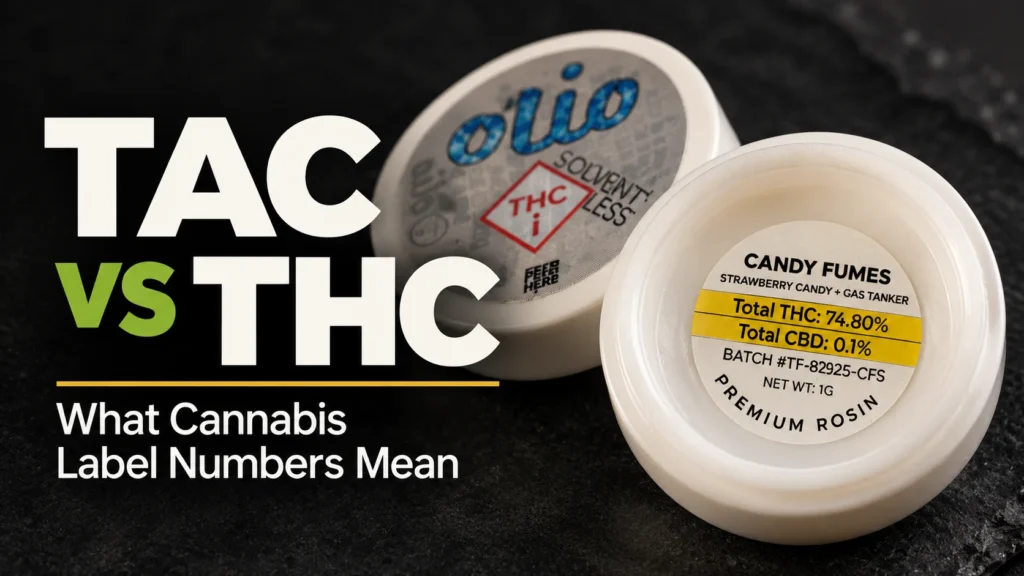
TAC vs THC: What Cannabis Label Numbers Actually Mean
Reviewed: October 14, 2026. This national guide uses laboratory documents, federal public-health information, NIST research, and a Massachusetts reporting rule as a clearly labeled jurisdictional example.
A cannabis label can go from simple to algebra surprisingly fast.
You may see delta-9 THC, THCA, total THC, total cannabinoids, or TAC sitting near one another. They look like competing potency scores. They are often measuring different things.
The most useful question is not “Which number is biggest?” It is “How did this report define and calculate that number?”
What Is the Difference Between TAC and THC?
THC refers to a specific cannabinoid. TAC is a broader total built from multiple cannabinoid results. The catch is that TAC is not defined by one nationwide formula, so the report or lab methodology matters.
| Term | What it describes | What to check | What it cannot establish |
|---|---|---|---|
| Delta-9 THC | The measured amount of delta-9 tetrahydrocannabinol in the sample. | Units, reporting basis, and whether the label is showing delta-9 THC specifically. | It does not include the potential THC represented by THCA unless the report combines them elsewhere. |
| THCA | The acidic precursor that can convert to delta-9 THC through decarboxylation from heat, light, or time. | Whether THCA is reported separately and how the report handles it in calculated totals. | THCA percentage by itself is not the same number as calculated total THC. |
| Total THC | A calculated estimate that commonly combines delta-9 THC with mass-adjusted THCA. | The formula used. A common formula is delta-9 THC + (THCA × 0.877). | It is not a measurement of how much THC a person will absorb. |
| TAC | Usually “Total Active Cannabinoids,” a combined cannabinoid figure based on the lab or report’s defined method. | Which cannabinoids are included, whether acidic forms are adjusted, and the report’s definition of the total. | It does not automatically measure intoxication, safety, quality, terpenes, or medical benefit. |
CDC describes THC as impairing and CBD as non-impairing, which is one reason a broad cannabinoid total should not be treated as an intoxication score. CDC cannabis FAQ
If the THC and THCA terminology is the part causing trouble, Bud Board’s THCA vs THC guide gives that comparison its own page.
What Does TAC Mean on a Cannabis Label?
In a potency context, TAC commonly means Total Active Cannabinoids. That sounds simple until you compare actual laboratory reports.
A 2026 MCR Labs New York certificate of analysis labels one line “Total Active Cannabinoids (sum of above table)”. The cannabinoid table above it includes delta-9 THC, THCA, CBG, CBGA, CBN, THCV, and other analytes. In other words, the word active in that report does not mean “only neutral cannabinoids after decarboxylation.” It is the name MCR uses for the sum defined on that report. MCR Labs 2026 COA
A real COA shows why the definition matters
On that MCR Labs report, the sample shows 41.8% Total Active Cannabinoids and 38.4% Total THC on the same potency page. Both numbers can be correct because they are different calculations.
SC Labs provides another useful example. Its FAQ distinguishes “Sum of Cannabinoids” from “Total Cannabinoids.” The sum adds tested cannabinoids as reported. Its Total Cannabinoids method applies a 0.877 mass adjustment to several acidic cannabinoids before adding them to their neutral forms. SC Labs also says the cannabinoid set and calculation can vary by lab location and state requirements. SC Labs FAQ
The useful rule: treat TAC as a report-defined total, not a universal formula. Read the legend, cannabinoid list, and calculation before comparing TAC across products or labs.
Terpenes stay outside this cannabinoid total. MCR Labs’ example report lists Total Cannabinoids and Total Terpenes as separate profiles. MCR Labs example report
For a broader explanation of the two compound families, see Bud Board’s Cannabinoids and Terpenes guide.
Is TAC the Same as Total THC?
No.
Total THC is a THC-specific calculation. It combines measured delta-9 THC with the theoretical THC contribution from THCA after a molecular-mass adjustment. Massachusetts, for example, requires combustion-intended cannabis products in its regulated market to calculate Total THC using only delta-9 THC and THCA. Massachusetts Cannabis Control Commission
TAC is broader. Depending on the report, it may combine THC-related values with CBD, CBG, CBN, CBC, THCV, acidic cannabinoids, or other cannabinoids on the test panel.
That also means “TAC should always be higher than THC” is too loose to use as a universal rule. First identify what the label means by THC. It could be delta-9 THC, calculated total THC, or a menu shorthand. Then confirm that TAC and THC use compatible units and reporting bases.
This is where a full cannabis-label check beats comparing two bold numbers on the front of a package.
A Real Rosin Label Shows the Difference
These original Bud Board photos show a real 1 g cannabis rosin jar and its retail potency label. The back label lists 74.80% Total THC and 0.1% Total CBD, but it does not display a TAC value.
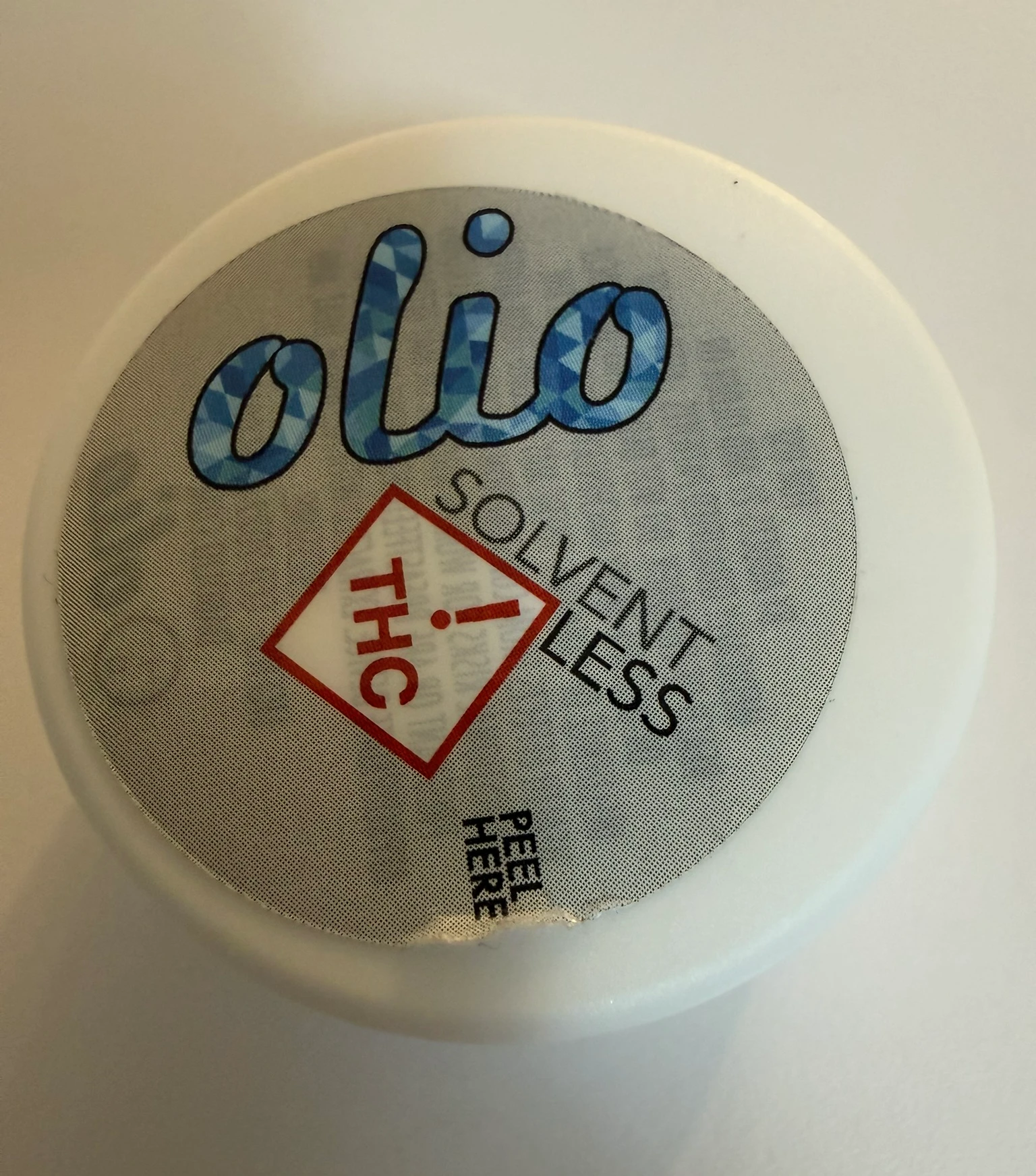
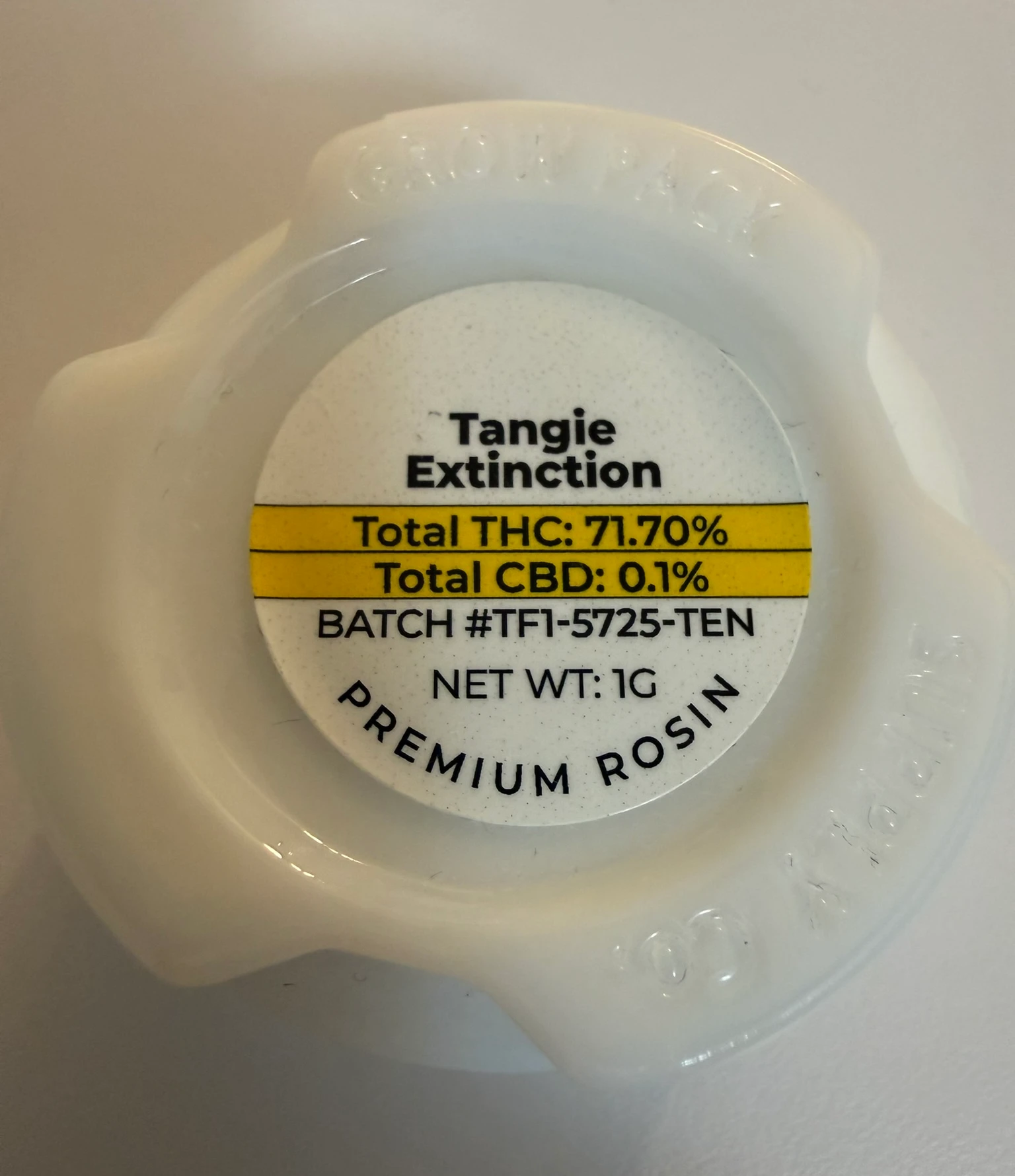
That absence matters. A retail package can prominently show Total THC without showing the broader cannabinoid total used by a laboratory. To know whether a TAC figure exists, which cannabinoids it includes, or how the lab calculated it, you would need the matching certificate of analysis or additional laboratory information.
How Is Total THC Calculated?
A commonly used calculation is:
The Massachusetts Cannabis Control Commission requires that exact calculation for specified combustion-intended products in Massachusetts. MCR Labs’ example report uses the same 0.877 factor for its Max THC calculation. Massachusetts guidance · MCR Labs example
Why 0.877? THCA loses a carboxyl group when it converts to THC. SC Labs explains that the multiplier adjusts for the resulting change in molecular mass. SC Labs FAQ
Hypothetical calculation
Suppose a flower report lists:
- 1.00% delta-9 THC
- 20.00% THCA
The arithmetic gives a theoretical calculated total. It does not mean a person will absorb 18.54% THC, and it does not promise complete conversion during smoking, vaping, or another heating process.
CDC notes that THCA can convert to THC when exposed to heat and that cannabis effects depend on several factors beyond a label percentage. CDC cannabis FAQ
Why Can Cannabinoid Totals Differ Between Lab Reports?
Two reports can disagree without one of them automatically being fake or dishonest. Several layers of the calculation can change.
1. The labs may test different cannabinoid lists
A total built from 15 reported cannabinoids is not necessarily comparable to one built from a smaller panel. SC Labs explicitly says its calculations can vary by location because state requirements and lab offerings include different cannabinoid sets. SC Labs FAQ
2. The totals may use different math
SC Labs’ own FAQ demonstrates this cleanly. Its “Sum of Cannabinoids” adds individual values directly. Its “Total Cannabinoids” applies acid-form conversion factors before summing. The labels sound similar. The math is not.
3. The reporting basis can change the percentage
Moisture basis matters for plant material. In 2024, Massachusetts changed its regulated reporting approach for certain cannabis products from dry-weight calculations to reporting cannabinoids “as received.” That is a Massachusetts requirement, not a nationwide rule. Massachusetts guidance
NIST’s Cannabis Laboratory Quality Assurance Program also distinguishes reporting basis and has laboratories compare cannabinoid measurements using defined sample conditions. NIST CannaQAP report
4. Analytical methods have real measurement variability
NIST designed CannaQAP to improve comparability between cannabis laboratories and to identify biases associated with extraction techniques, analytical methods, and calibration approaches. Its cannabinoid exercise examined within-laboratory and between-laboratory precision for delta-9 THC, THCA, total THC, and other cannabinoids. NIST CannaQAP
5. Rounding and detection limits can change the visible math
COAs may round displayed values, and tiny amounts can fall below a laboratory’s limit of quantitation. SC Labs explains that results below its quantitation threshold may appear as “< LOQ.” Adding the rounded numbers you can see may therefore produce a slightly different result from the laboratory’s calculation using underlying data. SC Labs FAQ
Does a Higher TAC Mean Stronger Effects or Better Quality?
No. TAC is a chemistry summary, not a quality grade or a promise about how someone will feel.
A higher TAC can come from cannabinoids other than THC. CDC describes delta-9 THC as impairing and CBD as non-impairing. That alone shows why adding multiple cannabinoids into one total does not create a clean “how high” score. CDC cannabis FAQ
CDC also lists previous cannabis experience, biology, route of use, amount, frequency, and use with other substances among the factors that can change a person’s response. A TAC percentage cannot compress all of that into one reliable prediction.
It is not a safety score either. Potency testing is only one part of a laboratory report. A full COA may separately cover microbial contaminants, pesticides, heavy metals, residual solvents, mycotoxins, water activity, or other tests depending on the product and jurisdiction. MCR Labs’ sample reports show cannabinoid potency and multiple safety panels as separate sections. MCR Labs example report
A bigger TAC number does not establish better flower, cleaner production, greater therapeutic benefit, a stronger “entourage effect,” or a more enjoyable experience. Those conclusions require evidence that a single cannabinoid total does not provide.
How Do You Read TAC on a Certificate of Analysis?
Start with the report before the headline number. A decent TAC comparison takes about a minute once you know where to look.
- Match the sample. Check the batch, lot, or sample ID and the report date so you know the COA belongs to the product you are comparing.
- Check the units. Percent by weight, dry-weight percent, as-received percent, mg/g, and mg per serving are different reporting formats.
- Find delta-9 THC and THCA separately. This tells you whether the displayed “THC” number is a direct measurement or a calculated total.
- Read the TAC or total definition. Look for a formula, footnote, legend, or line such as “sum of above table.” Do not assume another lab uses the same method.
- See which cannabinoids were actually tested. A broader panel can change a combined total.
- Watch for ND and <LOQ. “Not detected” and “below the limit of quantitation” describe the laboratory result, not necessarily a mathematically perfect zero.
- Check the rest of the COA. Potency alone does not tell you whether the batch passed applicable contaminant or safety testing.
SC Labs recommends using the official COA to view analyte-level results and notes that its reports include detection and quantitation limits. SC Labs FAQ
If you are new to the rest of the package language, Bud Board’s cannabis label guide covers the field-by-field basics. You can also browse Bud Board’s product categories to see how flower, concentrates, vapes, and edibles present cannabinoid information differently.
Common Mistakes When Comparing TAC and THC
Treating every “THC” number as the same thing
One menu may show delta-9 THC. Another may show calculated total THC. A COA may list both. Read the label before deciding two percentages are comparable.
Adding THCA to total THC again
If Total THC already equals delta-9 THC + adjusted THCA, adding THCA on top of that counts the same precursor twice.
Adding individual cannabinoids to TAC
If the report defines TAC as a sum that already includes those cannabinoids, adding CBD, CBG, CBN, or THC again inflates the total.
Comparing mismatched units
Twenty-five percent on a flower COA is not the same measurement as 25 mg in an edible. Even two percentages can use different moisture or reporting bases.
Assuming terpenes are inside TAC
TAC is a cannabinoid total. Terpenes are a separate chemical class and are commonly reported in their own profile.
Using TAC as a shortcut for effects or quality
TAC tells you about the report’s combined cannabinoid content under its method. It does not replace the cannabinoid profile, safety panels, product condition, or the many personal factors that influence cannabis effects.
Key Takeaways
- THC is one cannabinoid. TAC is a broader cannabinoid total.
- TAC is not standardized nationwide. The laboratory’s analyte list and calculation determine what the number includes.
- Total THC is a separate calculation. A common formula is delta-9 THC + (THCA × 0.877).
- “Total cannabinoids,” “sum of cannabinoids,” and “total active cannabinoids” are not safe to treat as interchangeable labels.
- Compare like with like. Match units, reporting basis, tested compounds, and calculation method before comparing products.
- Higher TAC does not automatically mean stronger effects, better quality, greater safety, or greater medical benefit.
Frequently Asked Questions
Is TAC the same as THC?
No. THC refers to tetrahydrocannabinol, while TAC is a broader cannabinoid total defined by the report or lab. A TAC figure can include THC-related values plus other cannabinoids.
Does TAC include THCA?
It can, but you need the report’s definition. A 2026 MCR Labs New York COA includes THCA in the cannabinoid table used for its “Total Active Cannabinoids” sum. Other labs may apply conversion factors or use a different cannabinoid set.
Does TAC include terpenes?
Not in a cannabinoid total. Terpenes are a different chemical class. MCR Labs, for example, reports total cannabinoids and total terpenes separately.
Why can TAC be higher than THC?
TAC may include additional cannabinoids beyond the THC-related result. Before comparing the two, confirm whether “THC” means delta-9 THC or calculated total THC and make sure both numbers use the same units and reporting basis.
Is there a universally good TAC percentage?
No. There is no evidence-based TAC cutoff that makes cannabis universally “good,” high quality, safe, or appropriate for a particular person. Product type and the laboratory’s calculation also affect the number.
Can TAC mean something else on a cannabis lab report?
Yes. In microbial testing, TAC can mean Total Aerobic Count, a measure related to aerobic bacteria. Context makes the difference. A microbial TAC result may use units such as CFU/g, while a potency TAC may appear as a cannabinoid percentage or other cannabinoid-content unit. Medicinal Genomics: Total Aerobic Count
Sources and Review Date
Reviewed October 14, 2026. Laboratory terminology and cannabis reporting rules vary by jurisdiction. The Massachusetts reporting requirement cited in this article is used as a documented example and should not be read as a nationwide or New Mexico rule.
- SC Labs FAQ: Sum of Cannabinoids versus Total Cannabinoids, 0.877 acid-form adjustment, LOQ, and measurement uncertainty.
- MCR Labs Example Report: Total Cannabinoids, Max THC formula, separate terpene reporting, and safety panels.
- MCR Labs 2026 New York COA: real-world “Total Active Cannabinoids (sum of above table)” example and Total THC reported on the same potency panel.
- Massachusetts Cannabis Control Commission, March 8, 2024: jurisdiction-specific Total THC formula and as-received reporting guidance.
- NIST CannaQAP Exercise 2: cannabinoid measurement comparability, laboratory methods, and precision.
- CDC Cannabis FAQ: THC, THCA, CBD, total THC context, impairment, and factors affecting a person’s response.
- Medicinal Genomics: Total Aerobic Count: the separate microbial-testing meaning of TAC.