
Last Updated: August 29, 2026. Cannabis science, testing rules, labels, and federal or state laws can change. This guide is educational and is not medical or legal advice.
THCA vs THC sounds like somebody added one letter to a chemistry test just to make the dispensary label more confusing.
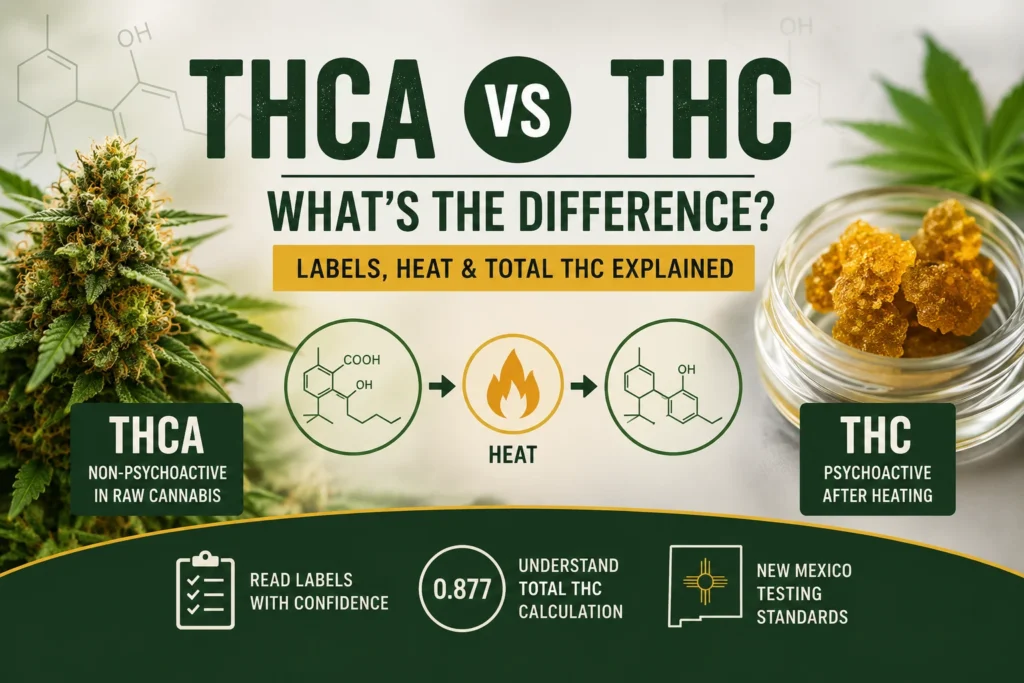
The good news is that the difference becomes much easier once you understand one idea: THCA is the starting form, and heat can convert it into THC.
That one reaction explains why flower can show a very high THCA percentage but a much smaller THC percentage, why smoking and vaping change the chemistry, and why a label’s “Total THC” number is not simply THCA plus THC.
THCA vs THC at a Glance
| Question | THCA | THC |
|---|---|---|
| Full name | Tetrahydrocannabinolic acid | Tetrahydrocannabinol, usually delta-9 THC in normal cannabis labeling |
| Where it appears | Commonly abundant in raw or unheated cannabis flower | Present in varying amounts depending on the product and processing |
| What heat does | Heat can decarboxylate THCA into THC | Already in the neutral form |
| Intoxication | THCA is chemically different from delta-9 THC, the cannabinoid primarily associated with cannabis intoxication | Delta-9 THC is associated with the classic intoxicating cannabis effect |
| Why it matters on a label | Shows how much acidic precursor was measured | Shows how much THC was already measured in the sample |
| New Mexico Total THC calculation | THCA percentage is multiplied by 0.877 | Measured THC is then added to the converted THCA value |
What Is THCA?
THCA stands for tetrahydrocannabinolic acid. It is an acidic cannabinoid produced by the cannabis plant and is the direct chemical precursor to delta-9 THC.
Fresh and unheated cannabis can contain much more THCA than THC. Over time, and especially when heat is added, some of that THCA can lose a carboxyl group and become THC.
This is why looking at only the THC line on a flower label can be misleading. A flower sample might show a relatively small amount of measured THC while carrying a much larger amount of THCA that can contribute to potential THC after heating.
For a broader look at how cannabinoids fit together, see Bud Board’s Cannabinoids and Terpenes Master Guide.
What Is THC?
THC usually means delta-9 tetrahydrocannabinol when people are talking about cannabis labels, flower, concentrates, or intoxication.
Delta-9 THC is the primary intoxicating cannabinoid associated with the classic cannabis high. It can affect perception, coordination, reaction time, memory, and judgment, which is why driving after using THC is unsafe.
THC is not a quality score. A higher number means a higher concentration of that cannabinoid, not automatically better flower, better flavor, better cultivation, or a better experience.
How Does THCA Turn Into THC?
The conversion is called decarboxylation.
In plain English, THCA has an extra chemical group attached to it. When enough heat and time are applied, that group can break away as carbon dioxide, leaving THC behind.
Smoking, vaping, and baking can all drive this reaction. Decarboxylation can also happen more slowly during storage, but heat speeds it up considerably.
The Simple Version
THCA + heat → THC + carbon dioxide
That tiny chemistry lesson explains a surprisingly large part of the modern cannabis label.
Peer-reviewed research describes THCA as the acidic precursor of THC and heating as one of the major drivers of decarboxylation.
Read the peer-reviewed review on acidic cannabinoid decarboxylation.
Why Does Cannabis Flower Show So Much THCA on the Label?
Because a laboratory tests the sample before you smoke or vape it.
At that stage, much of the potential THC in ordinary flower may still exist as THCA. So a regulated label can show separate numbers for THCA and THC rather than pretending they are already the same thing.
That is useful information, but it means shoppers need to know which number they are reading.
If you are looking at a New Mexico package and the rest of the tiny print is fighting back, our field-by-field cannabis label guide explains potency, serving information, warnings, dates, traceability, and other label details.
What Does “Total THC” Actually Mean?
Total THC is a calculated potency value that combines the THC already present with the potential THC contribution from measured THCA after applying a conversion factor.
New Mexico’s potency-testing rule for solid cannabis products uses this formula:
New Mexico Total THC Formula for Solids
Total THC = (THCA % × 0.877) + THC %
For liquid products, New Mexico uses the same relationship with THCA and THC reported in mg/ml.
This calculation gives a more useful picture of potential THC than looking at the measured THC line alone.
But Total THC is not a promise that your body will receive exactly that amount. Real-world conversion and absorption can vary with the product, temperature, device, time, losses during heating, and the person using it.
Why Does the Formula Multiply THCA by 0.877?
This number is not a dispensary tradition somebody made up between shifts.
THCA is a heavier molecule than THC because it contains the extra carboxyl group that is removed during decarboxylation. When that group leaves as carbon dioxide, some molecular mass is lost.
The ratio between the molecular weights of THC and THCA is approximately 0.877. That is why 1% THCA does not theoretically become 1% THC by weight.
A useful way to think about it:
100 units of THCA by weight can theoretically contribute about 87.7 units of THC after accounting for the mass lost during decarboxylation.
That conversion factor is the reason simply adding THCA + THC will overstate calculated Total THC.
How Do You Calculate Total THC From a Cannabis Label?
Here is a simple example using made-up numbers for teaching purposes.
Example Flower Label
THCA: 24.0%
THC: 1.0%
(24.0 × 0.877) + 1.0 = 22.048%
Calculated Total THC: about 22.05%
If you simply added 24% THCA and 1% THC, you would get 25%. That is not how New Mexico calculates Total THC.
The 0.877 factor accounts for the molecular weight lost when THCA converts to THC.
THCA vs THC Percentage: Which Number Should You Read?
When comparing flower, look at the numbers as a group instead of picking whichever percentage is biggest.
- THCA % tells you how much THCA the laboratory measured.
- THC % tells you how much THC was already present in the tested sample.
- Total THC % estimates combined THC potency after accounting for THCA’s potential contribution.
For a shopper trying to understand potential THC concentration in flower, Total THC is usually the most useful single number of the three.
It still should not be used as a quality grade. Two flowers with similar Total THC can differ in freshness, cure, aroma, cannabinoid balance, terpene profile, and overall characteristics.
THCA vs THC: Which Is Stronger?
This question mixes two different things.
If you are comparing the isolated molecules, delta-9 THC is the one associated with the familiar intoxicating cannabis effect. THCA is chemically different from delta-9 THC, the cannabinoid primarily associated with cannabis intoxication.
If you are comparing flower labels, though, a high THCA percentage can still matter a lot because heating the flower can convert a substantial portion of that THCA into THC.
A Better Question to Ask
How much measured THC is already present, how much THCA is present, and what is the calculated Total THC?
That is far more useful than treating THCA and THC like two competing potency brands.
THCA vs THC vs Delta-9: Are They the Same?
Not exactly.
- THCA is tetrahydrocannabinolic acid, the acidic precursor.
- Delta-9 THC is the neutral intoxicating cannabinoid produced when THCA decarboxylates.
- THC in everyday cannabis conversation commonly refers to delta-9 THC.
- Total THC is a calculated potency value that incorporates measured THCA and measured THC.
For a comparison with other THC-family cannabinoids, see Bud Board’s Delta-8 vs Delta-9 vs THCV guide.
What Is THCA Flower?
“THCA flower” is a phrase that has become common online, but it can make normal cannabis chemistry sound more exotic than it is.
Many cannabis flowers naturally contain THCA as a major cannabinoid before heating. Calling something “THCA flower” does not create a new cannabinoid species or mean the flower stays chemically unchanged once it is smoked, vaped, or otherwise heated.
What matters is the actual tested cannabinoid profile, the product’s legal status where it is sold or possessed, and how it is used.
For flower shopping generally, potency is only one part of the picture. Our guide to spotting quality cannabis flower covers freshness, aroma, cure, trichomes, cleanliness, and other useful signals.
How Does New Mexico Test THC and THCA?
New Mexico’s cannabis testing rules require potency testing to determine the quantity of THC, THCA, CBD, and CBDA in tested samples and to calculate THC and CBD potency.
For solid products, 16.8.7 NMAC reports cannabinoids by weight and gives the following Total THC formula:
Total THC = (% THCA × 0.877) + % THC
The rule requires potency testing for multiple regulated product categories when testing is required before sale, including flower and several concentrate or manufactured-product categories.
Read New Mexico 16.8.7 NMAC: Quality Control, Inspection, and Testing of Cannabis Products.
Why Total THC Is Useful but Not the Whole Story
Total THC can help compare cannabinoid concentration, but it cannot tell you everything about a cannabis product.
It does not tell you whether flower was cured well, whether the aroma is fresh, whether a concentrate has the texture you prefer, or exactly how a specific person will respond.
It also does not tell you the exact dose your body will absorb after smoking or vaping.
For concentrates, where cannabinoid percentages can be much higher than flower, the same principle becomes even more important. Read the label rather than treating the biggest number as a quality trophy.
Our Cannabis Concentrates Explained guide breaks down wax, shatter, live resin, rosin, and other concentrate formats.
Common THCA vs THC Misconceptions
Misconception 1: “THCA and THC are the same thing.”
They are closely related cannabinoids, but they are different molecules. THCA is the acidic precursor that can convert into THC.
Misconception 2: “You just add THCA and THC together.”
Not for New Mexico’s Total THC calculation. THCA is multiplied by 0.877 before measured THC is added.
Misconception 3: “A flower with 25% THCA has 25% THC.”
No. A THCA percentage is not the same measurement as already-present THC. Use the Total THC calculation or the laboratory’s reported Total THC value when available.
Misconception 4: “THCA flower stays THCA when you smoke it.”
Heating drives decarboxylation, so THCA can convert into THC during smoking or vaping.
Misconception 5: “Higher Total THC means higher quality.”
Higher Total THC means higher calculated THC concentration. It does not automatically mean better aroma, cure, freshness, flavor, cultivation, or overall quality.
Misconception 6: “Total THC tells me exactly how strong the experience will be.”
No. Total THC describes potency by concentration. It does not predict an individual’s exact response or the exact amount absorbed.
What Bud Board Budtenders Wish Shoppers Knew
“If a flower label shows a big THCA number and a small THC number, that does not mean the lab made a mistake. Start with Total THC and then look at the rest of the label.”
“THCA and THC are one letter apart, which is very efficient if your goal is making the back of a cannabis jar look like a pop quiz.”
Key Takeaways
- THCA is the acidic precursor to delta-9 THC.
- Heat can convert THCA into THC through decarboxylation.
- Cannabis flower can show much more THCA than measured THC before it is heated.
- New Mexico calculates Total THC for solids as (THCA % × 0.877) + THC %.
- The 0.877 factor accounts for molecular weight lost when THCA releases carbon dioxide and becomes THC.
- The 0.877 factor is not a real-world conversion-efficiency percentage.
- Total THC is more useful than simply adding THCA and THC percentages.
- Total THC is a potency calculation, not a guarantee of exact absorbed dose or individual effect.
- THC percentage alone does not determine overall cannabis quality.
Research and Official Sources
THCA vs THC FAQ
What is the main difference between THCA and THC?
THCA is the acidic precursor to THC. Heat can decarboxylate THCA and convert it into delta-9 THC. The two are related, but they are not the same molecule.
Does THCA get you high?
THCA is chemically different from delta-9 THC, the cannabinoid primarily associated with cannabis intoxication. When THCA is heated, however, it can convert into delta-9 THC. That is why smoking or vaping high-THCA flower can still produce intoxicating effects.
Does THCA turn into THC when heated?
Yes. Heat can drive decarboxylation, the chemical reaction that converts THCA into THC by removing a carboxyl group and releasing carbon dioxide.
Why does cannabis flower have more THCA than THC?
Before flower is smoked or vaped, much of its potential THC may still exist as THCA. The laboratory measures the unheated sample, so separate THCA and THC values can appear on the label.
What is Total THC?
Total THC is a calculated potency value that combines measured THC with the potential THC contribution from THCA after applying a conversion factor.
How does New Mexico calculate Total THC?
For solid cannabis products, New Mexico’s testing rule uses: Total THC = (THCA percentage × 0.877) + THC percentage.
Why is THCA multiplied by 0.877?
THCA loses part of its molecular mass when it releases carbon dioxide during decarboxylation. The 0.877 factor adjusts for that difference in molecular weight. It does not mean exactly 87.7% of THCA will convert into THC during real-world use.
Is THCA stronger than THC?
That is not a direct apples-to-apples comparison. Delta-9 THC is the cannabinoid primarily associated with intoxication. THCA can still matter greatly in flower because heating can convert a substantial portion of it into THC.
Is THCA the same as Delta-9 THC?
No. THCA is the acidic precursor. Delta-9 THC is the neutral cannabinoid produced when THCA decarboxylates.
Is THCA flower different from regular cannabis flower?
Many cannabis flowers naturally contain substantial THCA before heating. “THCA flower” is often a marketing or legal-category term, so use the tested cannabinoid profile and applicable local law rather than the name alone.
Does a higher Total THC percentage mean better cannabis?
No. It means a higher calculated THC concentration. Quality also involves factors such as freshness, cure, aroma, cleanliness, product format, and personal preference.
Reading a Cannabis Label Should Not Require a Chemistry Degree
If you are comparing THCA, THC, Total THC, serving sizes, or other label numbers, start with the tested information rather than the biggest number on the package. Bud Board budtenders can help explain product formats and labels without turning the conversation into chemistry class.
Find a Bud Board location in Carlsbad or Hobbs and check the current menu before you visit.
Pingback: Weed Trichomes Explained: Clear, Cloudy & Amber Trichomes