Last Updated: October 2026. Product names, formulations, potency, and inventory vary by brand and store. This guide is for adult cannabis education and shopping, not medical advice.
Moon rocks look like someone took a normal cannabis bud and gave it a winter coat.
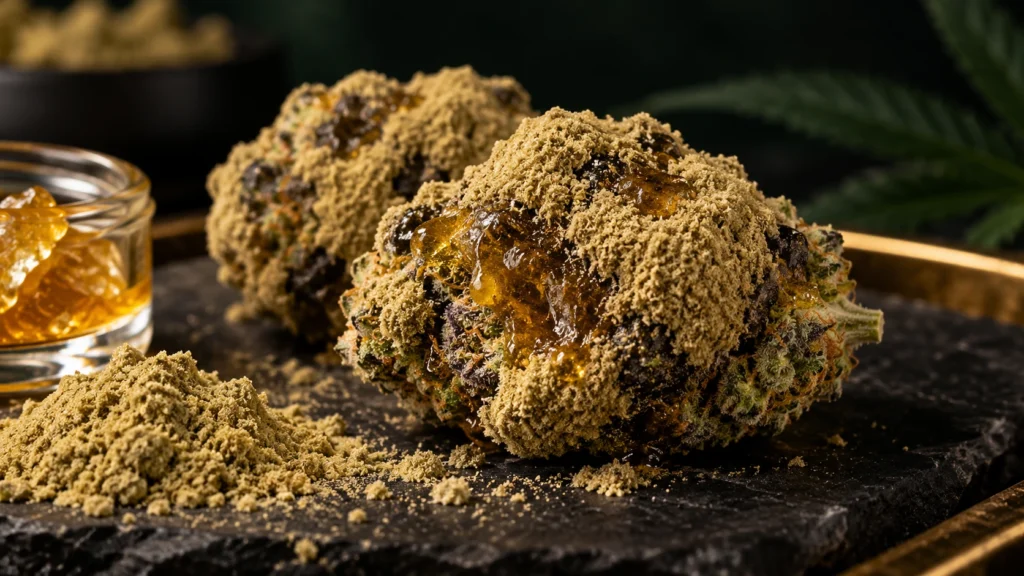
Under that fuzzy outer layer is a fairly simple idea: flower on the inside, concentrate around it, kief on the outside.
The confusing part starts when a menu adds words like moonrock joint, caviar, infused flower, or a THC number with no explanation of what produced it.
This guide sorts out those terms, shows you what to check on the label, and gives you a cleaner path from “What am I looking at?” to “Is this the product I actually want?”
What Is Moon Rock Weed?
Moon rock weed is cannabis flower coated in a cannabis concentrate and covered with kief. The finished product still has a flower bud at its core, but the added concentrate and kief make it different from ordinary flower.
That layered construction is the defining idea. The exact flower strain, type of concentrate, kief source, and final potency can all change from one product to another.
Moon rocks are commonly grouped with infused flower because the base flower has been combined with additional cannabis-derived ingredients. That does not mean every infused flower product is a moon rock.
Short version: all moon rocks are infused flower in the broad sense, but infused flower can be made in other ways and does not have to follow the flower + concentrate + kief structure.
If you want to compare ordinary buds before adding concentrates to the picture, Bud Board’s Flower page lets you browse current flower inventory by Carlsbad or Hobbs location.
What Are Moon Rocks Made Of?
Three layers create the classic moon rock structure.
Cannabis flower
The center is a whole or mostly intact cannabis bud. The strain and quality of that flower can vary by product.
Cannabis concentrate
A sticky cannabis extract or concentrate coats the outside of the flower. The exact concentrate may differ by manufacturer.
Kief
The coated bud is covered with fine trichome-rich material. Kief contains cannabinoids and terpenes separated from cannabis flower.
The concentrate layer is where a generic explanation can become misleading. “Hash oil” is often used as shorthand online, but commercial products may use different extracts or formulations. The package should tell you what went into the finished product.
For the concentrate side of the equation, Bud Board’s Concentrates page shows current concentrate categories and live store menus. For the powdery outer layer, the What Is Kief? guide explains what kief actually is and how it differs from more refined dry-sift products.
Moon Rocks vs Regular Cannabis Flower
They may both start as a bud, but they are not the same retail product once the extra layers go on.
| Feature | Moon rock weed | Regular flower |
|---|---|---|
| What it contains | Flower plus added concentrate and kief | Cannabis flower without an added concentrate coating |
| Texture | Dense, sticky, coated, sometimes tacky | Varies by cure and moisture, but lacks the added sticky coating |
| Potency | Often higher because multiple cannabis materials contribute cannabinoids | Depends on the tested flower batch |
| Easy to inspect? | The coating can make the flower underneath difficult to judge visually | Bud structure, trichomes, trim, and condition are easier to see directly |
| Grinder friendly? | Usually a poor fit because the coating can stick to teeth and screens | Commonly ground for many flower uses |
That last point is worth remembering if you just bought a nice grinder. Moon rocks can be sticky enough to coat the teeth and screen while leaving some of the concentrate and kief inside the grinder instead of on the product.
Bud Board’s Infused Cannabis Flower guide covers the larger infused-flower category if you want to see where moon rocks fit among other products.
How Much THC Is in Moon Rocks?
There is no single THC percentage for moon rock weed.
You will often see “around 50% THC” repeated online. Current Leafly and Weedmaps guides both use roughly that range as a general reference for many moon rock products. That is useful context, but it is not a definition, a legal standard, or a promise about the package in front of you.
The flower has its own cannabinoid profile. So does the concentrate. So does the kief. Change any of those ingredients or their proportions and the finished result can change.
Better shopping rule: ignore the folklore number and read the tested batch potency. If two products both say “moon rocks,” their THC percentages can still be very different.
A high THC percentage also does not tell you everything about freshness, flower quality, terpene content, ingredient quality, or whether the product fits your preferences. One number cannot do that much work.
Moon Rocks vs Infused Pre-Rolls
Both combine flower with added cannabis concentrates, but the format is different.
A moon rock keeps the bud structure largely intact and coats it externally with concentrate and kief. An infused pre-roll packages ground flower and one or more infused ingredients inside a ready-made roll. Some pre-rolls may also have concentrate or kief applied to the outside.
This is why moonrock joint can be a fuzzy search term.
What does “moonrock joint” usually mean?
On menus and product pages, the phrase can refer to an infused pre-roll inspired by moon rocks rather than a whole moon rock nug somehow stuffed into paper. The formulation may use flower, concentrate, kief, or another combination.
The name alone is not enough. Check the ingredient and product description.
For the broader category, see Bud Board’s Infused Pre-Rolls guide.
Moon Rocks vs Cannabis Caviar
The terms are sometimes used interchangeably, which is exactly why this comparison belongs here.
Leafly describes moon rocks as flower coated with liquid cannabis concentrate and kief. It notes that cannabis caviar may refer to a similar concentrate-coated bud but does not always include the outer kief layer.
In real retail language, brand naming can blur that distinction. If a dispensary menu says caviar, look at the ingredients instead of assuming kief is present.
Same advice in reverse: if a product says moon rocks, the label should give you a clearer picture of what concentrate and other ingredients the manufacturer used.
How to Read a Moon Rock Product Label in New Mexico
Moon rocks are exactly the sort of product where the ingredient list earns its keep.
Under current New Mexico cannabis labeling rules, finished product labels include the product identity, tested potency, manufacturer information, manufacture date, ingredients, expiration date, state tracking information, and other required details. The ingredient rules call for cannabis extracts or concentrates and isolated cannabinoids to be identified when used.
Start with the product identity
Look at how the manufacturer classifies the item. It may appear as infused flower, moon rocks, caviar, or another branded format.
Then read the ingredient list
You are looking for the three basic pieces: flower, the concentrate or extract, and kief or another trichome-rich outer material. Commercial formulas can vary, so do not assume the concentrate type from a photo.
Use the tested potency
New Mexico requires laboratory-confirmed potency on finished cannabis labels. For inhaled cannabis products, potency is expressed as a percentage in the state’s labeling framework.
Check the dates and manufacturer
The manufacture date and expiration date give you more context than a menu thumbnail. The label also identifies the licensed manufacturer responsible for the finished product.
Do not skip the QR code or peel-back label
Small packages do not have much real estate. New Mexico allows some required information to appear through an approved static QR code or peel-back label when space is limited.
The label should answer the useful questions
What is it? What cannabis materials are in it? What did the batch test at? Who made it? When was it made? That is more useful than trying to judge a fuzzy nug by eyesight alone.
How Should Moon Rocks Be Stored?
Follow the manufacturer’s directions first.
In general, keep moon rocks in their original closed container, away from excess heat, direct sunlight, moisture, children, and pets. The concentrate coating can soften or become messier when it gets warm.
An airtight container can also help limit unnecessary exposure to air, but the package the product came in should remain your starting point for storage directions and expiration information.
Do not toss moon rocks loose into the same container as ordinary flower unless you want everything else in the jar to become part of the experiment.
Shopping for Moon Rocks at a Dispensary
The menu category can vary.
One retailer may place moon rocks under flower or infused flower. Another may group them near concentrates. A brand may use a name like caviar or infused buds instead.
That makes the ingredient list and live menu search more useful than relying on one category label.
Start with the product categories
Bud Board’s Flower page and Concentrates page both let you choose a Carlsbad or Hobbs store and view current inventory. You can also use the Products hub when you want to browse across categories.
We are not saying Bud Board has moon rocks in stock right now. Inventory changes by location and can change during the day. Search the current menu for your store before making the trip.
Carlsbad — Pierce Street
Check the current Pierce Street menu, store hours, and directions.
View Pierce StreetCarlsbad — Canyon Street
Browse Canyon Street store details and current menu access.
View Canyon StreetCarlsbad — National Parks Hwy
See the National Parks Highway location, hours, and live shopping options.
View National ParksHobbs — West Marland Blvd
Check current Hobbs inventory and pickup options before you head over.
View HobbsCompare all Bud Board locations
Moon Rock Weed FAQ
Moon Rock Basics
What is moon rock weed?
Moon rock weed is cannabis flower coated in a cannabis concentrate or extract and then covered with kief. The exact flower, concentrate, kief, and potency vary by product.
What are moon rocks made of?
The classic structure uses cannabis flower as the center, a sticky cannabis concentrate as the coating, and kief as the outer layer. Commercial formulations can use different strains and different types of concentrate.
Are moon rocks the same as infused flower?
Moon rocks fit within the broader idea of infused flower because additional cannabis concentrates and kief are added to flower. Infused flower can also be made in other ways, so the terms are not interchangeable.
Are moon rocks the same as cannabis caviar?
Not always. The terms are sometimes used loosely, but caviar may describe concentrate-coated flower without the outer kief layer. Read the product description and ingredients instead of relying on the name alone.
THC and Product Comparison
How much THC is in moon rocks?
There is no fixed percentage. Online guides often mention products around 50% THC, but potency varies with the flower, concentrate, kief, ratios, and manufacturing process. Use the tested potency on the exact product label.
Are moon rocks stronger than regular flower?
They often test higher because the finished product combines flower with additional cannabinoid-rich concentrate and kief. The size of the difference is product-specific, so compare laboratory-tested labels instead of assuming a number.
What is a moonrock joint?
The phrase often refers to an infused pre-roll that uses flower with concentrate and kief or a similar moon-rock-inspired formulation. It does not guarantee that a whole moon rock nug is inside. Check the package ingredients and product description.
Should moon rocks go in a weed grinder?
Usually not. The concentrate coating and kief can stick to grinder teeth and screens, leaving part of the product behind and making the grinder harder to clean.
Shopping and Storage
Where can I buy moon rock weed in New Mexico?
Availability varies by licensed dispensary and by current inventory. Search the live menu for the store you plan to visit and verify the exact product label before purchasing.
Does Bud Board sell moon rocks?
Moon rock inventory can change, so this article does not assume a product is currently in stock. Check Bud Board’s live Flower, Concentrates, or store menus for the location you plan to visit.
How should moon rocks be stored?
Follow the package directions and keep them in the original closed container away from excessive heat, direct sunlight, moisture, children, and pets. Check the expiration date and any manufacturer-specific storage instructions.
Key Takeaways
- Moon rock weed combines cannabis flower, a cannabis concentrate or extract, and kief.
- The layered construction separates moon rocks from ordinary flower and many other infused products.
- There is no universal moon rocks THC percentage. The tested batch label is the useful number.
- The “around 50% THC” figure commonly repeated online is a general reference, not a standard or guarantee.
- Moon rocks and cannabis caviar are sometimes used as overlapping terms, but caviar does not always include kief.
- A moonrock joint is usually an infused pre-roll format, not a standardized product definition.
- New Mexico labels can tell you the product identity, potency, ingredients, manufacturer, dates, and other regulated information.
- Moon rocks are sticky enough that putting them through a grinder can leave concentrate and kief behind.
- Bud Board inventory varies by store. Check the current Flower, Concentrates, Products, or location menu before making a trip for a specific item.
Research & Reference Sources
- Weedmaps: What Are Moon Rocks? — current terminology, composition, potency variability, storage, and moon rocks versus caviar.
- Leafly: Moon Rocks Glossary — flower, concentrate, kief, and caviar terminology.
- Leafly: What Are Moon Rocks? — moon rock composition and commonly cited potency context.
- New Mexico 16.8.3 NMAC — current finished-product labeling and packaging requirements.
- Bud Board Flower — current flower shopping by Carlsbad and Hobbs location.
- Bud Board Concentrates — current concentrate shopping by location.