Last Updated: July 2026. This guide provides general adult-use cannabis education. Potency and effects vary by product and batch, so read the label, ask questions, and do not drive after using THC.
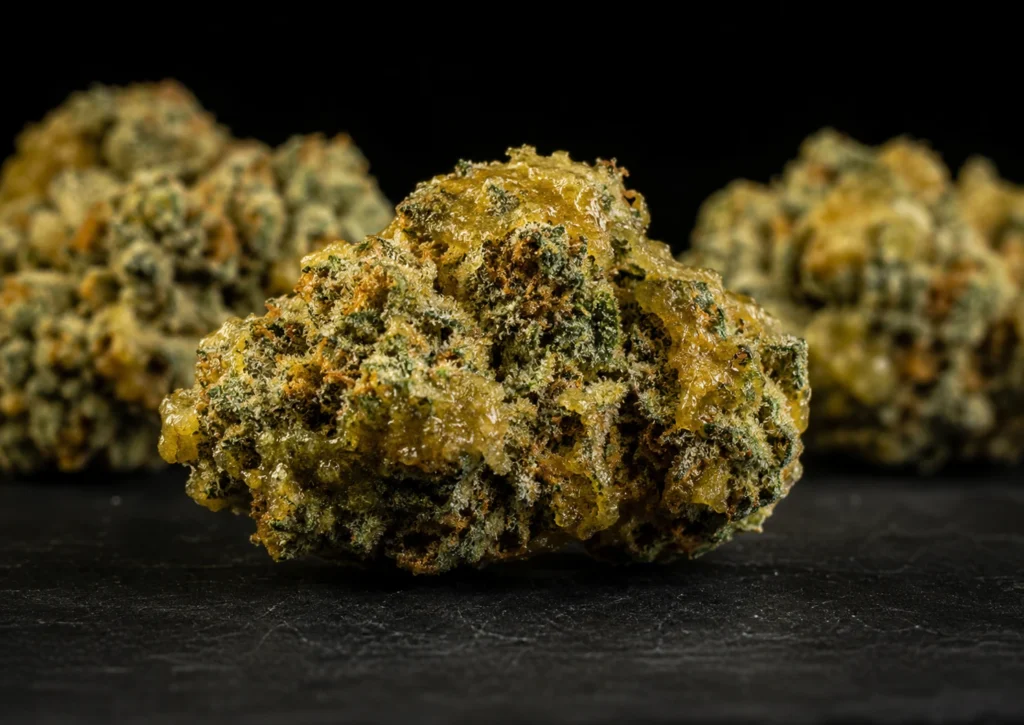
You asked your budtender for something a little stronger, and they pointed you toward a jar that looked like regular flower had gotten dressed up for a night out, shiny, sparkly, slightly extra. That’s infused flower, and it is not just fancy bud with better lighting (please don’t grind it in your regular grinder, we’ll get to that). Here’s what infused cannabis flower actually is, how it’s made, why the name on the jar tells you less than the number on the label, and what to check before it ends up in your rotation.
What Infused Cannabis Flower Actually Is
Infused flower starts as ordinary cured cannabis bud. A processor then adds a second layer of cannabinoids by applying a concentrate, commonly distillate, live resin, or hash oil, to the outside or throughout the flower. Many versions are finished with a coating of kief, the fine, trichome-rich powder that collects at the bottom of a grinder.
Because infused flower carries both the flower’s own cannabinoids and an added concentrate, it generally tests higher in THC than standard flower. For context, cannabis flower tested in national potency-monitoring data averaged under 4% THC in the mid-1990s and had climbed to roughly 16% by the most recently reported year, according to the National Institute on Drug Abuse’s cannabis potency data. Infused flower adds a concentrated layer on top of whatever baseline the flower already carries, which is the main reason it reads so much higher on a certificate of analysis.
How Infused Flower Is Made
Processors generally use one of three approaches. Think of it like adding cheese to a burger: sometimes it goes on top, sometimes it’s mixed all the way through, and sometimes it gets applied in a way that makes you wonder how they managed it. The goal is always the same, more cannabinoids packed into the same amount of flower.
Coated From Outside
A concentrate is brushed, dipped, or rolled onto the surface of the bud, then often finished with kief. This tends to look the most dramatic on a menu photo, but coverage can be uneven from piece to piece.
Mixed Throughout
Ground or whole flower is blended with a concentrate so the cannabinoids distribute more evenly through the product. This method is often used for infused pre-rolls, since even distribution matters more once the product is already rolled.
Sprayed or Heat-Applied
A liquefied concentrate, often distillate, is sprayed or lightly heated onto the flower so it binds to the surface. This scales well for larger batches but is sensitive to temperature control during production.
What’s Actually Used to Infuse It
The concentrate applied to the flower is usually one of the same extract categories used in vape carts, dabs, and infused pre-rolls. For a full breakdown of how each type is made, see Bud Board’s Cannabis Concentrates Explained guide.
- Distillate: a highly refined, mostly odorless and flavorless cannabinoid oil, often used because it’s easy to spray or coat evenly.
- Live resin or live rosin: concentrates made from freshly frozen plant material, prized for preserving more of the original terpene profile.
- Hash oil or rosin: broader categories of pressed or solvent-based extracts used for coating or mixing.
- Kief: the loose, powdery trichomes that collect at the bottom of a grinder (or a specialty kief box), commonly used as a finishing layer rather than the primary infusion.
How Infused Flower Compares to Flower, Pre-Rolls, and Straight Concentrate
The table below lines up the four product categories side by side. Use it to see roughly where infused flower sits before you decide what to buy, then check the actual label for the tested number, since ranges vary by batch, brand, and method.
| Product | What It Is | Commonly Reported THC Range* | Typically Best For |
|---|---|---|---|
| Standard flower | Cured cannabis bud, no added concentrate | Roughly mid-teens to low-20s percent | Everyday shoppers and beginners |
| Infused flower (moon rocks, caviar, sun rocks) | Bud coated, mixed, or sprayed with a concentrate, often finished in kief | Often reported in the 40 to 70 percent-plus range | Experienced consumers wanting a stronger flower-based option |
| Infused pre-roll | Ground flower blended with concentrate, then rolled and ready to light | Often reported in the 30 to 50 percent-plus range | Shoppers who want infused strength without hand-rolling |
| Straight concentrate (wax, live resin, rosin) | Extract with no added flower | Often reported in the 60 to 90 percent-plus range | Experienced dabbers and vape users |
See Bud Board’s Infused Pre-Rolls in Carlsbad and Hobbs guide if a ready-to-light option sounds more practical than loose infused flower.
Moon Rocks, Caviar, Sun Rocks: Are They the Same Thing?
If that lineup sounds like a menu at a fancy sushi restaurant, you’re not wrong to be confused. Moon rocks, sun rocks, caviar, and diamond-infused flower are all commonly used names for the same general category, cannabis flower enhanced with a concentrate. The names are not standardized across brands or states, so one shop’s “moon rocks” might be built differently than another’s “caviar.”
The misconception to avoid: a fancier name does not automatically mean a stronger or better product. The tested potency on the label, not the marketing name, is the reliable number.
Is Infused Flower Automatically Stronger? What the Label Actually Tells You
We know, a number on a label is not exactly a thrill ride, but it matters more here than the cool name on the jar. In New Mexico, potency on inhaled cannabis products, including flower and infused flower, must be expressed as a percentage on the label under 16.8.3.11(B) NMAC. That percentage reflects lab testing of that specific batch, not an industry average or a brand’s general reputation.
Because infusion methods vary (external coating, internal mixing, or spray application), two products both labeled “infused flower” can land in very different places on the potency scale. Always check the printed percentage rather than assuming based on the product name, packaging, or how “frosty” it looks.
Questions to Ask Before You Buy Infused Flower
A little label literacy goes a long way here. Before you commit to a jar, it helps to ask:
- What concentrate was used to infuse it, and is that listed on the label?
- What is the tested THC percentage for this specific batch?
- Is a certificate of analysis or batch testing summary available to review?
- Is this product coated, mixed, or sprayed, and does that affect how evenly it burns?
- Is this a reasonable starting point if you don’t already have an established tolerance?
For a broader look at evaluating flower quality before you buy, see Bud Board’s How to Spot Quality Cannabis Flower guide.
What Bud Board Budtenders Want Shoppers to Check
Two jars can share the same menu name and still be meaningfully different. The base flower, concentrate, application method, and final lab result all affect what ends up in the package.
“The most important thing is to compare the actual batch label, not just the product name. Ask what concentrate was used, check the tested percentage, and make sure the product matches your experience level.”
“Infused flower can be sticky enough to turn a clean grinder into a craft project. If it looks heavily coated, ask how the store recommends breaking it apart before you sacrifice your favorite grinder.”
Why the Same Product Name Can Vary by Batch
Storage and Responsible Use
Infused flower’s concentrate coating tends to make it stickier and more heat sensitive than standard bud, sticky enough to test your grinder’s patience (and yours, when you have to clean it). Store it the same way you’d store any cannabis flower: in an airtight, opaque container, away from heat and direct light. For the full rundown, see Bud Board’s Safe Cannabis Storage in New Mexico guide.
Okay, serious face on for a moment. Because infused flower commonly tests much higher than standard flower, start with a noticeably smaller amount than you’d normally use, especially if you’re newer to cannabis or trying a new batch. Follow the product label and your device’s instructions, never drive after using THC, and keep all cannabis products, infused or not, locked away from children and pets. If you have a health condition or take medication, a healthcare professional is a better source for personalized guidance than a product label.
Buying Infused Flower in Carlsbad or Hobbs
Infused flower is a specialty category, so it isn’t guaranteed to be in stock everywhere or every day. Inventory changes, so check the current menu or contact the store rather than assuming a specific product is available. You can browse Bud Board’s Carlsbad and Hobbs locations to see current menus, or contact a location directly if you have a label or potency question before you visit.
Key Takeaways
- Infused flower is standard bud enhanced with a concentrate, often finished with kief, using coating, mixing, or spray application.
- Names like moon rocks, caviar, and sun rocks describe the same general category, but they are not standardized between brands.
- Infused flower commonly tests well above standard flower’s typical THC range, but the exact number varies by batch, so check the label.
- New Mexico requires inhaled products, including infused flower, to display tested potency as a percentage.
- Its concentrate coating makes it stickier and more heat sensitive, so handle and store it like a slightly more delicate version of regular flower.
- Start with less than you would with standard flower, especially if you don’t have an established tolerance.
Frequently Asked Questions
Is infused flower the same as an infused pre-roll?
Not exactly. Infused flower is typically sold loose in a jar, while an infused pre-roll is already rolled and ready to light. Both use a similar concentrate-plus-flower concept. See Bud Board’s Infused Pre-Rolls guide for the pre-rolled version.
Is infused flower always stronger than regular flower?
Usually, since it carries an added concentrate on top of the flower’s own cannabinoids, but “usually” is not “always.” Potency depends on the concentrate used, the application method, and the specific batch, so check the tested percentage on the label rather than assuming.
Do moon rocks, caviar, and sun rocks all mean the same thing?
They generally describe the same category of concentrate-enhanced flower, but the names are not standardized across brands, so recipes and potency can differ from one product to the next.
Can beginners try infused flower?
It’s not the ideal starting point. Because it commonly tests much higher than standard flower, newer consumers are generally better served starting with standard flower first and working up gradually.
Does infused flower need special storage?
The basics are the same as standard flower, an airtight, opaque container away from heat and light, but the concentrate coating can make it stickier and more temperature sensitive. See Bud Board’s storage guide for full details.
Can I put infused flower in a regular grinder?
It’s not the best idea. The concentrate coating tends to gum up standard grinder teeth. Many shoppers break infused flower apart by hand instead.
Helpful Next Step
Curious how infused flower stacks up against vapes, dabs, or infused pre-rolls? Read Bud Board’s Cannabis Concentrates Explained guide, or check the current menu at your nearest Carlsbad or Hobbs location to see what’s actually in the jar this week.