Information reviewed: October 21, 2026. This is general U.S. product education. Cannabis regulations and labeling conventions vary by state. Bud Board Dispensary is the publisher, not a testing laboratory or medical provider.
You might see RSO on a small syringe of oil or in the ingredients of a gummy. It might be just 3 letters, but they’re very different products. That abbreviation is definitely doing a lot of heavy lifting.
What Does RSO Stand For?
Rick Simpson is the person behind the name. He made cannabis oil widely known after sharing his own account of using it following a cancer diagnosis. That personal story is part of RSO’s history. It is not proof that the oil treats cancer.
Today, the name appears on concentrated oils and some finished products, including gummies. It does not point to one brand or one recipe. Two products sold as RSO can have different amounts of THC and different directions for use.
The health claims need a careful look. The National Cancer Institute separates studies on cancer symptoms from studies on treating cancer itself. We cover that difference below.
What Is in RSO Oil?
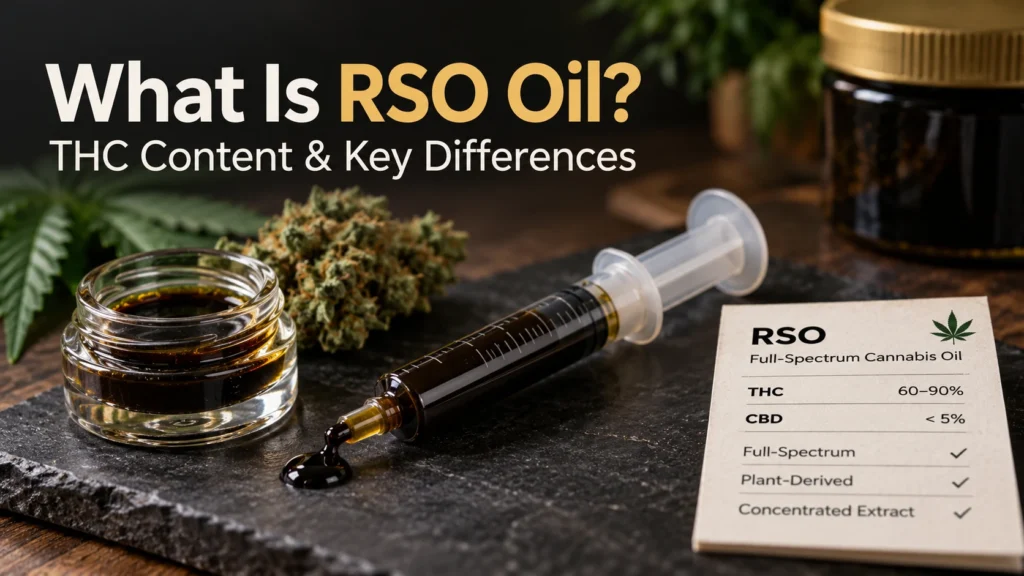
RSO usually contains a high amount of THC. It may also contain CBD, other cannabinoids (natural compounds in cannabis), and some material from the plant. The starting flower and the way the oil is made both matter.
Two batches might look like twins on the shelf. Their THC test results could still be miles apart.
A study of full-extract cannabis oils found that processing can change which cannabinoids, terpenes, and other plant compounds remain in the oil. That is why whole plant and full spectrum cannot tell you the exact contents of a batch.
Can you tell how strong RSO is by looking at it?
No. Dark oil is not always stronger oil. Thickness also cannot show whether any solvents used during processing remain in the product. A label saying full spectrum still won’t tell you how much THC or CBD is inside.
Your eyes can find the jar just fine. Asking them to run a THC test is a bit much. For a closer look at different extracts, see our cannabis concentrates guide.
How Is RSO Different From Distillate and CBD Oil?
All four names include the word oil. That is where this family reunion gets awkward. RSO is named after a person and a type of extract. Distillate is made by further refining an extract. CBD oil puts CBD front and center. Hemp seed oil comes from seeds and is generally used as a food oil.
Swipe the table sideways to see all columns.
| Term | Typical meaning | Still worth checking |
|---|---|---|
| RSO | Thick cannabis extract, often high in THC | THC and CBD amounts, ingredients, any required solvent testing, and directions for use |
| Distillate | Refined cannabis extract made using distillation | Main cannabinoids, added ingredients, and whether other extracts were mixed in |
| CBD oil | Oil product marketed for its CBD content | CBD per serving, any THC, other ingredients, and batch testing |
| Hemp seed oil | Oil pressed from hemp seeds, usually sold as a food oil | Whether it says hemp seed oil or hemp extract; they are different products |
The FDA makes this distinction too: hemp seed ingredients and CBD extracts are different. For more on refined extracts, read our Live Resin vs Distillate guide.
Is RSO the Same as FECO?
Sometimes, but you should still check the label. FECO often means Full Extract Cannabis Oil. Some research uses Full-spectrum Extract Cannabis Oil. Both terms refer to cannabis extracts, but they do not promise the same ingredients or strength. RSO gets its name from Rick Simpson.
In a 2025 study, researchers tested less-refined and more-refined FECO oils. The amounts and mix of plant compounds differed. So even FECO does not describe one fixed recipe.
Useful shortcut: Compare the ingredients and test results instead of trusting the initials. At this point, the alphabet soup may be thicker than the oil.
Does RSO Get You High?
Yes, RSO with enough THC can cause a high and impair you. The effects depend on how much THC is in the product, how much is taken, how it is used, and the person using it. The name alone cannot predict how anyone will feel.
The CDC warns that THC taken by mouth can take longer to affect you and may last for hours. A small package can still hold a large amount of THC.
THC can affect judgment and coordination. Do not drive while impaired. Store cannabis products in a locked, child-resistant container, away from children and pets.
What Does RSO Mean on an Edible Label?
If you see RSO on a gummy’s ingredient list, the maker says it used that kind of cannabis oil. The gummy is still a finished product with its own tested THC amount.
Here’s the common mix-up: the weight of the oil and the weight of the THC inside it are two different numbers. One cannot stand in for the other.
Example: 500 mg of oil is not 500 mg of THC
Made-up example for the math: Say an extract weighs 0.50 gram (500 mg), and a lab finds it is 60% THC by weight.
That gives you 300 mg of THC in the example oil. It does not tell you how much THC is in each finished gummy. You would need the final product’s tested total and serving count. This is a math example, not advice on how much to take.
If a label says “500 mg RSO,” it may mean 500 mg of oil. You still need its THC percentage to work out how much THC that oil holds. Even a calculator needs all the numbers. It is talented, not psychic.
See our cannabis label guide for serving sizes and package totals. Our TAC vs THC guide explains why similar-looking lab numbers can mean different things.
What Are the Risks and Evidence Limits of RSO?
THC concentration and health risks
Products with a lot of THC can cause anxiety, confusion, poor coordination, and other unwanted effects. Effects may take longer to start when THC is swallowed. Cannabis may also interact with medicines. The CDC explains these health risks in more detail.
What about claims that RSO treats cancer?
RSO has not been proven to cure cancer in clinical trials. The National Cancer Institute explains that strong cannabis oils are sometimes promoted as cancer cures, even though trials in people have not shown that they are effective or safe cancer treatments. A personal story cannot tell us what caused someone’s recovery.
Researchers have also studied cannabinoids for some cancer-related symptoms. The FDA has approved two prescription cannabinoid drugs, dronabinol and nabilone, for nausea and vomiting linked to chemotherapy in certain cases. That does not mean store-bought RSO is an approved cancer medicine. NCI patient summary
What Should an RSO Label or Lab Report Tell You?
A good label tells you much more than “RSO.” These are the details worth checking on an oil or an RSO-based edible.
- What kind of product is it? Is it an oil sold on its own or an edible made with RSO? Follow the maker’s directions. Never assume an oil meant for eating is safe to vape.
- How much THC and CBD? Look for milligrams (mg) per serving or per package, or a percentage by weight. Those numbers mean different things.
- Which cannabinoids are listed? Check delta-9 THC, THCA, Total THC if shown, CBD, and any others tested. A combined total may use its own formula.
- What else is in it? Look for added oils and other ingredients. If the product was made using a solvent, check any required test for solvent left behind.
- Does the lab report match? Check that the batch number on the product matches the certificate of analysis (COA). Look at the dates too.
- What else was tested? Depending on the state and product, tests may cover pesticides, germs, heavy metals, and leftover solvents. A THC result alone does not prove a product is safe.
Good news: no lab coat required. Start with the units, package total, and batch number. The fine print is much less scary once you know where to look.
Browsing cannabis products in New Mexico?
Browse our concentrates and edibles guides. Adults 21+ can check the Hobbs store or visit our locations page to choose a Carlsbad menu. Check current listings before visiting, since RSO stock has not been confirmed.
Frequently Asked Questions
Is RSO a full-spectrum cannabis oil?
People often call it full spectrum, but that term does not tell you the exact cannabinoids or terpenes inside. Check the ingredients and batch report.
Is RSO the same as a cannabis tincture?
Usually no. A tincture is a liquid product that often mixes a cannabis extract with another liquid. RSO usually refers to the concentrated extract itself. Read the ingredients to see what you have.
Does all RSO contain THC?
RSO is usually linked to THC-rich oils, but the name alone cannot confirm the amount. Look for the THC result on the label or lab report.
Can you vape RSO?
Do not assume RSO is made for vaping. Only use products for their stated purpose. An oil made to be taken by mouth is different from an oil made and tested for vaping.
Does RSO in gummies mean the whole gummy is RSO?
No. RSO is just one possible ingredient. Read the finished gummy’s THC per piece and total THC per package.
Is dark RSO stronger than light-colored oil?
Not necessarily. Color cannot tell you the THC amount or whether an oil is safe or high quality. You need test results for that.
Is Rick Simpson Oil FDA-approved?
No. RSO is not an FDA-approved cancer treatment. Some prescription cannabinoid drugs have FDA approval for specific uses, but that approval does not cover retail RSO.
Key Takeaways
- RSO means Rick Simpson Oil. The name has a history, but no single recipe.
- RSO, FECO, distillate, and CBD oil are different terms. Read the label instead of guessing from the name.
- Oil weight is not THC weight. “500 mg RSO” does not automatically mean 500 mg THC.
- THC can impair you. Effects from swallowed THC may take time to start. Store products safely and never drive impaired.
- RSO is not a proven cancer treatment. Personal stories and approved prescription drugs are different forms of evidence.
Research and Official Sources
- Peer-reviewed FECO processing study (2025): cannabinoid and non-cannabinoid variation in crude and purified cannabis oil.
- National Cancer Institute, Cannabis and Cannabinoids, health-professional version: clinical-evidence limits and unproven cancer-cure claims.
- National Cancer Institute, patient summary: symptom research and approved prescription cannabinoid medicines.
- CDC, Cannabis and Poisoning: delayed edible effects and secure storage.
- CDC, Cannabis Health Effects: impairment and other health risks.
- FDA, Cannabis and CBD Regulation FAQ: distinctions among cannabinoid extracts, hemp seed products, and approved drugs.
Sources were reviewed October 21, 2026. Product descriptions are educational; no inventory, potency, personal medical result, or laboratory test is attributed to Bud Board.