
Last Updated: September 2026. Cannabis products, testing rules, retail inventory, and laws can change. This article is educational and written for adults 21+.
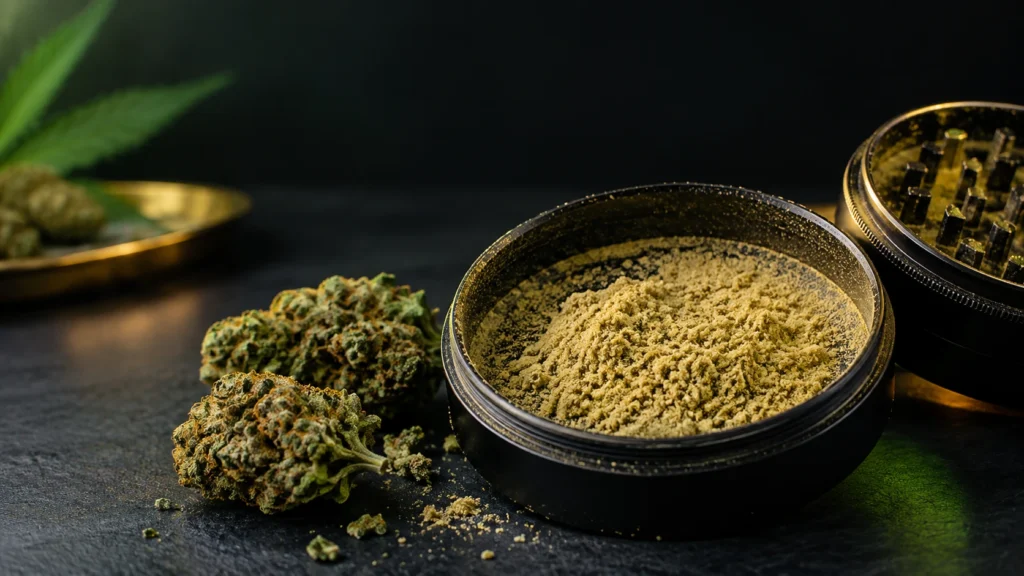
If you have ever opened the bottom chamber of a grinder and found a layer of pale, sandy-looking powder, congratulations: your grinder has been quietly collecting the part of the plant everyone keeps talking about.
That powder is the trichome-rich material people call kief.
The useful part is not the slang. It is knowing what the material actually is, why it can be more concentrated than ordinary flower, how it differs from hash, and what to look for on a regulated product label.
What Is Kief?
Kief is a loose collection of cannabis trichomes and resin material that has separated from the flower. It usually looks like a fine, slightly sticky powder and can range from pale tan to greenish or golden depending on the plant material and how much non-trichome material is mixed in.
Why does anyone care about plant dust? Because glandular trichomes are major production and storage sites for cannabinoids and terpenes. Separating more of those resin-rich structures from the bulk flower creates a material that can be more concentrated than the flower it came from.
As cannabis concentrates go, the concept is refreshingly simple. No dessert-menu vocabulary required.
What Does Kief Look Like?
The material usually looks dry, powdery, sandy, or slightly clumpy. Under magnification, it contains detached trichome heads and other fine plant particles.
Color can vary from light cream or tan to yellow-green or deeper green. A greener sample may contain more plant material, but color alone is not a reliable purity score. Lighting, genetics, age, processing, and the starting flower can all change what you see.
A better question than “Is lighter kief better?” Ask how the product was collected, what the tested cannabinoid profile says, how fresh it is, and whether the label clearly identifies the manufacturer and batch.
Where Does Kief Come From?
The loose powder comes from resin-bearing surface structures on cannabis, especially the glandular trichomes found on female flowers and bracts.
Those structures produce and store many of the compounds people associate with cannabis, including cannabinoid acids and terpenes. That is why frosty-looking flower gets so much attention. The “frost” is not sugar. It is a dense field of tiny resin glands.
If you want to judge the flower itself before thinking about what falls off it, Bud Board’s guide to spotting quality cannabis flower is the better starting point.
What Are Trichomes?
Trichomes are small structures that grow on the surface of cannabis and other plants. Cannabis has both glandular and non-glandular trichomes. The glandular types matter here because they produce resin rich in cannabinoids and aromatic compounds.
Researchers commonly describe three glandular forms in cannabis: bulbous, capitate-sessile, and capitate-stalked trichomes. The larger stalked trichomes on mature flowers are particularly important sites for cannabinoid and terpene production.
That connection also explains why the sift can smell surprisingly aromatic for something that looks like seasoning at the bottom of a grinder.
For more on the aroma side of that chemistry, see Bud Board’s guide to cannabinoids and terpenes.
How Is Kief Collected?
Producers collect the material by separating loose trichomes from dried cannabis flower. At home, a multi-chamber grinder can do part of that work naturally as you use it. Commercial dry-sift products use screened separation on a larger and more controlled scale.
That is enough process detail for a shopping guide. The important distinction is that dry-sieved kief is a solventless product. It is mechanically separated rather than dissolved into an extraction solvent.
The method sounds simple. Producing a clean, consistent retail product is not. Screen size, starting material, handling, contamination with plant matter, and batch testing all affect what ends up in the package.
Kief vs Flower: What’s the Difference?
Flower is the dried cannabis bud. Kief is mostly the loose resin-rich material separated from that flower.
| What to compare | Flower | Kief |
|---|---|---|
| What it is | Dried cannabis inflorescence | Separated trichome-rich resin material |
| Plant material | Contains the full bud structure | Contains much less bulk flower, though some plant material may remain |
| Potency | Varies by batch | Often more concentrated than the flower it came from, but exact potency varies |
| Texture | Buds or broken flower | Powdery, sandy, or slightly clumpy |
That last row matters. There is no fixed THC percentage that applies to every batch, just as there is no single potency for all flower.
Kief vs Hash: Are They the Same?
No. Kief and hash are related, but they are not identical. Kief is the loose trichome-rich material. To make hash, producers usually collect, compress, work, or otherwise process that resin into a more cohesive concentrate.
One of the oldest pathways is straightforward in concept: collect resin-rich trichomes, then turn that material into hash. That is why the terms overlap so often in conversation.
But if a menu uses the term “kief,” expect a loose or powdery material. If it says “hash,” read the product description. Hash can refer to several formats, and the production method matters.
Kief vs Cannabis Concentrates
Kief is one type of concentrate, but “cannabis concentrates” is a much broader category.
This mechanically separated, solventless trichome product sits alongside hash, rosin, live resin, wax, shatter, distillate, sauce, and other formats made with very different processing methods.
If the concentrate shelf is where the vocabulary starts multiplying, use Bud Board’s Cannabis Concentrates Explained guide. That page owns the broad concentrate topic. This one stays focused on the loose trichome product.
Is Kief the Same as Dry Sift?
Producers make dry sift by screening or sieving dried cannabis to separate trichome-rich material. In casual conversation, people often use “dry sift” and the term “kief” almost interchangeably.
Retail terminology can be more specific. A producer may reserve “dry sift” for material intentionally screened and refined through mesh, while the looser term can also describe mixed trichome powder that gathers in a grinder.
There is no reason to turn this into a vocabulary fight. Look at the actual product description and lab information.
Why Does Kief Collect in a Grinder?
A multi-chamber grinder can separate fine resin material from broken flower as you use it. Small particles and detached trichomes pass through the screen into the lower chamber while larger pieces stay above.
That is the little compartment people call the catcher.
How quickly it fills depends on the flower, trichome density, dryness, grinder design, screen, handling, and plain old time. A nearly empty catcher does not automatically mean the flower is bad, and a mountain of powder does not automatically mean it is premium.
How Potent Is Kief?
The separated trichome material is often more concentrated in cannabinoids than ordinary flower, but there is no universal potency.
Peer-reviewed processing literature describes dry-sieved material as a concentrated trichome product, but the actual THC, THCA, CBD, and other cannabinoid levels depend heavily on the starting flower and how cleanly producers separate the trichomes.
So skip the internet rule that says every batch is always some fixed percentage. The batch label wins.
In New Mexico, regulated cannabis labels provide tested potency information. Bud Board’s cannabis label guide explains how to read those numbers without treating the largest percentage like a quality trophy.
How Is Kief Used?
You will see the material in several retail contexts. It may be sold as its own concentrate, used as an ingredient in infused flower or pre-rolls, or serve as starting material for some hash products.
We are deliberately keeping this at the product-category level rather than turning the article into a step-by-step preparation guide.
For example, Bud Board’s infused cannabis flower guide explains why manufacturers may coat or combine flower with concentrate, including kief. Our infused pre-roll guide covers that format separately.
How Should You Store Kief?
Keep the product sealed, labeled, secure, and away from excess heat, light, and air. Cannabis research shows that light, temperature, oxygen, and storage conditions can change cannabinoids and volatile compounds over time.
For a retail product, the safest starting point is the original labeled package with the lid closed properly. Then keep it in a cool, dark storage area that children and pets cannot access.
New Mexico RLD advises consumers to keep personal-use cannabis out of public view and out of reach of children and pets.
For the full home-storage setup, see Bud Board’s safe cannabis storage guide.
What Should You Look for When Comparing Kief Products?
The category name gets you started. The package tells you the product.
A Six-Point Kief Checklist
1. Tested Potency
Compare the actual THC, THCA, CBD, and other reported cannabinoid values for the batch rather than relying on a generic category estimate.
2. Appearance
Look for an even powder or sift texture. Color can add context, but do not use it as a stand-alone purity grade.
3. Aroma
Fresh aroma can be useful product information. Flat or stale aroma may reflect age, storage, or the starting material.
4. Label and Batch
Check manufacturer, weight, potency, dates, traceability, warnings, and other required label information.
5. Product Description
Confirm whether the product is loose sift, dry sift, part of an infused product, or another resin format.
6. Storage
A good product can still age badly. Check packaging condition and follow the manufacturer’s storage directions.
Why Color Alone Does Not Set Quality
A darker or greener sample is not automatically bad, and a pale gold product is not automatically elite. Color can reflect plant material, genetics, age, processing, and lighting. Cannabis does not become trustworthy just because it picked a flattering color palette.
Want to See What’s on the Menu in Carlsbad or Hobbs?
Bud Board’s online menus let adults 21+ browse the current selection for each Carlsbad and Hobbs location and place a pickup order with their preferred shop.
Because inventory changes, we do not assume any specific concentrate is always in stock. Use the Bud Board locations and online ordering page to check today’s menus before you make the trip.
Key Takeaways
- The loose powder called kief is trichome-rich resin material separated from cannabis flower.
- Trichomes are major production and storage sites for cannabinoids and terpenes.
- A grinder can collect the material naturally, while producers can also separate it intentionally through dry sifting.
- Hash and kief are related, but hash is a further-processed resin product rather than loose sift.
- The broader cannabis concentrate category includes this trichome product along with many other extract and resin formats.
- Potency varies by starting flower, separation quality, and batch, so there is no universal THC percentage.
- Store the product sealed, labeled, secure, and away from heat, light, children, and pets.
- For shopping, use the tested label and current menu rather than assumptions based on color or product name.
Kief FAQ
What is kief?
Kief is the loose, powdery collection of trichome-rich resin material that separates from cannabis flower. Because trichomes contain cannabinoids and aromatic compounds, the separated material can be more concentrated than the flower it came from.
What is kief in a grinder?
In a multi-chamber grinder, fine trichome material can fall through a screen into the bottom compartment as flower is ground and handled. That collected powder is commonly called grinder kief, or simply kief.
Is kief the same as hash?
No. Kief is loose trichome-rich material. Producers make hash by further collecting or processing cannabis resin into a more cohesive concentrate. Some hash begins with this loose trichome material as its starting material.
Is kief the same as dry sift?
Dry sift is trichome-rich material produced through dry screening. In retail language, “dry sift” may suggest intentionally screened or refined material, while “kief” can also refer to looser material collected in a grinder.
Is kief stronger than flower?
The sift often contains a higher concentration of cannabinoids because it has more resin-rich trichome material and less bulk flower. Exact potency still varies widely, so compare the tested batch instead of assuming a fixed strength.
What color should kief be?
The material can range from pale tan or gold to greenish shades. Color alone does not prove potency or purity. Starting material, processing, age, and the amount of plant material in the sift can all affect appearance.
How should kief be stored?
Keep it sealed in its labeled container and protect it from excess heat, light, and air. Store all cannabis securely, out of public view, and out of reach of children and pets.
Can I shop for kief online at Bud Board?
You can browse current Bud Board menus online for Carlsbad and Hobbs and place pickup orders through the location you choose. Inventory changes, so check the live menu to see whether the product or another concentrate is currently available.
Research and Official Sources
- Cannabis sativa: Origin and History, Glandular Trichome Development, and Cannabinoid Biosynthesis
- Cannabinoids and Terpenes: Trichomes and Cannabis Phytochemistry
- Cannabis Glandular Trichomes: A Cellular Metabolite Factory
- Processing and Extraction Methods of Medicinal Cannabis: A Narrative Review
- Postharvest Operations of Cannabis and Their Effect on Cannabinoid Content
- New Mexico Cannabis Control Division: Cannabis FAQs
- New Mexico RLD: Yes and Knows
Kief Is Simple. The Label Is Still Smarter.
Once you know that kief is separated trichome material, most of the mystery disappears. From there, compare the product in front of you: tested potency, batch, aroma, freshness, label clarity, and collection method.
Adults 21+ can browse Bud Board’s current Carlsbad and Hobbs menus online and place a pickup order with their preferred location.